Introducing AI Skills: a framework to score how well an engineer manages coding agents.
In the last year, the biggest challenge in engineering became how do you manage agents.
Today, we've solved that. We built a model to judge every prompt across six dimensions:
We're announcing the public beta of https://t.co/YgMb6QF79k
We spent the last two years building the best solution for people buying and selling data, whether you're a researcher in a lab or a company trying to sell data.
Data is the fundamental bottleneck for AI progress, and DataVendor will be the infra that solves it.
the newest frontier is agent swarms. watch us launch 700 sandboxes -- all connected to the same file system -- in 10s, then have them collaborate and build a city on that file system
i used sandboxes here, but if i used serverless tool calling? the total cost of this compute would be $0.28
the future is packing agents 40x tighter on each CPU and giving them access to the same shared file system context
we're about to witness a rapid reshuffling of the "ai infrastructure" as people realize that the tools required to run a single agent are very different than the tools required to run thousands of agents that need to coordinate
the bedrock of what that future looks like? real, distributed file systems that can be mounted from many locations simultaneously in milliseconds.
for the past year, most agent data has just lived on the local disk of the sandbox (persistent or otherwise). this will not scale as agents work with larger data sets and coordinate more amongst each other, you need *shared storage* which allows multiple sandboxes to access the same data
luckily, we've been building for this future for years at Archil, with the worlds fastest shared file system (approaching local disk) that can also reduce the amount of vcpu required for agents by 40x with serverless tool calling
Today, we're announcing Archil's new $10/mo plan for individual developers -- making it more accessible for builders to use the world's most advanced AI infrastructure.
To celebrate, we're hosting our inaugural [super fast] hackathon in a couple of weeks at Casco's offices in SOMA! We'll have $50K in prizes, and will be a great way to see how others on the frontier are building.
RSVP here https://t.co/VcUE3zS3xq and we'll see you soon!
Impatience is a virtue.
When you're building products that will make the world better, delays are really costly.
Building autonomous surgery, I know patients are stuck on waiting lists or getting suboptimal treatment every day. Solving that even a little sooner has huge value.
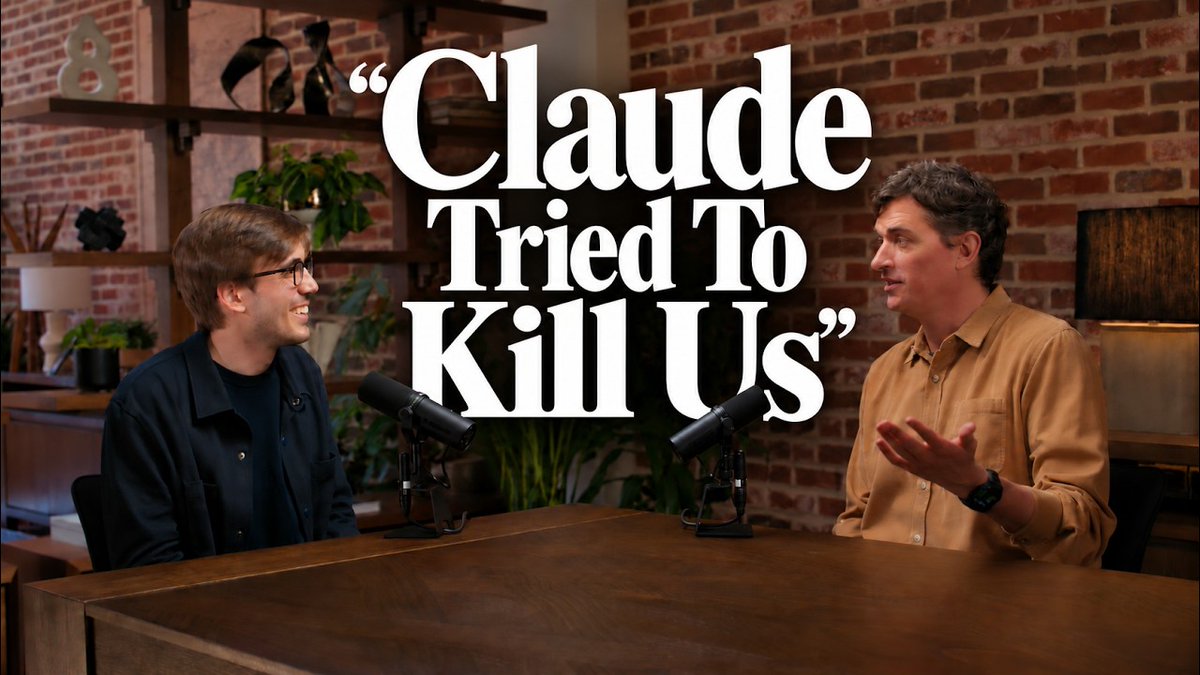
The question on a lot of founders minds: What do you do when Claude enters your market?
I sat down with @alexdanilowicz from @magicpatterns to provide some thoughts and advice for founders imagining how they would react and rise to the occasion.
In addition, we talk about Magic Patterns new MagicOS launch, a design agent built for the future.
Introducing Procedures.
Agents are probabilistic. Each time they run, they decide again where to pull the data and how to calculate the answer. Two runs of the same question can return two different numbers.
A procedure makes that path deterministic. It takes a run you've validated and turns its steps into code. The steps are fixed, so every run returns the same number.
Finance needs both. Deterministic work is best for the numbers themselves, and probabilistic work is best for the analysis and explanation behind them.
Procedures are now live in @Concourse_ai.
the industry hasn't yet internalized how much serverless tool calling will change agent economics
watch me run 1000 agents in parallel on a single archil sandbox, with tool calls going to actual Linux microVMs -- all for 30x less than a traditional sandbox
it doesn't matter how cheap or expensive the underlying cpus are if you don't waste them while inference is running
the cpu capacity crisis will be solved by running agents on right-sized hardware
Today we're launching MagicOS. And we've come to the conclusion that designers are NOT getting replaced.
most of the industry moved to the same answer this year: give the agent its own canvas, let it run, hand you the output.
we made a different bet: the canvas should be yours and the agent is your collaborator. that’s MagicOS.
most AI design tools are a linear conversation: prompt, generate, iterate, repeat. a hundred prompts in, you might have a great final design, but the reasoning, rejected directions, and inspiration that got you there are buried in a chat log nobody will ever scroll back through.
MagicOS is a persistent, spatial canvas. Your PRD, inspiration images, design system, variations, rejected directions, final picks - all of it lives together, all in one place, instead of stacked on top of itself and lost.
it’s voice-first. talk to it in real time and watch work land directly on the canvas as you speak.
it’s also multiplayer. your whole team works on the same canvas together.
and it still runs on your design system and components because none of this matters if the output doesn’t look like your actual product.
three months ago, this was internal only at Magic Patterns, my co-founder's weekend project. it’s now live for everyone.
Design everything, everywhere, all at once.
When building RL tasks and evals, it's difficult to distinguish between actual model capability failures and bad RL task design.
We're sharing some our task design principles so you can write better tasks before ever evaluating a model on them.
https://t.co/A81UxBDvFV





![jhleath's tweet photo. Today, we're announcing Archil's new $10/mo plan for individual developers -- making it more accessible for builders to use the world's most advanced AI infrastructure.
To celebrate, we're hosting our inaugural [super fast] hackathon in a couple of weeks at Casco's offices in SOMA! We'll have $50K in prizes, and will be a great way to see how others on the frontier are building.
RSVP here https://t.co/VcUE3zS3xq and we'll see you soon!](https://pbs.twimg.com/media/HUyIGzTa0AAa4e6.jpg)