Intelligence is becoming a line on the balance sheet. That's the real thesis behind Stripe's $8B acquisition of OpenRoute. My notes on what follows: intelligence as capital, routing as pricing power, and the shift from selling software to selling outcomes. https://t.co/kIhmpz5SRE
the silliest way to lose a lot of money in 2026 is to hold onto stupid priors for dear life
the second silliest is to make “safe” bets behind prestige vs. first principles evaluation of tech/business. if a company has fancy pedigree but is just losing…don’t fight the tape
Running several AI agents is not the same as progress. Thariq suggests slowing down and asking what deserves your full attention. My rule: decide the priority first, then decide whether more agents will genuinely help it.
1/ Write one sentence before you begin: “The most important outcome from this session is ___.”
2/ Give that outcome the strongest model, the clearest instructions and your review time. Use parallel tasks only for supporting work such as gathering options, summarizing background or checking details.
3/ When results return, judge them by whether they moved the priority forward—not by how many tasks the AI completed. @trq212
I think most people multi-tasking with agents could benefit from slowing down
most of the stuff you're doing wont really matter- what's your P0? what would it look like if you gave it your full attention?
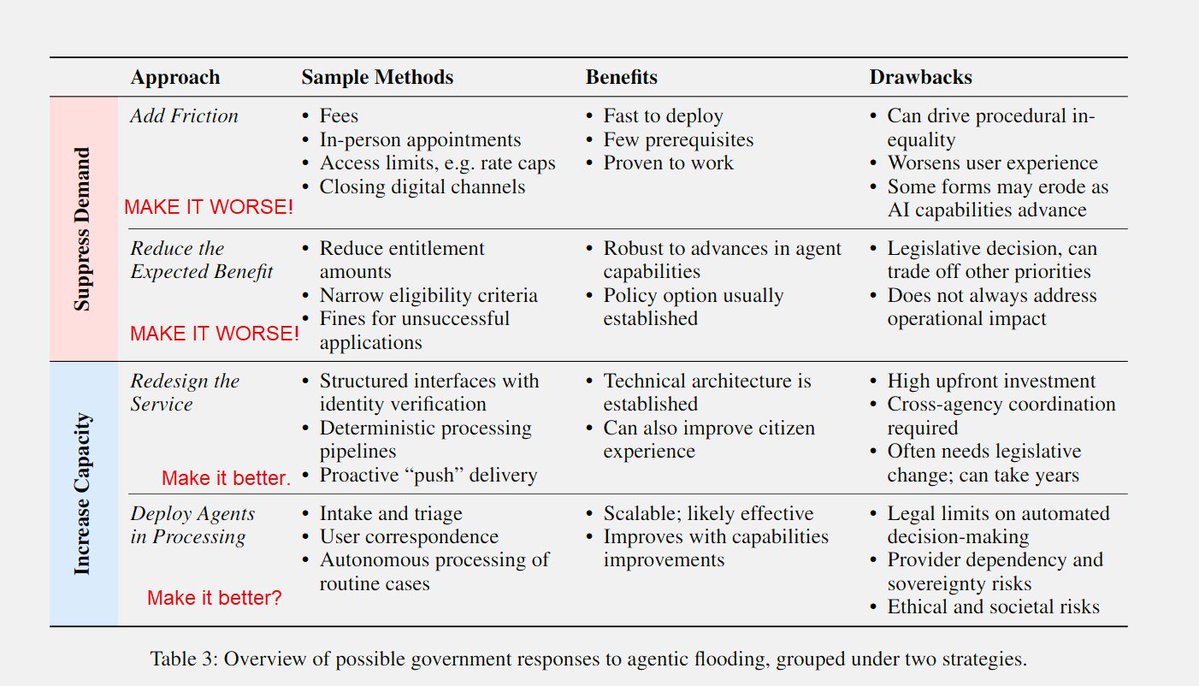
AI agents can make it cheap to repeat inquiries, applications and requests that once demanded human patience. The attached chart frames the response as a choice between suppressing that demand and increasing the capacity to serve it.
• The clearest observation is that adding fees, appointments or access limits may reduce traffic quickly, but it can also make services harder to reach—especially for people with less time, money or flexibility.
• The more durable path is to redesign services around structured requests, identity checks and predictable processing, while using AI for intake and routine cases. That requires more upfront work, but it improves the underlying system instead of rebuilding friction.
• For power users building agents, successful automation is only half the job. Ask what happens when usage grows dramatically: where requests queue, which decisions still need people, and whether the service can absorb demand without quietly degrading access. @emollick
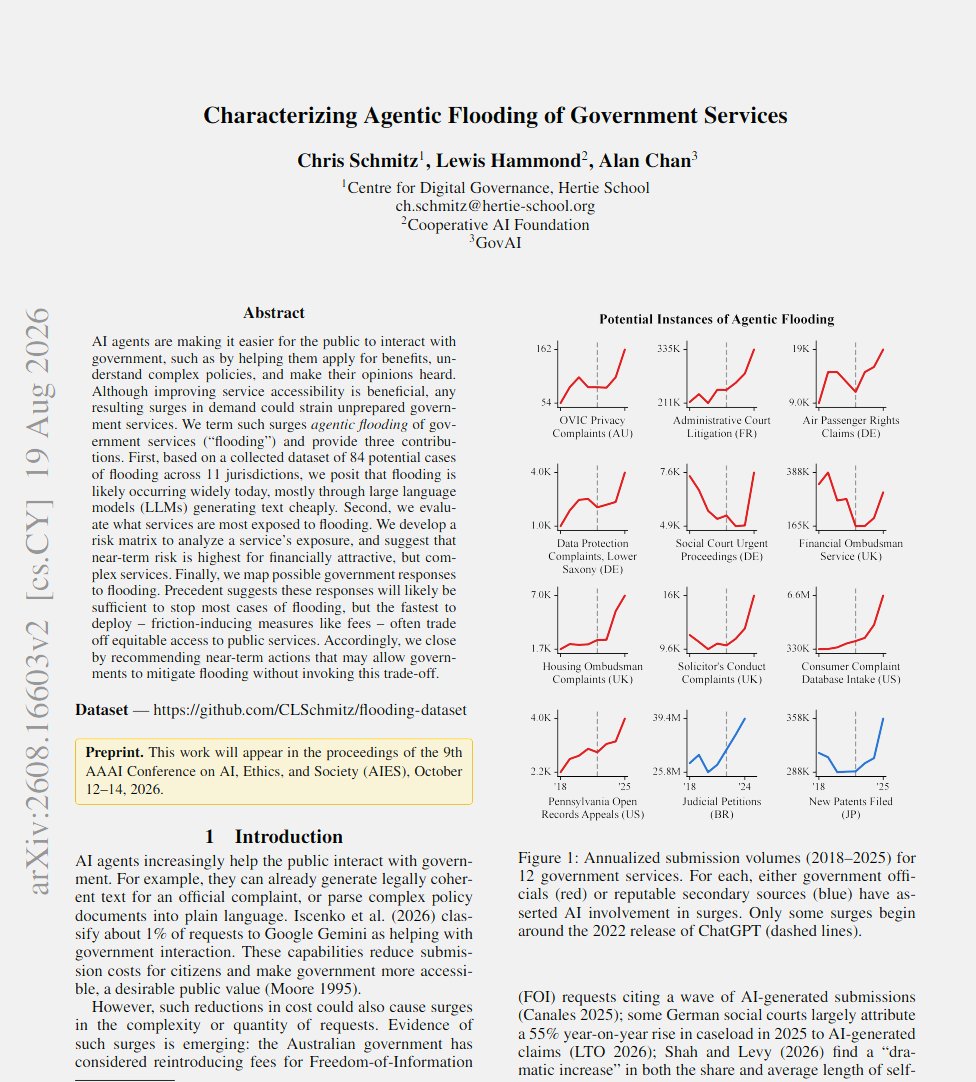
A consequential choice will be made soon by government and companies as they are increasingly flooded with agentic AI inquiries that overcome the frictions that gated access (see the graphs - it has already started!)
Two options: do you make services worse or better as a result?
@deepseek_ai@DeepSeekHarness The chart is a promising reason to test DeepSeek, not a reason to switch blindly. Your own repeated tasks are the better final benchmark.
@kimmonismus My takeaway: choose models by the job, not by a single reputation. This chart describes one specialized capability—not overall model quality.
According to @a16z , willingness to let AI choose and purchase stays below 30% in every listed category.
1/ A16Z reports that 42% of surveyed consumers would not trust AI to purchase on their behalf. Even the leading categories remain near one in four: clothing and accessories at 27%, electronics and technology at 26%, and travel or experiences at 25%.
2/ For power users, the practical workflow is recommendation first, delegation second: ask ChatGPT or Claude to compare options against your criteria, show tradeoffs and flag missing information—but keep final selection and checkout under your control.
3/ If you do allow an AI tool to act, start with a low-cost, reversible purchase. Require confirmation of the exact item, seller, total price, delivery date and return policy before payment.
Local AI choices are becoming less binary: you can choose how much capability, storage and responsiveness you actually need.
• The striking observation is that each Bonsai model uses substantially less listed memory than the same-size Qwen3.5 model in the chart, while still leading it on some tests such as instruction following and coding.
• A smaller model leaves more room for your other apps and may respond more comfortably on constrained devices. But size alone does not guarantee the best answers or speed.
• If you’re choosing a local assistant, first check whether it fits your device, then try it on a few tasks you actually repeat—summarizing notes, answering questions or working with images. Keep the smallest model that performs those tasks reliably. @PrismML
Muse Wonder is now available in Cursor, with a reported 46.1% on CursorBench—a coding-focused evaluation used by Cursor—and the strongest result among Muse models at default effort. The attached chart adds useful context: “best Muse” does not mean the highest score across every model shown.
• Gemini 4 Argon and Opus 5.5 appear above Muse Wonder on this particular evaluation. That is one signal about coding performance, not a verdict on overall model quality.
• Cursor lists Muse Wonder at $4 per million input tokens and $20 per million output tokens. Before making it your default, compare it with your current model on a few difficult, recurring tasks.
• Pay attention to the total path to a usable result: corrections, retries and review time. If Muse Wonder consistently saves enough effort to justify its price, use it for those demanding tasks; routine work may not need it. @cursor_ai@bot@grok
Muse Wonder from Meta Superintelligence Labs is now available in Cursor!
It scores 46.1% on CursorBench at default effort, the highest of any Muse model.
Priced at $4/M input and $20/M output tokens.
Gemini 4 Argon has taken a narrow lead over GPT-6 Astra on Humanity’s Sixth Sense, a benchmark for reasoning about things that are not directly visible. Scale Labs reports scores of 55.4% and 53.6%, respectively.
• The category results should be more useful for choosing a model. The test covers hidden objects, predicting what happens next and understanding human behavior—abilities that can matter very differently depending on your work.
• If you compare the models yourself, use a few tasks where the answer must be inferred from incomplete images or video. Ask what probably happened, what may happen next and which details support the conclusion.
• Score each category separately. A model that is better at tracking hidden objects may not be your best choice for interpreting people’s intentions—and a small overall lead can conceal those differences. @GeminiApp
The moment you've been waiting 4…
Our new frontier model, Gemini 4 Argon, is rolling out now in the Gemini app to bring your most complex ideas into reality.
See how Gemini 4 Argon and our latest updates across the Gemini app help you get the most out of every prompt. 🧵