PUBLIC MONEY IS NOT EXECUTIVE PROPERTY: THE CONSTITUTIONAL TRUTH ABOUT CHAPTER TWELVE
Fellow Kenyans,
The bottom line of Chapter Twelve is simple: the Executive DOES NOT own public money, THE PEOPLE do.
Our 2010 Constitution intentionally strips the President and Cabinet of unchecked power over your taxes through six strict principles:
1) People Own the Funds: Government only administers public money; it never owns it.
2) Parliament Approves Spending: The Executive cannot spend a single shilling without explicit parliamentary authority.
3) The Treasury is Independent: Under Article 225, the Treasury is an autonomous custodian, not a political department subordinate to the Executive.
4) Independent Oversight: The CRA, Controller of Budget, and Auditor-General ensure no single entity controls the financial chain.
5) Personal Liability for Looting: Under Article 226(5), any official who directs unlawful spending must pay it back from their own pocket, even after leaving office.
6) No Free-For-All Borrowing: Debt is strictly tied to legitimate budget deficits, not executive whims.
The power of the purse belongs to the people, not the Executive. We must defend our Constitution! #ReKe #GetitDone #KnowYourConstitution #ConstitutionKe2010
https://t.co/THmleX3KBq
FELLOW KENYANS, THE CONSTITUTION IS UNDER SIEGE! 🇰🇪
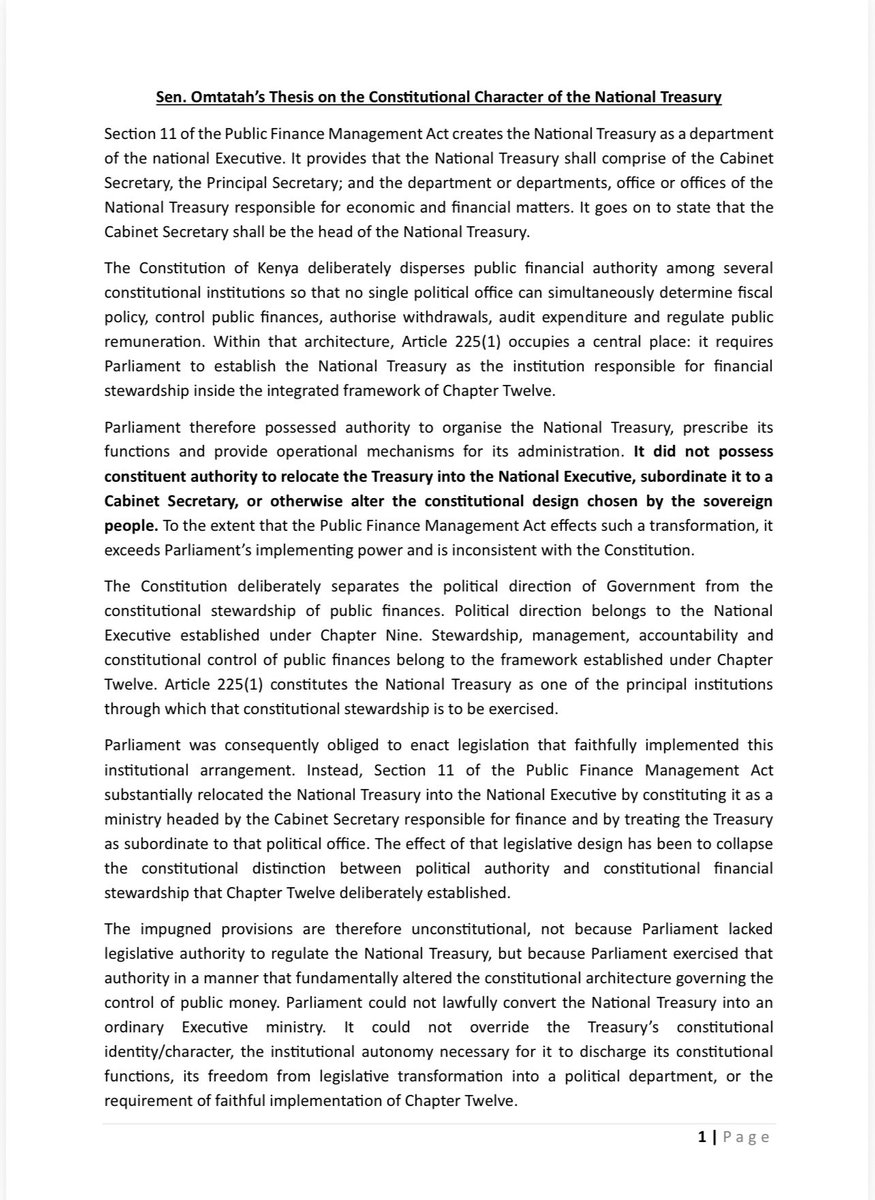
Our Constitution was designed with one clear principle. No single political office should have unchecked control over public money. That is why it separates political leadership from the management of the country’s finances.
Article 225(1) establishes the National Treasury as the constitutional custodian of public finances. Its role is too important to be left to politics alone.
Yet Section 11 of the Public Finance Management Act places the National Treasury under the National Executive and under the authority of a political Cabinet Secretary.
This is not a small legal issue. It goes to the heart of constitutional governance.
Parliament has the power to make laws that implement the Constitution. It does not have the power to change the Constitution through an ordinary Act of Parliament.
When the independence of public financial management is weakened, the checks that protect taxpayers’ money are weakened too.
The Constitution must remain above politics. Every law passed by Parliament must respect it.
If we fail to defend Chapter Twelve today, we risk eroding one of the most important safeguards for accountability and responsible use of public resources.
The Constitution belongs to all of us. Defending it is a duty we all share.
💥 Lightweight, breathable, and easy to wear—these men's mesh sneakers are the perfect choice for walking, training, and daily casual use. Stay comfortable, stay active, and look great doing it. Order now!
I say this with love, but please stop eating deep-fried foods daily from busy public areas.❤️
I just reviewed some preliminary lab results from used cooking oil samples, and it’s bad what we are finding.
Reusing oil day after day creates toxic chemicals that fuel inflammation and cancer.
No one else is going to warn you about this.
If you love fried food, please just make it safely at home with fresh oil. Your health is worth more than a quick craving.
You can share this to protect someone you love.
If the law is against you,argue the facts.If facts are against you ,argue the law.If the facts and the law are against you,argue procedure.If procedure,law and facts are against you settle.If you can't settle,go to the kitchen because you are about to be cooked.
Kenya is becoming less attractive to investors due to high electricity costs, frequent tax changes and bureaucracy.
Economists say countries like Rwanda, Tanzania, Ethiopia and Egypt are attracting more investment with cheaper power, tax incentives and simpler regulations.
I know 90% of you will hate this take, but we need an absolute ban on plainclothes police.
If they aren't directly accompanied by a uniformed officer, they shouldn't have policing powers, period.
When armed men in unmarked black Prados can pull up on citizens like in Ol kalau, the line between law enforcement and a kidnapping cartel vanishes.
Law-abiding citizens shouldn't have to play a guessing game with their lives just to satisfy "undercover" tactics.
If you think this is acceptable, you are actively defending a police state.
NB: the image used is AI generated
In a case I filed alongside BERNARD MUCHIRI MUCHERE and NAOMI NYAKERARIO MISATI challenging the constitutionality of privatising the Kenya Pipeline Company @kenyapipeline the High Court has explicitly preserved one substantive question for determination on merit:
"Whether the Privatisation of KPC, being primarily driven by IMF loan conditionalities and not an independent sovereign determination of public interest, violates the sovereignty of the people (Article 1), national values of patriotism (Article 10) and constitutes an unlawful abduction of state authority to an external entity."
The Court also directed the Government to produce, within 21 days, important documents relating to the privatisation. The Court has effectively invited the Petitioners to prove, through documentary evidence, that the privatisation was not a sovereign policy choice but a coerced compliance with IMF conditionalities, hence, a violation of Article 2(6) of the Constitution.
https://t.co/gIabTvB4cU
@cbs_ke 1. If you're not skilled, don't attempt...you may make matters worse or even endanger your life and others.
2. Your 'Good Samaritan' deed may land you in court as a witness or an accused. We all know how the police work, so better safe than sorry.
The Asymmetry of Rights: There in no Equality Before the Law for the IMF
1. Section 5 of the Bretton Woods Agreements Act of 1963, as read with the Schedule to the Act, creates an impermissible asymmetry before the law. Fund Agreement Article IX, Section 2 gives the IMF full juridical personality, including the capacity “to contract,” “to acquire and dispose of immovable and movable property,” and “to institute legal proceedings.”
2. However, Article IX, Section 3 then provides that the Fund, its property and assets enjoy “immunity from every form of judicial process,” except where the Fund expressly waives immunity.
3. The result is a one-sided legal relationship:
-The IMF can sue Kenyans in Kenyan courts.
-Kenyans cannot sue the IMF.
-The IMF can contract, own property, and enforce rights in Kenya.
-Kenyans cannot enforce rights against the IMF.
4. This asymmetry offends the constitutional principle of equality before the law. Article 27(1) provides that “Every person is equal before the law and has the right to equal protection and equal benefit of the law.”
5. Equality before the law is not satisfied where one legal person may invoke the protection of Kenyan law but is placed, by ordinary legislation, beyond the reach of constitutional scrutiny.
6. A statutory regime that allows an international institution to sue, contract, own property, and enforce rights in Kenya, while denying affected persons and constitutional organs effective access to judicial process, creates a one-sided legal relationship that cannot be justified under the Constitution.
#DeniBandia #OdiousDebt