The Atlantic’s writers and editors have selected 25 books to suit every mood or fancy. See the full list, including cult classics to obsess over, books to teach you something new, and page-turners to keep you entertained all summer. https://t.co/XXeWQEkwc2
🎨: Dhrutika Khimani
The NYT interview with Taylor Swift on her songwriting process is so good.
Here she explains her approach to choruses and bridges:
“The importance for me of a bridge is it just feels like we’re painting a picture. We’re setting a scene. We have this opportunity as a songwriter to tell an entire story. Or an entire movie. Or a very detailed description of one scene in a movie. Or a very nuanced dynamic between people or a complicated emotion.
And we have only so long to do this. I’ve written some really long songs in my life. But, for the most part, they’re between 3.5 to 4 minutes.
You can start painting the picture in the verse. You can get to the heart of it at the chorus. But then the bridge can be where you zoom back, you walk 20 feet back, and you see what this entire painting was supposed to be.
You’ve seen brushstrokes. You’ve seen the color tones.
But the bridge can be when you step back and you feel everything that that piece of art was supposed to make you feel. That’s just how I feel about bridges.
I came up as a songwriter in Nashville, where structure is a huge part of how you effectively tell a story, right?
You go verse - chorus - second verse - chorus - bridge - chorus.
Maybe you repeat that first verse if you want to. If you want to pull at some heartstrings. If it makes sense. Now, that’s something that I absolutely subscribe to…that structure is important. But I think that when you write enough songs — at least in my case — the intuitive part of your songwriting brain can kind of create a new structure that’s not as classically what you’ve been taught.
Jack Antonoff is a collaborator of mine and one of my best friends. We established this thing that we love to do and we call it the rant bridge.
I could point to examples like, ‘Out of the Woods’, ‘Is It Over Now?’ or ‘Cruel Summer’.
And oftentimes we love these rant bridges, where it’s basically like stream of consciousness. Endless pouring-out of emotion. Intrusive thoughts, blended with metaphor with discussion with shouting.
You want this rant bridge to feel the most intense of what that feeling is…that you’re trying to, establish over the course of the song and you want it to kind of be a crescendo.”
***
Full interview here: https://t.co/atYltC1JXC
This 2 hour Stanford lecture on AI careers will teach you more about winning in the AI race than every piece of AI content you have scrolled past this year.
Bookmark this & give it 2 hours, no matter what. It'll be the most productive thing you could do this weekend.
Your brain at 2 AM writing a paper you started at 10 PM is operating in a neurochemical state that most productivity systems spend thousands of dollars trying to replicate.
Sleep deprivation suppresses your prefrontal cortex. That's the region responsible for self-criticism, second-guessing, and the voice that says "this paragraph isn't good enough." At 2 AM, that voice goes quiet. Not because you've achieved some zen state. Because the hardware running it is shutting down for the night and you won't let it.
Meanwhile the deadline is dumping norepinephrine and cortisol into your system, which narrows your attention to a single point. Your brain physically cannot multitask in that state. No checking your phone. No opening a new tab. The stress response has commandeered every available resource and pointed it at the Google Doc.
Lowered inhibition plus chemically forced single-task focus. That combination is almost identical to what Csikszentmihalyi documented across 30 years of flow state research. Clear goal, immediate feedback, challenge matched to skill. A 12-page paper due in 8 hours hits all three criteria by accident.
The lo-fi beats matter more than people think. Repetitive audio at 60-70 BPM synchronizes with resting heart rate and suppresses novelty-seeking circuits. You stop hearing it within minutes. It becomes an auditory wall that blocks interruption without costing you any cognitive load. It's the cheapest sensory deprivation chamber ever built.
And the black coffee at midnight is pharmacologically different from your morning cup. Your adenosine levels have been building all day, so the caffeine is fighting a much stronger sleep signal. The subjective experience of "wired but calm" at 1 AM is a different drug interaction than alert-at-9-AM. Same molecule, completely different neurochemical environment.
Every semester, twice a semester, four years straight. That's 40 sessions of accidental deep work before anyone had a name for it.
The grade was an A- because the conditions were perfect. Not despite the chaos. Because of it.
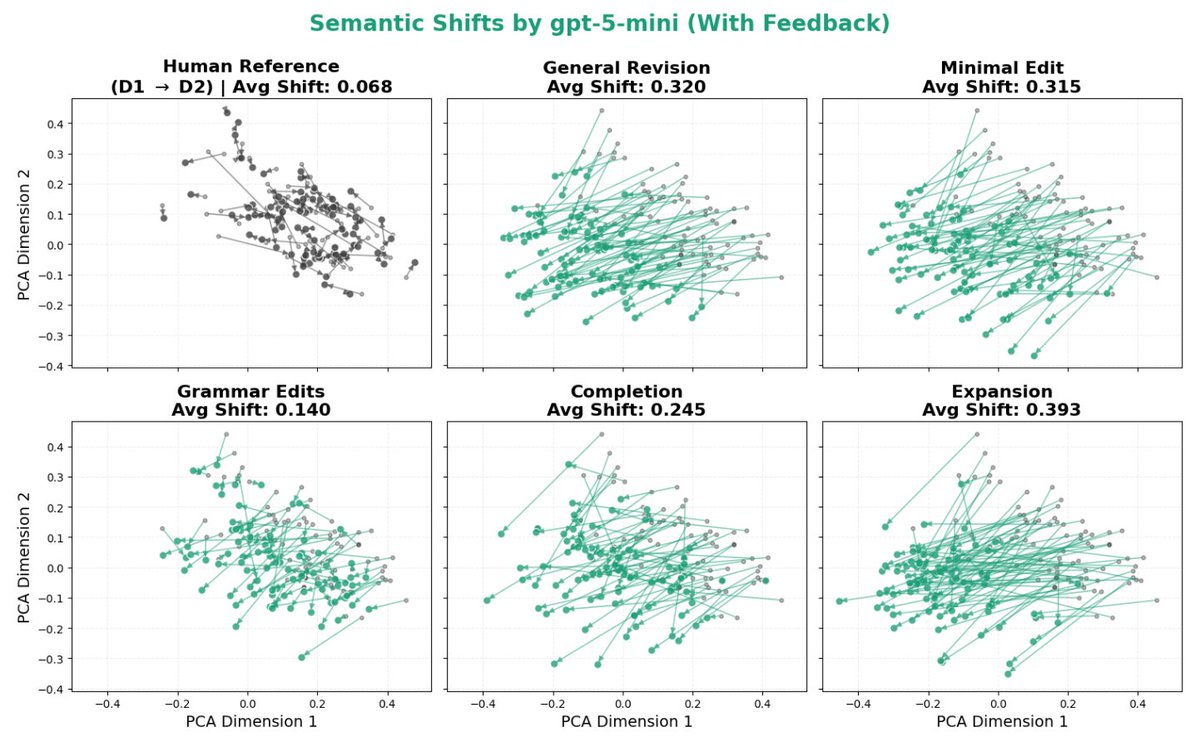
The paper I’ve been most obsessed with lately is finally out: https://t.co/KgdWKknCJK! Check out this beautiful plot: it shows how much LLMs distort human writing when making edits, compared to how humans would revise the same content.
We take a dataset of human-written essays from 2021, before the release of ChatGPT. We compare how people revise draft v1 -> v2 given expert feedback, with how an LLM revises the same v1 given the same feedback. This enables a counterfactual comparison: how much does the LLM alter the essay compared to what the human was originally intending to write? We find LLMs consistently induce massive distortions, even changing the actual meaning and conclusions argued for.
My best tip for anyone trying to get back into reading is to remember that you can read books to avoid other responsibilities in your life, and it can become a vice if you play your cards right.
I just gave a closed-book, pen-and-paper midterm exam in my 300-level course at UBC with 100 students. All exams were graded by an experienced graduate-level TA according to a rubric.
*** The average was 64/100.***
My class averages at UBC are usually 80-85.
Context:
• This was the first midterm, covering ONLY 4 weeks of material.
• Students had a list of possible questions in advance: no surprise questions.
• Questions included (a) 3 concept definitions, (b) 3 paragraph-long questions, and (c) a 1.5-page essay.
• I have taught this class multiple times. Nothing in my teaching style changed this semester.
• We read entire paragraphs of text in class, so students don't have to do something on their own that wasn't covered during the lecture.
• Students take a 10-question multiple-choice quiz at the end of every class (30% of the final grade).
• Attendance is 95-99% every class. Attention during lectures and participation in pair-work activities are very high → anticipating the end-of-class quiz.
*** But unfortunately, I suspect many students are not reading the material on the syllabus. They are asking LLMs to summarize it instead.***
After the midterm, students reported:
• They thought they knew concept definitions but couldn't produce them on paper.
• They thought they understood the arguments but struggled to connect them or identify points of agreement and disagreement.
My view:
It might be “cool” or “innovative” to teach students to summarize readings with ChatGPT or write essays with Claude. But we may be doing them a disservice: reducing their ability to retain material, think creatively, and reason from what they know. If you only read what AI has summarized for you, you don’t truly "know" the material.
Moving forward:
We have a second midterm coming up. I don't know how to convey to students that the best way to do better on the exam is to rely on and improve their own reading skills.
Justin Trudeau took the opportunity to show the difference between France french and Canadian French while on his trip to Paris 🇫🇷🍁 At the end of the video, when asked what "girlfriend" is, he answered with "Blonde, even if she's not blonde," a reference to his current relationship with Katy Perry who joined him on his trip.
📽️ : atfrenchies
#JustinTrudeau #CanadavsFrance
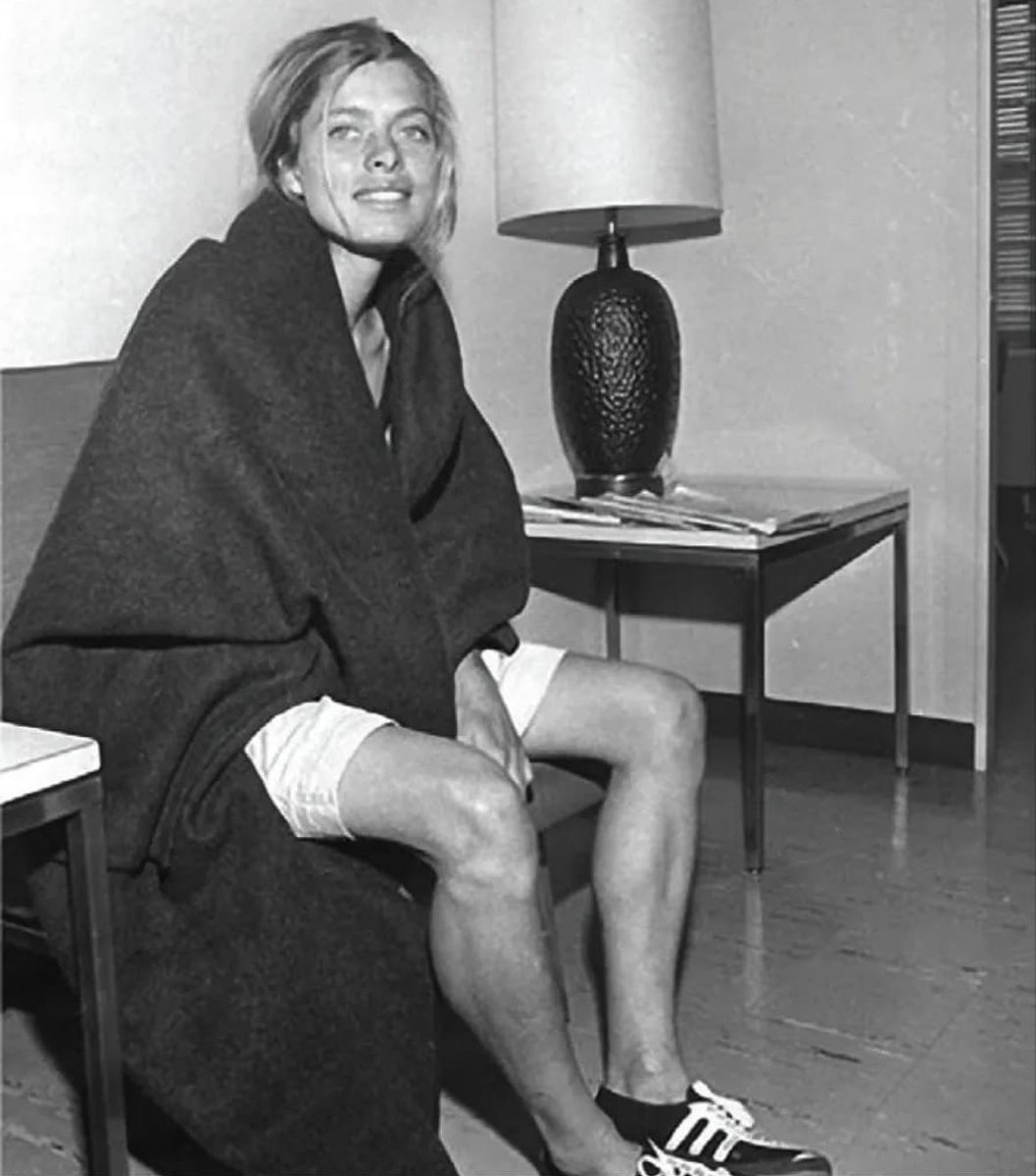
This is 23-year-old Bobbi Gibb in 1966, right after becoming the first woman to run the Boston marathon.
A few months earlier, Gibb had received a letter in the mail, disqualifying her for the marathon. The letter stated that women are "not physiologically able to run a marathon." The Amateur Athletics Union even went as far as prohibiting women from running more than 1.5 miles (2.4 km), and the organizers of the Boston Marathon did not want to "take the liability" of having a woman compete.
However, the rejection letter only emboldened her. On the day of the race, Gibb showed up wearing a blue hooded sweatshirt over a black swimsuit and her brother's Bermuda shorts. She hid behind a bush near the starting line and waited. When the starting gun fired, Gibb waited some more until about half the runners had passed. She then jumped in and blended into the pack.
However, it wasn't long before the men saw that she was a woman. To her surprise, she was not met with hostility but with encouragement and support. She removed her sweatshirt and finished the race in 3 hours and 21 minutes and 40 seconds, beating two-thirds of the runners.
Diana Chapman Walsh, who later went on to become the President of Wellesley College, recalled that day many years later: "That was my senior year at Wellesley. As I had done every spring since I arrived on campus, I went out to cheer the runners. But there was something different about that Marathon Day-like a spark down a wire, the word spread to all of us lining the route that a woman was running the course. For a while, the 'screech tunnel' fell silent. We scanned face after face in breathless anticipation until just ahead of her, through the excited crowd, a ripple of recognition shot through the lines, and we cheered as we never had before. We let out a roar that day, sensing that this woman had done more than just break the gender barrier in a famous race..."