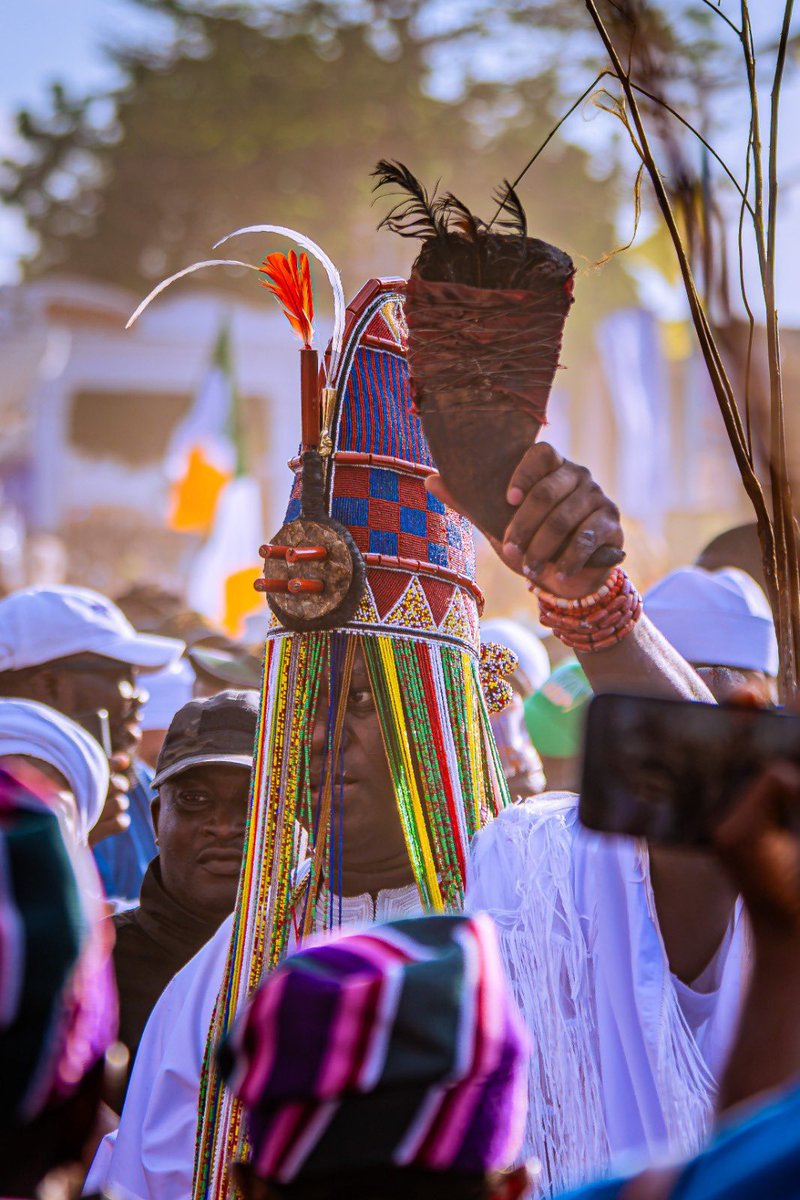
MOGBE!!! 🔥🔥🔥🔥🔥🔥
This is, without a doubt, one of the deepest and longest Adamu Orisha chants I have ever heard. The fierceness, intensity, raw fury, commanding delivery, and sheer accuracy are second to none!
I have shared a few stories about this extraordinary young woman under the tag “Bata Girl,” but she is far more than a phenomenal Bata dancer. She is a gifted artist, a passionate cultural ambassador, and a remarkable custodian of Yoruba culture, heritage, and traditional practices.
Her name is Iremide Okunade, and she is one of those young Yoruba women reminding us that our cultural heritage is alive, powerful, and in capable hands.
From the Bata drums to the sacred power of our chants, she embodies the beauty, depth, and living spirit of Yorubaland.
Our culture is not merely something to admire; it is a legacy to preserve, practise, and pass on. And young custodians like Iremide are making sure that legacy never fades.
Yoruba culture is alive! Àṣà wa ò ní ṣòfò! Àṣẹ!
🪇🔥🔥🪇🔥🔥
'All Olofins/Ooni were called 'Olori Aye' cuz the entire Yorubaland down to Sierra Leone was his territory. Science has confirmed there's no race older than we Yorubas'- Traditional Historian, Eniowo aka Olofin Itan.
I was right, wasn't I? Plz, tell ur children!
**Btw, now u know uve got the DNA of gods.
Be arrogantly YORUBA & be bullishly Oodua!
1. TO UNDERSTAND YOURSELF 🧵
You cannot navigate life effectively without understanding yourself.
Ifá divination provides a framework for understanding your circumstances, character, choices, strengths, and challenges.
Sometimes, the answers you seek begin with understanding who you are and how you live.
2. TO MAKE INFORMED DECISIONS 🧵
Before making a major decision, have you considered its possible consequences?
Ifá consultation offers traditional guidance to help you reflect on your options, responsibilities, and possible outcomes.
You don’t have to wait until a crisis comes before seeking wisdom.
3. TO UNDERSTAND RECURRING CHALLENGES 🧵
Why do you keep experiencing the same problems in different forms?
Ifá divination can help you examine recurring difficulties through the wisdom of Odù Ifá, identify areas that need attention, and consider the necessary changes.
Sometimes, the solution begins with understanding the pattern.
4. TO CULTIVATE GOOD CHARACTER (ÌWÀ PẸ̀LẸ́) 🧵
If you think Ifá consultation is only about money, enemies, and spiritual attacks, you are missing something important.
Good character is fundamental to Yoruba philosophy.
Ifá can remind you of the importance of patience, honesty, humility, discipline, and responsibility.
What is the value of a favourable destiny if your character destroys it?
5. TO UNDERSTAND YOUR RESPONSIBILITIES 🧵
Spirituality is not just about asking for blessings. It is also about understanding your responsibilities.
Through divination, a Babaláwo may communicate relevant guidance, taboos, recommendations, or prescribed ebo according to the tradition and the consultation.
The goal is not merely to ask for more but to understand what is required of you.
6. TO SEEK GUIDANCE DURING UNCERTAINTY 🧵
Life comes with crossroads: marriage, career, business, family, and personal growth.
When uncertainty becomes overwhelming, Ifá divination offers a traditional avenue for seeking guidance and examining your situation.
You may not control every circumstance, but you can seek wisdom before deciding your next step.
7. TO UNDERSTAND YOUR RELATIONSHIP WITH YOUR ORÍ 🧵
In Yoruba philosophy, Orí represents a profound dimension of personal destiny and identity.
Ifá consultation can help a person reflect on their destiny, choices, character, and relationship with their Orí within their particular tradition.
Remember: understanding destiny should encourage responsibility, not make you passive.
8. TO ADDRESS SPIRITUAL CONCERNS 🧵
Not every problem is necessarily spiritual, but spiritual concerns matter to many practitioners of Ìṣẹ̀ṣe.
Ifá divination provides a traditional framework for examining such concerns and determining appropriate spiritual responses.
A responsible practitioner should distinguish spiritual guidance from matters that require medical, legal, or other professional assistance.
9. TO PRESERVE YOUR CONNECTION TO YOUR ANCESTRAL WISDOM 🧵
Ifá is more than a method of predicting the future.
It is a vast body of Yoruba knowledge containing teachings, narratives, ethical principles, and traditional wisdom accumulated and transmitted across generations.
Consultation can help you engage with this knowledge and deepen your understanding of Ìṣẹ̀ṣe.
10. TO PREPARE, NOT JUST TO REPAIR 🧵
Many people remember Ifá only when life becomes unbearable.
But why wait until a problem arises?
Divination can also be sought for guidance before important undertakings, during periods of transition, or as part of an established spiritual practice.
You service your car before it breaks down. Why must spiritual consultation always begin with a crisis?
Oba Solomon don drop another powerful submission on the Oluwo of Iwo’s recent comments about ancient Yoruba crowns.
I always love the wisdom and depth in Oba Solomon’s submissions. This man no dey talk anyhow! 😂🙌
More wisdom, Oba Solomon Agbaye! Ọgbọ́n àti ìmọ̀ ò ní tán o. 🙏🏾
TO OONIRISA: Let Us Look Again at OKE-ORA by Prince Jay Ile Oodua.
Dear Kabiyesi,
As the Ọ̀rànfẹ̀ Festival returns to the Source, I write with the humility due both to the throne and to a hill our traditions have never treated as ordinary ground.
In the oral history of Ilé-Ifẹ̀, OKE-ORA, some eight kilometres east of the city, between Ifẹ̀ and Ìtagunmọ̀di, holds a place few sites can claim. It is remembered as the seat of Ọ̀rànfẹ̀, Onílẹ̀ Iná, and as the hill from which Odùduwà is said to have descended into the plain of the Ẹ̀lú Mẹ́tàlá. The name itself holds the memory: òkè, the hill, and Ọ̀rà, the divinity.
Coronation ritual still gestures toward that descent. Nearby, Ìgbó Orè has already yielded stone figures associated with the early centuries of Ifẹ̀. Here, tradition and landscape meet on the same ridge.
What scholarship has placed beside that memory remains thin. The principal investigation of OKE-ORA linked to the Department of Archaeology at the University of Ifẹ̀ was undertaken by my dear Daddy, Dr Omotoso Eluyemi, the Apẹ̀na of the Source. May his soul continue to rest in peace. Work in the rock shelters of these eastern hills has yielded axes, pottery, charcoal, clay figurines and traces of paved ways, including vessels pierced at the rim so they might be hung in the palm for wine. These are signatures of habitation. They are not yet a chronology, or an answer to the questions the hill is asked to bear.
Why has so little followed that mission? The pavements, terracottas and glass of the Ifẹ̀ valley have rightly drawn generations of scholars. The hill that tradition places before that florescence has not. Excavation may not confirm every account we have inherited. Oral tradition and the spade do not always agree. A site named in the origin narratives of kingship, linked to Ọ̀rànfẹ̀, and already shown to hold evidence of early occupation, nevertheless deserves more than a single season.
There is a mercy in the hill’s present quiet. Beyond distant views, OKE-ORA is scarcely photographed and scarcely visited as a spectacle. Some sacred places are better kept when they are not offered to the curiosity of the world. Documentation need not mean exposure. A palace-guided programme of survey, mapping and limited excavation, conducted with the priests of Ọ̀rànfẹ̀, the relevant lineages, and the Department of Archaeology at Obafemi Awolowo University, can record what the hill still holds without turning it into a thoroughfare.
As we celebrate Ọ̀rànfẹ̀ once again, I humbly appeal to Oonirisa to champion that work: a renewed study of OKE-ORA, undertaken with reverence and published so that the Source may know its own hill more clearly. There is a history waiting there. It should not be left only to memory.
Kábíyèsí o👑.
I hope you don't forget the lessons that loosing taught you. I hope you don't forget the strength it took you to rise up again.. The wisdom that came from rising again and again and again.. I hope you don't forget the people that stood by you when you were figuring it all out.
Some oral tradition says we have two Sango, one is Sango Ayilegbeorun and the other one is Alaafin Sango who turned Orisa. Then, some say the first Sango is what Ife call Oramfe Onile Ina. Who is Oranfe Onile Ina?
Let me tell you about a brother that reached out this morning.
He’s 32.
His wife is 23.
They have a 14-month-old son.
He married her when he was 30. She was 21 or 22 at the time.
Before he met her, he had already lived alone for more than seven years. He was used to his space, his routine, and handling his own life.
There was a family friend who used to help him with his parents. She lives close to their family house, so whenever he wasn’t around she would collect things for them, check on them, and make life easier for him because of the distance.
Sometimes he even let her use his house to study when he wasn’t home. He was clear that nothing ever happened in that house.
When they were younger they had a thing once. That was it. They both outgrew it and moved on.
The girl is 27 this year.
He said he was the one who told his wife about his own past. He found out about hers himself. By the time she was 20 she already had 14 body counts.
According to him, she has been faithful in the marriage. That part he didn’t argue. But every day it’s insults, shouting and fighting.
It started because she wanted him to cut that family friend off completely. He didn’t do it immediately, not because he wanted to keep anything going, but because of the role the girl was playing for his old parents.
He’s the last child and the only one living in the same city as them. A lot of the responsibility sits on him, including part of the financial load, because he’s doing well for himself.
His wife insults him constantly. This is a woman he is 100% responsible for. He pays for everything in that house. Salt, pepper, school, everything.
When he married her, her father stepped back, which he said is normal. She still had one last lap in a private university. The fees were over a million naira. He paid it comfortably.
He later cut the family friend off completely just to make his wife happy.
It didn’t change anything.
She still has serious trust issues. He said he can’t even greet a neighbour without her reading another meaning into it.
Most times he just stays quiet when she starts ranting and shouting. That silence only made things worse.
Then it became physical.
She started throwing objects at him and injured him.
He got so furious that he went and cheated out of anger. He even left traces for her to find. After that he kept denying it.
Now she’s raining threats that she will cheat back and even do it better.
Since September 1st their house has not known peace. It wasn’t peaceful before, but now it’s worse.
He said the marriage has worn him out.
The economy is already stressing him and his home is stressing him on top of that.
Sometimes he stays out late just so he can enter the house and sleep.
He admitted he’s not perfect. He has his own faults. He just doesn’t want to make the next decision from emotion or anger.
What would you tell him?
AJD.
These are the traditional Yoruba names for the months.
January – Ṣẹ́rẹ́
February – Èrèlé
March – Ẹrẹ̀nà
April – Ìgbé
May – Èbìbí
June – Òkúdu
July – Agẹmọ
August – Ògún
September – Owewe
October – Ọ̀wàrà
November – Bélú
December – Ọ̀pẹ̀