This is Anton Kreil.
A kid from Liverpool, raised by a single mom with no money, who walked into Goldman Sachs at 20 and walked out of Wall Street at 28 with the kind of resume nobody believes is real.
His prop book at Goldman grew from $25M to over $400M in four years.
Lehman headhunted him in 2004.
JP Morgan paid him a fortune to run their global pharma, biotech, and chemicals trading franchises in 2006.
He retired in May 2007, months before the entire system blew up.
The 16 minutes below is the closest thing I've seen to an actual trader explaining how he thinks.
No fluff, no charts, just the framework that made three of the biggest banks on Wall Street fight to hire him.
I'm obsessed with cognitive biases.
A "cognitive bias" is a systematic error in thinking that destroys decision-making.
11 most powerful (and dangerous) cognitive biases I've found: 🧵
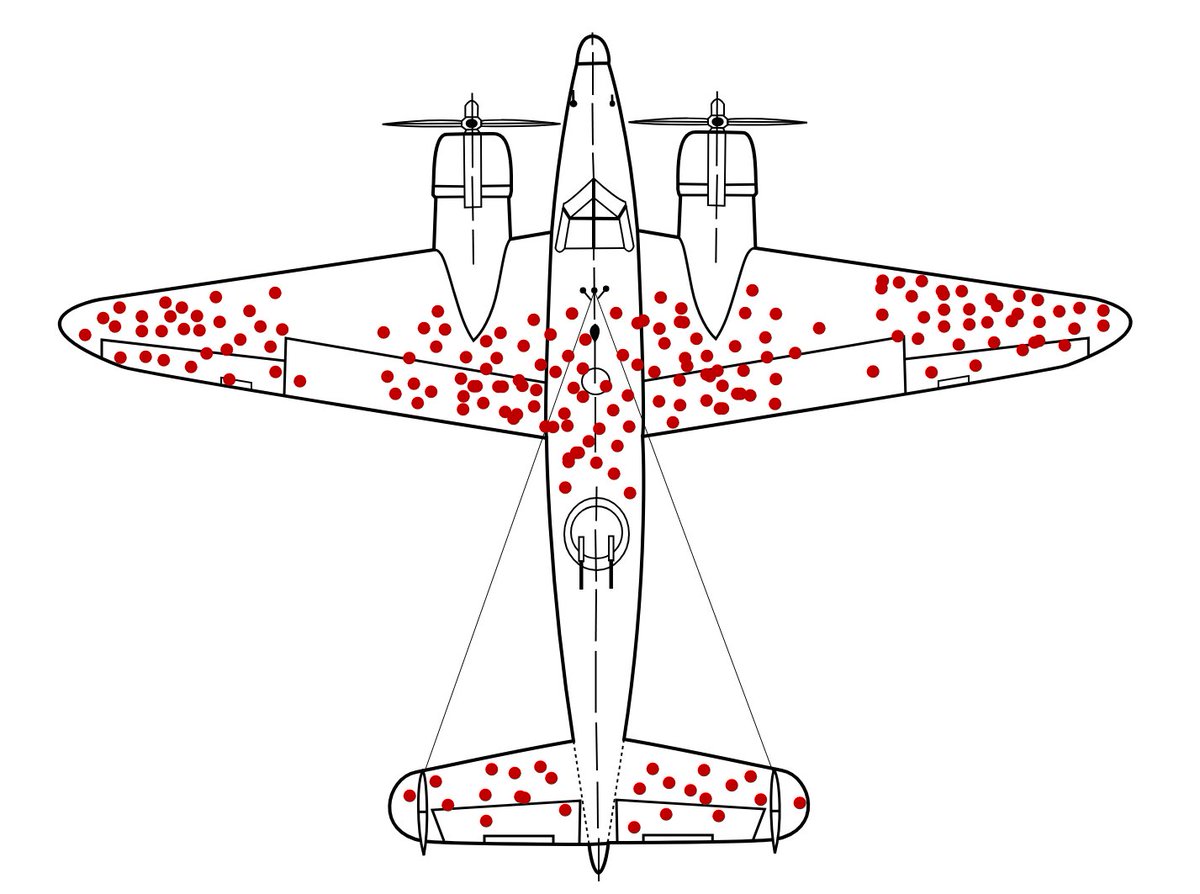
1. Survivorship Bias:
Price and volume are the market’s heartbeat. Read them well, and you’ll know exactly when big money is buying and when it’s quietly heading for the exit.
I accidentally discovered how to compress a semester of learning into 48 hours.
A grad student at MIT showed me his NotebookLM setup. I thought he was just organized. Then I watched him pass a qualifying exam on a subject he'd never studied before.
Here's exactly what he did:
First: he didn't upload a textbook.
He uploaded 6 textbooks, 15 research papers, and every lecture transcript he could find on the subject.
Then he asked NotebookLM one question:
"What are the 5 core mental models that every expert in this field shares?"
Not "summarize this." Not "explain this topic."
Mental models. The stuff that takes professors years to develop.
But the next part is what broke my brain.
He followed up with:
"Now show me the 3 places where experts in this field fundamentally disagree, and what each side's strongest argument is."
In 20 minutes he had a map of the entire intellectual landscape of the field:
the debates, the consensus, the open questions.
Most students spend a full semester just figuring out what those debates even are.
Then he did something I've never seen before.
He asked:
"Generate 10 questions that would expose whether someone deeply understands this subject versus someone who just memorized facts."
He spent the next 6 hours answering those questions using the source material. Every wrong answer triggered a follow-up:
"Explain why this is wrong and what I'm missing."
By hour 48, he could hold a conversation with his thesis advisor without getting destroyed.
The tool didn't change. The questions did.
Most people treat NotebookLM like a fancy highlighter.
These students are using it like a private tutor who has read everything ever written on the subject.
The difference between a semester and 48 hours isn't the amount of content.
It's knowing which questions to ask.
🚨 BREAKING:
Claude can now explain any complex topic like a university professor (for free).
10 Claude prompts to learn anything 10× faster:
(bookmark it)
BREAKING: AI can now analyze stocks like Wall Street analysts (for free).
Here are 10 insane Claude prompts that replace $2,000/month Bloomberg terminals (Save for later)
Richard Feynman had one superpower: making the complex feel obvious.
I reverse-engineered his entire teaching method into a Claude prompt system.
Use it to understand anything in under 10 minutes (Save this for later):
Claude Cowork is f*cking ridiculous for stock research
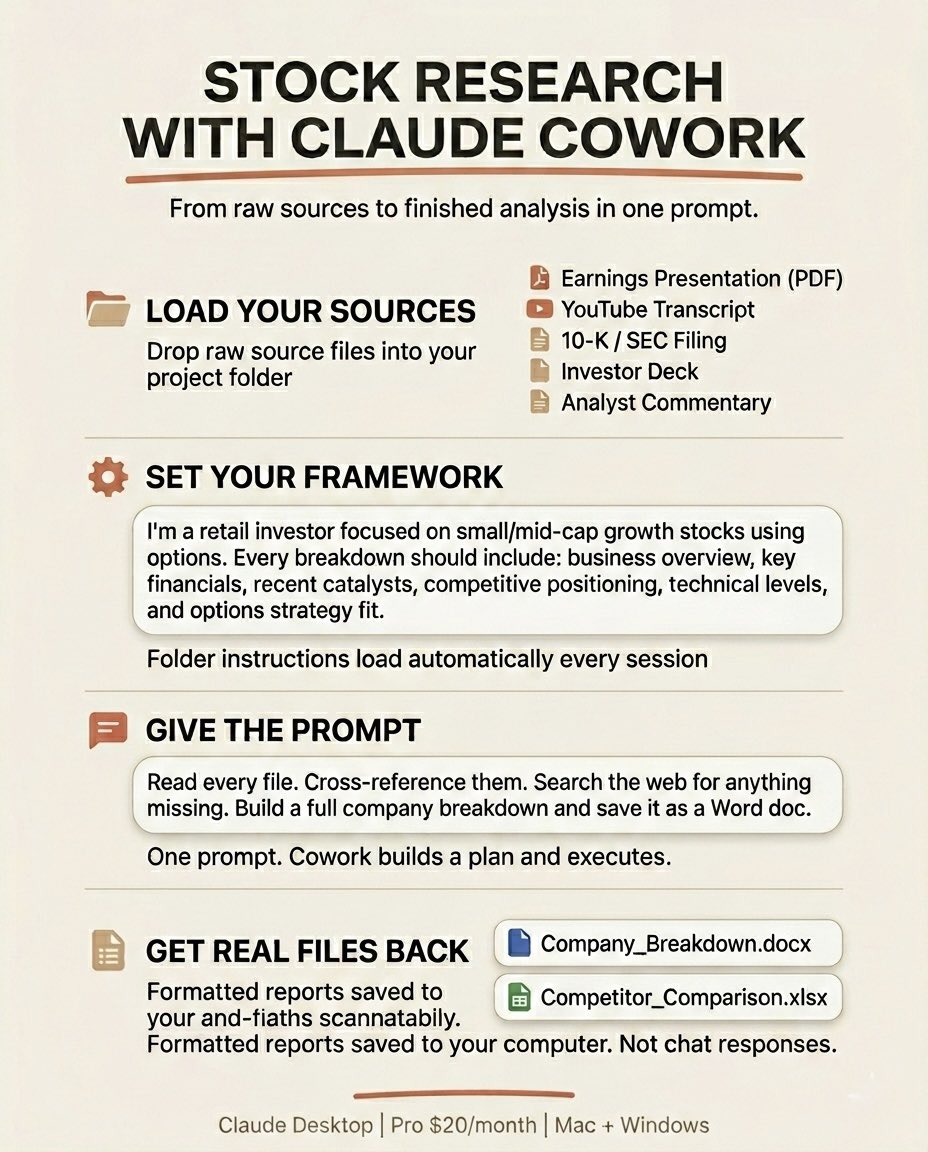
One prompt + a folder of source material = a finished company breakdown saved as a real document on your computer.
Not a chat response. A file.
If you're spending 2-3 hours every week bouncing between 12 browser tabs, reading earnings transcripts, watching YouTube bull cases, skimming SEC filings, and copying random numbers into Apple Notes just to forget half of it...
Claude Cowork eliminates the entire loop:
-> Drop your raw sources into a folder (earnings decks, YouTube transcripts, 10-Ks, investor presentations, PDFs)
-> Point Cowork at the folder and tell it what you need
-> It reads every file, cross-references them, and searches the web for what you're missing
-> It builds a full company breakdown and saves it as a real .docx or .xlsx on your machine
-> It connects to tools like Notion so you can pull in context you already have
No more 12-tab research sessions.
No copy-pasting between sources.
No starting from scratch every time.
What you get:
-> Business overview, financials, catalysts, competitive positioning, and risk factors synthesized from YOUR sources
-> A formatted report saved on your computer you can reference before every trade
-> Web research layered on top filling gaps your files didn't cover
-> A reusable framework that loads automatically every session through folder instructions
Mine tells Cowork: "I'm a retail investor focused on small/mid-cap growth stocks using options. Every breakdown should cover business overview, key financials, recent catalysts, competitive positioning, technical levels, and which options strategy fits the current IV environment."
Set it once. Every research session already has context.
Available inside Claude Desktop on Pro ($20/month). Mac and Windows. Still a research preview with some rough edges. Pro users may hit usage limits on heavy sessions.
$20/month for what used to be a 3-hour manual process.
If there's interest I'll do a full walkthrough with my exact folder setup, instructions, and prompts.