In 1898, an Austrian physicist published a radical mathematical theory that claimed the entire universe was slowly, irreversibly ticking toward its own death.
The elite scientific establishment mocked him so relentlessly that he slipped into a deep depression and eventually took his own life.
Only a few years later, the world realized he was entirely right.
His name was Ludwig Boltzmann.
Today, his breakthrough formula is carved onto his tombstone in Vienna.
Yet outside of the physics community, almost no one understands the brutal, mind-bending philosophical truth he discovered about how our lives actually work.
In the late 19th century, physics was neat, orderly, and beautiful. Scientists believed that if you knew the exact position and velocity of every particle in the universe, you could predict the future perfectly.
The universe was a flawless clock.
Boltzmann looked at the world and realized that was an illusion.
He wanted to solve a deceptively simple riddle: Why does time only move forward? Why does a dropped coffee mug shatter into a hundred pieces, but a hundred scattered pieces never spontaneously jump back together to form a mug?
The laws of standard physics said it could happen. The math didn't forbid it.
So why didn't it?
Boltzmann realized the establishment was looking at the problem completely wrong. They were trying to track every single particle individually. It was an impossible formula.
Instead, Boltzmann decided to use probability and statistics. He stopped looking at individual atoms and started looking at the chaos of the crowd.
He invented a concept called Entropy, the mathematical measure of disorder.
His breakthrough was simple but devastating:
There is only one specific way for the atoms in your coffee mug to be perfectly arranged. But there are trillions of disordered ways for those same atoms to be scattered across the floor.
Things don’t break because the universe is malicious. They break because chaos is statistically overwhelming. Order is rare; disorder is infinite.
Boltzmann proved that the universe is constantly, inevitably moving from a state of low entropy (perfect order) to high entropy (maximum chaos). This cosmic slide toward disorder is the very reason time exists. The "arrow of time" is just the universe getting messier.
The professors of his day were furious. They hated his math because it relied on probability instead of certainty. They refused to believe that the fundamental laws of reality were governed by statistics.
But Boltzmann’s math laid the groundwork for quantum mechanics and explained the fate of the cosmos.
The philosophical lesson Boltzmann left behind is a cold, liberating truth for everyday life:
Order requires deliberate energy. Chaos is free.
Most people treat problems in their lives, a collapsing relationship, a chaotic career, a messy mind, as a sign of personal failure. They think they did something uniquely wrong.
But Boltzmann’s math proves that if you leave any system alone, it will naturally decay into chaos all by itself. Your room doesn't get messy because you are a bad person; it gets messy because the laws of physics dictate that there are infinitely more ways for your clothes to be on the floor than in the closet.
If you want to maintain order, sanity, or success in any area of your life, you cannot rely on things "just working out." The universe is actively trying to scramble your plans.
What is an area of your life right now that is sliding into chaos? Stop waiting for it to fix itself. Chaos is the default setting of the universe. What is the precise, deliberate energy you need to inject into that system today to fight back against the entropy?
You'll be shocked at how intelligent you become through curiosity & humbleness.
They don't announce it, but Academia promotes arrogance in knowledge accumulation.
You realize, knowledge accumulation doesn't make you smart if you're acquire it through a narcissistic perspective.
If bad luck was a person, It was Krishna.
Born in a prison cell.
With chains.
Cold walls.
And fear.
The West writes self-help books after one breakup and a weekend depression.
Krishna was born with a death warrant.
His own uncle wanted him dead.
He never drank his mother's milk.
Hours after birth,
his father carried him across a mad river at midnight.
Rain above.
Death behind.
Darkness ahead.
No burning bush.
No sea parting.
No miracle announcing salvation.
No therapist with scented candles.
Just survival.
Born a prince.
Raised a cowherd.
Before he could speak,
they sent Putana.
Then Shakatasura.
Trinavarta.
Kaliya.
One after another.
As if destiny hated him personally.
And he still smiled.
People today collapse over an unfollow.
He lost everything early.
His parents.
His childhood.
His home.
And Radha.
Ah, Radha.
The part Bollywood never understands.
His closest friend Sudama lived in poverty.
Krishna could not protect everyone he loved.
Shishupala insulted him publicly.
Again and again.
Before assembled kings.
Krishna listened calmly.
Then came Jarasandha.
17 invasions.
Mathura burned again and again.
Then came the greatest tragedy.
The Mahabharata.
Krishna tried to stop it.
He went himself.
He sat before Duryodhana.
Pleaded for peace.
Just 5 villages.
Duryodhana refused.
And humanity walked into hell smiling.
18 days later, rivers carried blood.
1.66 billion dead.
Think about that.
An entire civilisation collapsing into dust.
And Krishna carried that silence.
No lamentation carved into scripture.
No prophet demanding heaven explain itself.
Just silence.
Then Gandhari cursed him.
A grieving mother blamed him for everything.
Krishna accepted it.
That is spiritual strength.
Then came the final collapse.
His own clan destroyed itself.
Drunk. Violent. Mad.
The Yadavas killed each other.
His own son died in that chaos.
Krishna watched.
Because some endings cannot be stopped.
Then Dwarka sank.
His city.
His dream.
His life's work.
Gone beneath the waves.
And finally...
The man who was greatest strategist.
The man kings feared.
The man sages worshipped.
Died alone in a forest.
One arrow.
A hunter's mistake.
No throne.
No army.
No grand farewell.
No Resurrection.
Just silence beneath the trees.
And yet...
He is called the complete being.
Not because life was kind.
But because pain never poisoned him.
That is Krishna's greatness.
Not miracles.
Not powers.
Not mythology.
Life gave him suffering.
He gave life wisdom.
Life gave him betrayal.
He gave humanity the Gita.
Life gave him war.
He gave the world detachment.
And in the middle of chaos,
he left us one terrifying truth:
"You control your actions.
Never the outcome."
Krishna did not teach escapism.
He taught endurance.
He did not teach positivity.
He taught responsibility.
He taught how to stand inside hell,
without becoming hell yourself.
That is why he still smiles.
And maybe...
That is why Bharat still survives.
In 1880, a reclusive, self-taught telegraph operator with no university degree went to war with the greatest scientific minds in the British Empire.
He won, changed the mathematics of physics forever, and quietly built the foundation for the entire modern electrical grid.
Yet today, almost no one outside of electrical engineering and applied mathematics even knows his name.
His name was Oliver Heaviside.
The story of how he solved one of the hardest engineering problems in human history is a masterclass in why book smarts fail where deep, messy intuition succeeds.
In the late 19th century, the world was trying to lay massive underwater telegraph cables across the Atlantic Ocean. But they had a crippling problem: the signals kept distorting. You would type a message in London, and by the time it reached New York, it was a smeared, unreadable mess of electricity.
The top physicists of the day, using traditional university math, said the solution was simple: make the cables purer and reduce resistance. They spent millions of dollars trying to make the lines perfect.
It didn't work. The signals still broke.
Heaviside looked at the exact same problem from his messy, self-taught perspective and realized the elite academic establishment was blind.
They were treating an electrical wire like a water pipe. They thought the electricity was inside the copper.
Heaviside figured out that electricity doesn’t flow inside the wire; it flows in the electromagnetic field around the wire.
Then, he did something that made mainstream mathematicians furious. He invented a bizarre shortcut called operational calculus. Instead of spending weeks solving complex, multi-page differential equations to map these fields, he treated calculus like basic algebra.
To the professors at Cambridge, this was a sin. They called his math clumsy, unrigorous, and nonsense.
Heaviside didn't care. His famous response to them was: "Should I refuse my dinner because I do not fully understand the process of digestion?"
He used his illegal math to propose a mind-bending solution: to fix the distorted signal, engineers didn't need to make the cable cleaner. They needed to deliberately add more corruption to it. He suggested wrapping the cables in iron wire to introduce "inductance", intentionally fighting one distortion with another.
The establishment ignored him for years. But when AT&T finally tried his method, the results were instant. Long-distance communication was solved.
Heaviside wasn't trying to pass a math exam or impress a peer-review board. He wanted to solve a real-world problem.
In the process, he took James Clerk Maxwell’s famously complex 20 equations of electromagnetism and condensed them into the 4 beautiful formulas that every single physics student is forced to memorize today. Heaviside did the heavy lifting, but Maxwell got the name.
The lesson Heaviside left behind is a philosophical blueprint for navigating a complex world:
The people who memorize the proper formulas are excellent at solving textbook problems. But they are entirely dependent on the rules staying the same.
The people who understand the underlying system don't care about the rules. They break them to find what actually works.
Most of us approach our life's problems like the 19th-century British establishment. When something goes wrong in our career or relationships, we try to make our existing wire purer. We try harder at a broken method.
But sometimes, the problem isn't that you aren't trying hard enough. The problem is that you are looking inside the wire instead of looking at the field around it.
What is a distortion in your life right now that you keep trying to fix with the standard advice? What happens if you stop trying to follow the textbook formula and start looking at the hidden forces causing the noise?
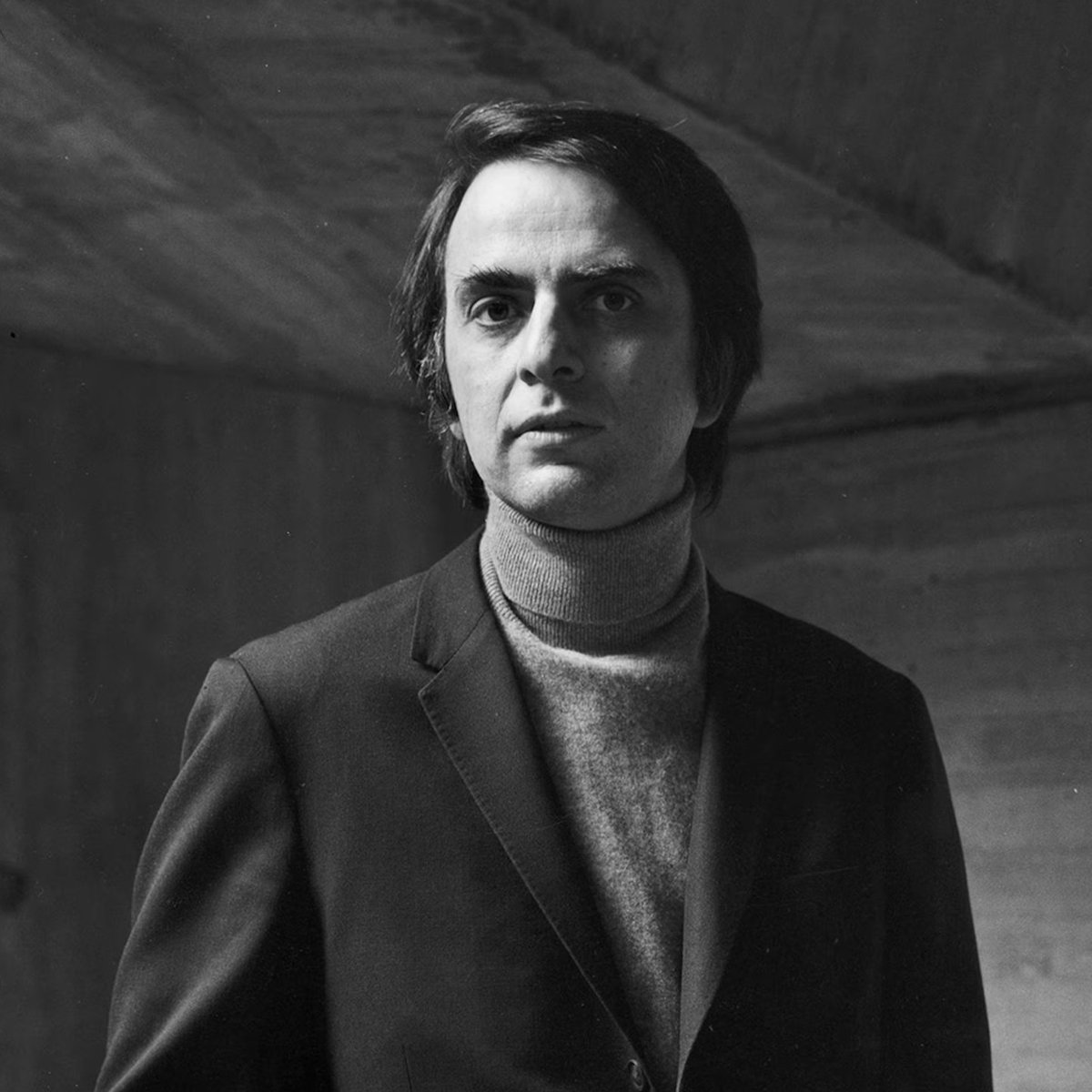
“I have a foreboding of an America in my children's or grandchildren's time -- when the United States is a service and information economy; when nearly all the manufacturing industries have slipped away to other countries; when awesome technological powers are in the hands of a very few, and no one representing the public interest can even grasp the issues; when the people have lost the ability to set their own agendas or knowledgeably question those in authority; when, clutching our crystals and nervously consulting our horoscopes, our critical faculties in decline, unable to distinguish between what feels good and what's true, we slide, almost without noticing, back into superstition and darkness...
The dumbing down of American is most evident in the slow decay of substantive content in the enormously influential media, the 30 second sound bites (now down to 10 seconds or less), lowest common denominator programming, credulous presentations on pseudoscience and superstition, but especially a kind of celebration of ignorance”
― Carl Sagan, The Demon-Haunted World: Science as a Candle in the Dark
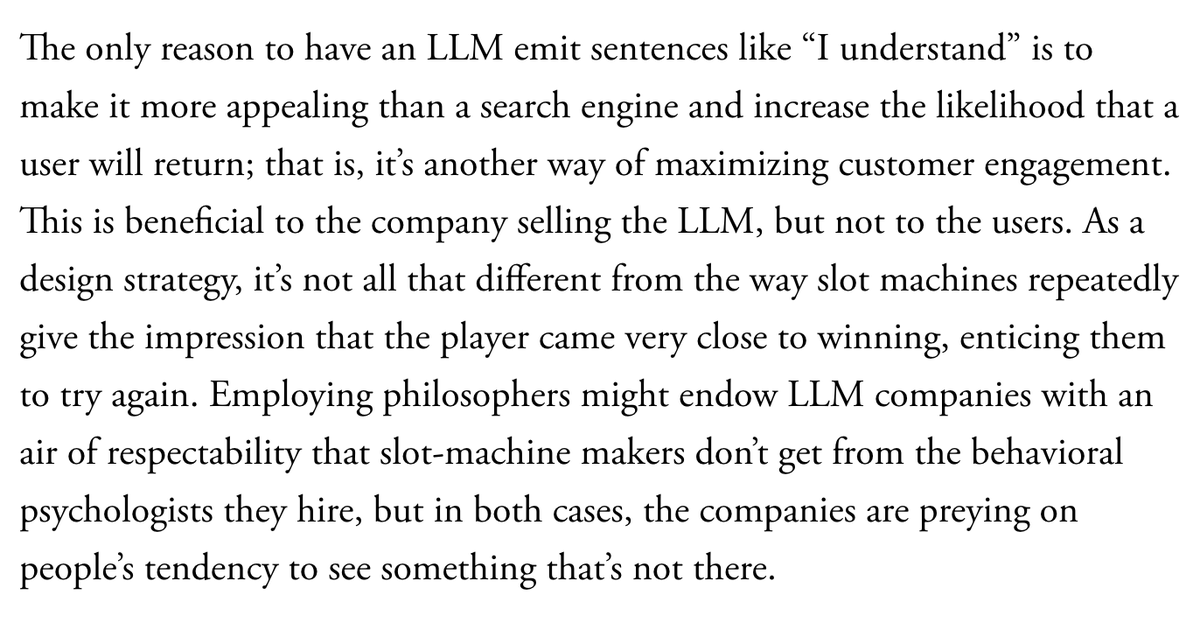
Compelling essay by sci-fi writer Ted Chiang on why LLMs are nowhere near consciousness, but why it serves the interests of LLM companies to constantly suggest that they might be.
I've pulled one quote below, but the whole article is worth reading.
No one is more annoyed by the AI revolution than people who can actually write a sentence. Basically, having any ability to write now is suspect - you will get accused of being AI at some point. It feels like you are being accused of being a witch, of holding a type of rare magic that only the machines are now allowed to have.
1987. A room in New Delhi is thick with the smell of old files & cold tea. The United States has just delivered a stinging slap to the face of the Indian Republic. They have officially refused to sell India the 'Cray X-MP' Supercomputer, the most powerful machine on Earth, claiming that India would use it for nuclear weapons.
The American officials mockingly suggest that India does not even have the electricity to keep such a machine running. In the middle of this national humiliation, a young, soft-spoken engineer named Vijay Bhatkar is asked by then Prime Minister Rajiv Gandhi: "Can we build our own?" Bhatkar does not hesitate. He looks at the No of the West & says: "We will not just build it; we will build it faster than you can ship it."
The Americans did not just stop at refusing the sale; they actively lobbied other nations to ensure India remained digitally blind. They believed that w/o their Logic Gates, India would remain a 3rd world backwater.
Bhatkar realized he could not replicate the Single-Processor behemoth of the Cray. Instead, he turned to Parallel Processing. He decided to stitch together 1000s of low-cost, off-the-shelf microprocessors. It was like building a giant's brain out of the neurons of ants.
In 1991, while the West was still celebrating its monopoly, Bhatkar unveiled the PARAM 8000. It was not just a computer; it was a Gigaflop monster.
To prove the PARAM was real, Bhatkar ran a standard global benchmark test. The results were sent to an international conference in Zurich. The PARAM 8000 was ranked as the 2nd most powerful supercomputer in the world, behind only the American machines. But there was a twist: the PARAM cost a fraction of the Cray, performed better in tropical heat, & was built in just 3 years.
When the PARAM 8000 was 1st turned on, the team did not have a high-tech cooling system like the Americans. They used industrial-grade desert coolers & adjusted the airflow manually. It was the ultimate Jugaad that defeated the most sophisticated tech embargo in history.
A major US newspaper ran a story with the headline: "Denied supercomputer, Angry India does it!" The ghost of the Native Engineer had officially entered the silicon temple. Vijay Bhatkar’s history is the story of how India became the IT Capital of the world.
Bhatkar founded the Centre for Development of Advanced Computing (C-DAC). He did not just build a machine; he built an ecosystem. Every software engineer in India today stands on the shoulders of the man who proved we did not need the West's permission to compute. Bhatkar was the 1 who realized that if computers only spoke English, 90% of India would be left behind. He led the development of GIST (Graphics & Intelligence Based Script Technology), allowing computers to work in Indian languages. He gave the Machine a local tongue.
Today, Bhatkar is a Padma Bhushan awardee, but he lives a life of deep spirituality & simplicity. He vanished from the corporate headlines to become a philosopher of the digital age.
The West thought they could freeze India’s future by withholding a single machine. They forgot that the Indian mind does not need a 'Cray' to think; it only needs a 'No' to ignite. Forget building a supercomputer; Bhatkar built a mirror, & for the 1st time, the West had to look into it & see that the primitive colony had become the master of the code.
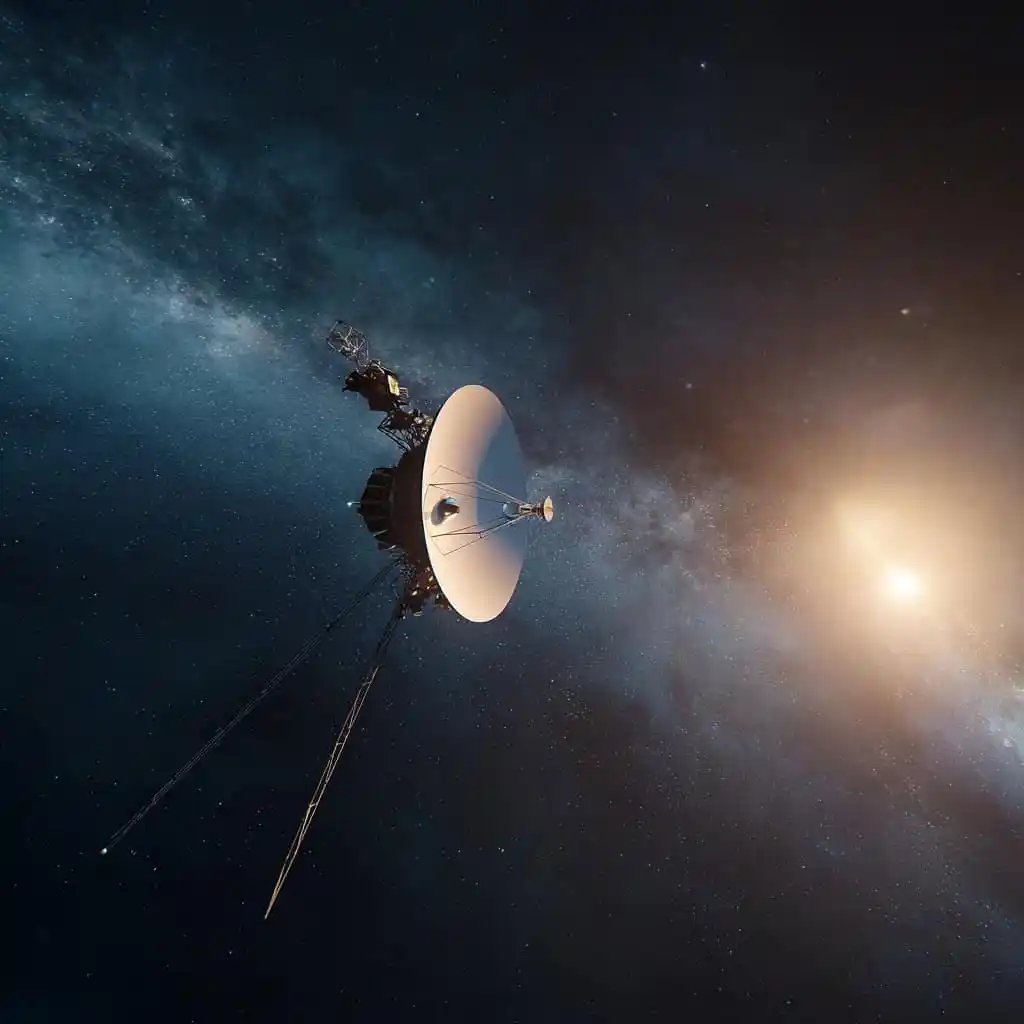
Voyager 1 is about to cross the line no human creation has crossed.
One light-day from Earth. 16 billion miles of cold nothing.
49 years of real travel for what light does in 24 hours.
Look at this number: 3,200,000,000,000.
That's how many planets exist in our galaxy alone.
If you tried to count them — one per second, every second, never stopping — it would take you over 100,000 years.
That's just in one galaxy.
There are 2 trillion more galaxies.