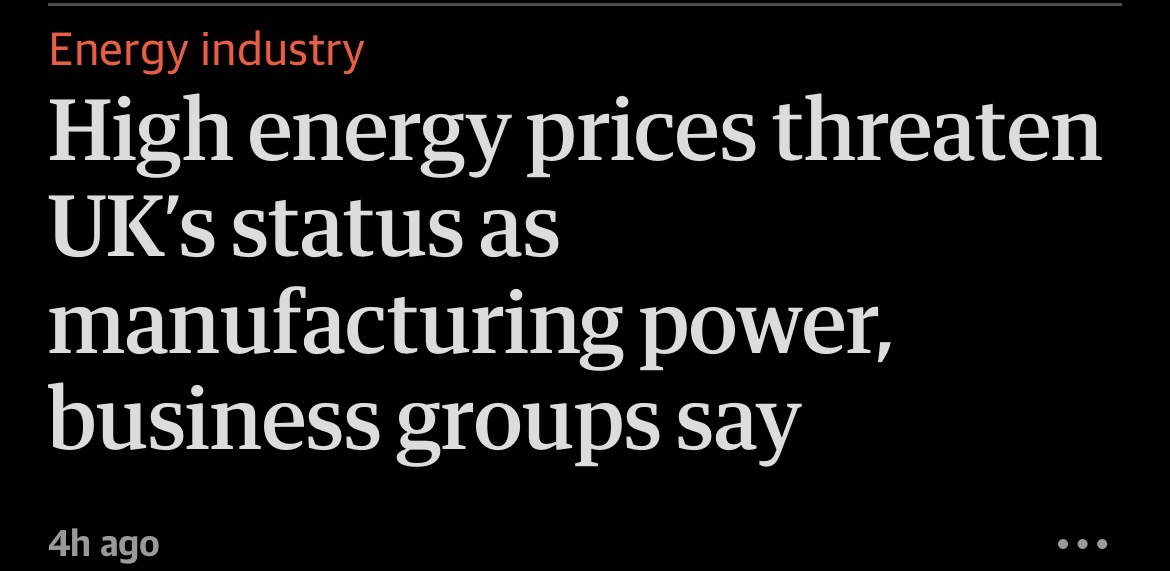
“When the foundations are extractive, everything built on top is expensive.”
Govt economic policy has to change and change rapidly.
Any review on energy has to consider public ownership as an option.
Here’s why:
This isn’t just about a bad year or a temporary spike. It’s not something we fix with another sticking plaster or short term rebate.
This is structural.
For 40 yrs we’ve treated the basics of our economy as assets to sweat, not foundations to strengthen. Energy, water, transport, housing, even parts of our food system have been organised around extraction first, production second.
When the foundations are extractive, everything built on top is expensive.
High energy prices don’t just hit families trying to heat their homes. They hit factories, pubs, farms, small manufacturers. They feed straight into food prices, rents and transport costs.
That’s why the cost of living crisis & the cost of doing business crisis are the same crisis.
You can’t build a serious manufacturing base on top of an energy system designed to reward volatility.
You can’t have food security when water companies are loaded with debt and paying out dividends.
You can’t grow regional industry when transport is fragmented and overpriced.
You can’t ask small firms to invest when commercial rents are inflated by land speculation.
Tinkering won’t cut it.
Price caps without structural reform just socialise the risk and privatise the reward.
Short term subsidies ease the pain but leave the model untouched.
Industrial strategy without control over energy costs is industrial strategy with one hand tied behind its back.
If we’re serious about growth and renewal, we’ve got to talk about democratic control of the basics.
Not control for its own sake. Control that lowers the cost of capital. Control that aligns investment with long term public need. Control that treats water, energy, transport, housing and food as the infrastructure of prosperity, not chips in a global casino.
A Productive State doesn’t micromanage everything. It does something more important. It shapes the rules, owns or co-owns the natural monopolies, and makes sure essential services run at cost plus resilience, not cost plus maximum extraction.
Right now we’ve got manufacturers paying some of the highest industrial energy prices in Europe. Households squeezed. Government spending billions managing the fallout instead of fixing the cause.
Every time we patch instead of reform, we lock in higher structural costs. For families. For firms. For the state.
The business groups are right to worry.
But we won’t fix this by begging for another relief scheme.
We fix it by rebuilding the foundations.
Energy priced for production, not speculation.
Water run for resilience and public good, not dividend flows.
Transport integrated to support growth.
Housing treated as infrastructure, not a tax shelter.
Food supply anchored in security, not fragility.
Until the basics are under far stronger democratic guidance, the cycle carries on.
Higher bills.
Higher business costs.
Lower investment.
Lower growth.
That isn’t fate.
It’s a policy choice.
And we can choose differently.
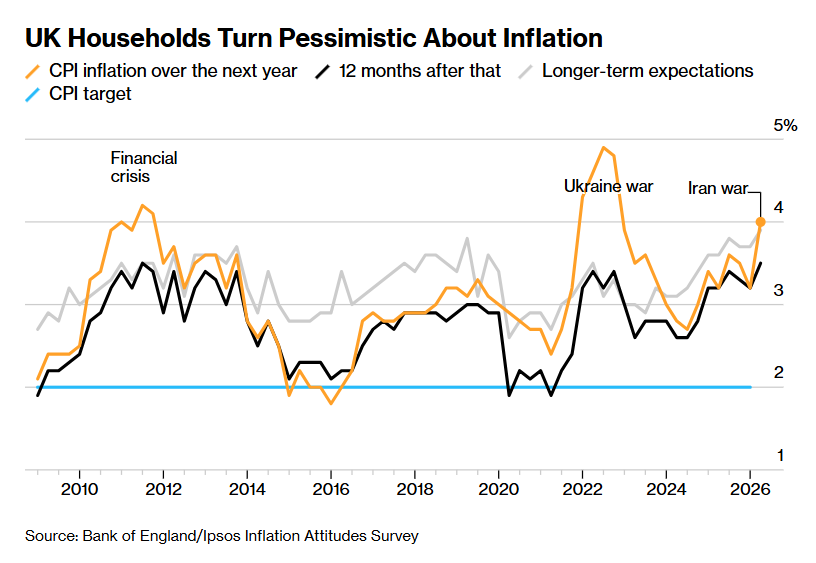
“Bailey to tolerate slow return to inflation target as interest rates held” - but inflation does NOT return to target if policy is kept relaxed when inflation is persistently above target. Little sign of inflation getting back to 2pc and staying there. https://t.co/oq0rujZEgo
The many takes flying around about John Healey, resignation gossip and national security spending miss a fundamental point.
In Finland, where people have a strong social safety net and a real sense of shared national purpose, around 80% say they would be prepared to defend their country. In the UK, that figure is closer to 30%.
That should tell us something.
Until we change the financial architecture of our economy and bring the essentials of life out of the grip of corporate extraction and into public ownership, we will always be told to choose between bombs and butter.
But the reality is we need both.
Modern hybrid warfare means every public service is part of our national resilience. Energy, water, housing, health, transport, food security and social care are not separate from defence. They are defence.
If we want people to defend the country, we have to build a country people believe is worth defending. A thriving state. A fair economy. A society where everyone feels they have a stake.
I spoke about this on Peston on Monday night.
The Fed maintained an easing bias in the April FOMC statement.
The debate has clearly already skipped past whether to have a neutral bias and towards
1) whether to have a tightening bias—possibly as soon as July,
and then, 2) when to take back the "insurance" cuts of 2025.
Trump's prepared remarks at Warsh's swearing in: "I want Kevin to be totally independent. I want him to be independent and just do a great job. Don’t look at me. Don’t look at anybody. Just do you own thing. Do a great job. OK?"
Living standards for lower-income households were especially hard hit in the last few years.
For poorer families, annual incomes have sunk, on average, since the end of the pandemic, and truly plunged at the very bottom.
Read how to reset Britain’s economic policy https://t.co/UKO97rBCGa
I do have one issue with the SFA statement. They appear to believe that, because the game clock shows 53.07 (98.07) at conclusion, Celtic v Hearts was fully played out, no premature ending. But Callum Osmand’s goal was scored at 52.30 (97.30) and was immediately followed by fans on the pitch. So this SFA claim doesn’t make sense. The outcome of the match was not in doubt but the SFA can hardly claim that “more than the minimum additional time of eight minutes” were added. Not unless they mean that both teams could actually have played on with fans on the field.
A tonal shift on the Fed from Trump, who two weeks ago tweeted out a picture of Powell falling into a dumpster and who last month said he thought Warsh would reduce interest rates
Living standards for lower-income households were especially hard hit in the last few years.
For poorer families, annual incomes have sunk, on average, since the end of the pandemic, and truly plunged at the very bottom.
Read how to reset Britain’s economic policy https://t.co/UKO97rBCGa
BREAKING: The IMF tells Britain to stick to its fiscal plans and warns “domestic uncertainty” could hurt the economy
It says the UK must continue to reduce borrowing and control welfare
And that there is only limited space for tax rises
Seems a clear warning to Andy Burnham
BREAKING: Heart of Midlothian FC have issued a statement condemning the alleged physical and verbal abuse towards their players and staff at Celtic Park this afternoon, during the Celtic celebration pitch invasion
Read more: https://t.co/ahu1rplI8c
🗣️ “If Hearts players have been accosted by some of our fans, that’s pretty serious.”
🗣️ “I was asking the fourth official, or one of the linesmen, in the tunnel, and he said it’s over.”
Martin O’Neill on the post-match scenes after Celtic's title win over Hearts ⤵️
Even more significant. O'Neil confirms the Fourth Official told him there was approximately a minute of the game left when Celtic scored their third goal.