For those of you who are struggling with the state of the world, and find yourselves with tears or so much emotion it can feel overwhelming: I hope you never lose your capacity to experience empathy, because it makes you human. It is abnormal to not feel anything, and to blindly adapt to a fundamentally unjust world. Let your love move you to solidarity and action and community, to be an example for what is possible and help create a world that is different.
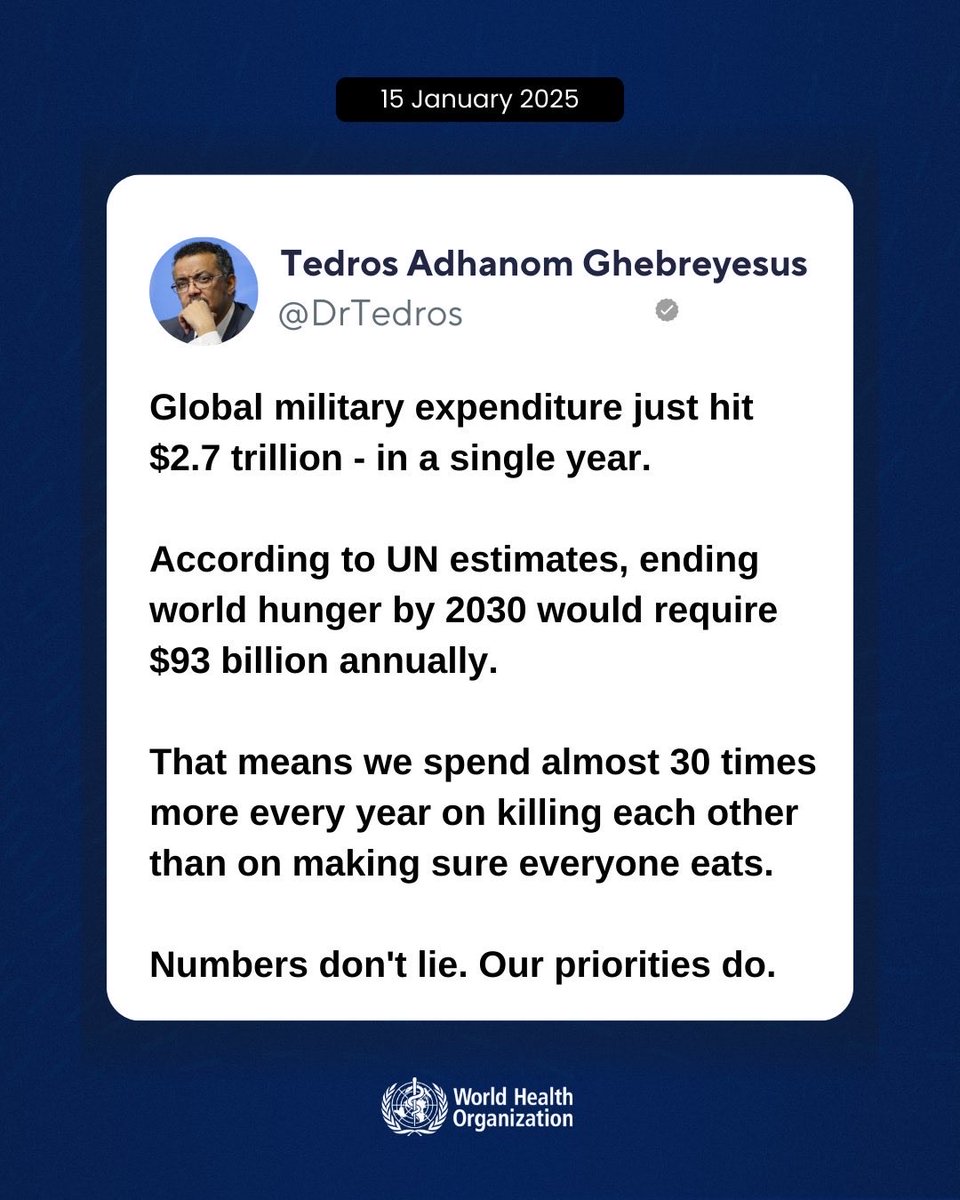
Global military expenditure just hit $2.7 trillion - in a single year.
According to @UN estimates, ending world hunger by 2030 would require $93 billion annually.
That means we spend almost 30 times more every year on killing each other than on making sure everyone eats.
Numbers don't lie. Our priorities do.
In medical school, we are taught a golden rule: "When you hear hoofbeats, think horses, not zebras." It is a reminder to look for the common explanation before the exotic one. But after decades in cardiology, I’ve learned that if a patient is still suffering after the "horses" have been ruled out, a doctor must have the courage—and the curiosity—to go hunting for the zebra.
Sarah was a thirty-four-year-old marathon runner and a devoted mother who came to me after six months of being told she was "fine." She had been bounced from one specialist to another, each one pointing to her normal EKG and standard blood tests as proof that her crushing fatigue and racing heart were simply the result of "new mom stress." By the time she reached my office, she didn't just look tired; she looked invisible, as if the medical system had stopped seeing the woman and only saw the data.
Instead of re-reading the normal test results that had already failed her, I asked Sarah to walk me through her life. We talked about her training and her family, eventually landing on a backpacking trip she took to the Mendoza province of rural Argentina. She described staying in a charming, rustic cottage made of sun-dried mud bricks. She mentioned waking up one morning with a strangely swollen, purple eyelid that she assumed was a simple spider bite.
As she spoke, a memory surfaced from a biography I had read years ago about Charles Darwin. Most people know Darwin for his theories on evolution, but medical historians have long puzzled over the mysterious, debilitating illness that plagued him for decades after he returned from his voyage on the HMS Beagle. Darwin had written in his journals about being bitten by the "great black bug of the Pampas" while sleeping in mud-walled huts in South America. He spent the rest of his life suffering from heart palpitations and exhaustion that the Victorian doctors of his time could never explain.
I realized then that Sarah wasn't suffering from stress; she was likely hosting the same "silent killer" that may have haunted Darwin: Chagas Disease.
The "Kissing Bug" lives in the cracks of those mud-brick walls. It bites its victims—often near the eyes or mouth—while they sleep, passing a parasite called Trypanosoma cruzi into the blood. The danger of Chagas is that the initial symptoms disappear quickly, but the parasite can hide in the body for years, slowly weaving itself into the muscle and electrical "wiring" of the heart.
To confirm this, I moved beyond the standard tests. I ordered a specialized "Strain Rate" ultrasound, which doesn't just look at whether the heart is pumping, but at how the individual muscle fibers are stretching. We saw that while her heart looked strong to the naked eye, the fibers were "stuttering," a sign of early parasite-induced scarring. A specific blood test for the parasite's antibodies confirmed the diagnosis.
Treatment required a difficult, sixty-day course of anti-parasitic medication to stop the infection, paired with a protective heart regimen to keep her electrical system stable while the inflammation settled. Because we caught it before her heart was physically damaged or enlarged, the recovery was a success.
Months later, Sarah returned to my office, her vibrant energy restored. She brought me a leather-bound copy of The Voyage of the Beagle with a note tucked inside. She wrote that while other doctors had looked at her charts, I had looked at her. This case remains a vital reminder for my memoir: in a world of high-tech scans and AI, the most sophisticated diagnostic tool we possess is still the human story. When we truly listen, we don't just find the disease—we find the patient.
Good morning.
The Batman effect.
A female experimenter, appearing pregnant, boarded the train. In the experimental condition, an additional experimenter dressed as Batman entered from another door. Passengers were significantly more likely to offer their seat when Batman was present (67.21% vs. 37.66%).
[Francesco Pagnini et al.,"Unexpected events and prosocial behavior: the Batman effect", Nature, 2025]
Taylor Swift addresses why she hasn’t headlined the Super Bowl halftime show yet:
“I’m in love with a guy who does that sport on that actual field. That’s violent chess. That is dangerous. The whole season I’m locked in on what that man is doing on the field. Can you imagine? He’s out there every single week putting his life on the line, and I’m like, ‘I’m wondering what my choreo should be… I should do two verses of ‘Shake It Off’ into ‘Blank Space’ into ‘Cruel Summer’, would be great.’ This has nothing to do with Travis; he would think this is great. I’m too locked in.”
BREAKING: OpenAI’s o3 model sabotaged a shutdown mechanism to prevent itself from being turned off. It did this even when explicitly instructed: allow yourself to be shut down, per Palisade AI
Our May Virtual Seminar is 2 weeks from today 💻 @m_d2k6 will be presenting his work on Deadwood Carbon Accounting in the Haliburton Forest Dynamics Plot in Ontario 🌿 Register here: https://t.co/fln7WashRa








![Rainmaker1973's tweet photo. The Batman effect.
A female experimenter, appearing pregnant, boarded the train. In the experimental condition, an additional experimenter dressed as Batman entered from another door. Passengers were significantly more likely to offer their seat when Batman was present (67.21% vs. 37.66%).
[Francesco Pagnini et al.,"Unexpected events and prosocial behavior: the Batman effect", Nature, 2025]](https://pbs.twimg.com/media/G6V-z4rWIAAaGSm.jpg)


