Lab-in-the-loop therapeutic antibody design
At @PrescientDesign @genentech we have spent 3+ years reimagining drug discovery. We built a machine learning system to design and execute experiments. Here's how it works and what we can do 🧵
1/
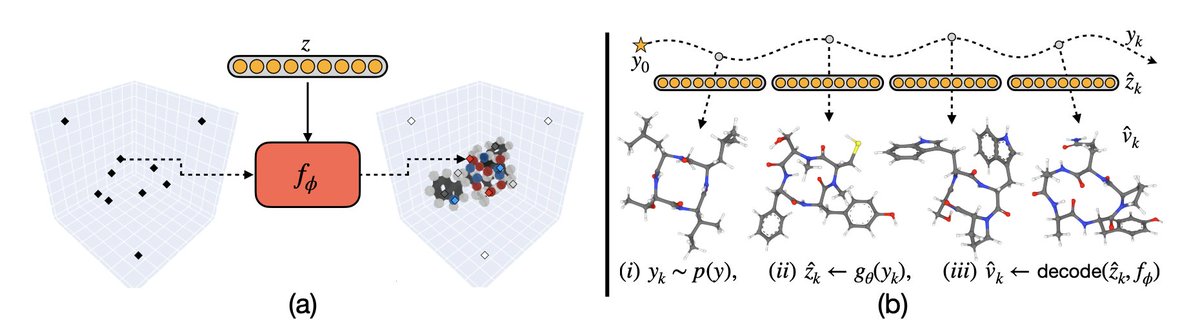
Score-based 3D molecule generation with neural fields @PrescientDesign
1. FuncMol introduces a novel method for 3D molecular generation, leveraging continuous atomic density fields as the molecular representation. Unlike point clouds or voxel grids, this approach ensures scalability and expressivity without assumptions on molecular structure.
2. The model employs neural fields, parameterizing molecular fields using a shared neural network and molecule-specific latent modulation codes. This allows for low-dimensional, compact representations and flexibility across molecular scales.
3. FuncMol employs a walk-jump sampling method: (i) "Walk" generates noisy latent codes using Langevin MCMC, (ii) "Jump" denoises these codes, and (iii) decodes them into atomic coordinates. This approach ensures one order of magnitude faster sampling compared to traditional methods.
4. Unlike voxel-based models, FuncMol is memory-efficient and supports free-form molecular representations. It trains faster and requires less computational overhead, scaling to large molecules such as macrocyclic peptides.
5. On benchmarks, FuncMol demonstrated competitive performance on datasets like GEOM-drugs and CREMP, achieving high stability, validity, and drug-likeness metrics. It is particularly effective in capturing complex molecular distributions.
6. This method extends to various applications in chemistry and biology, including structure-based drug design and modeling of electron densities. Its domain-agnostic nature makes it versatile for molecular design challenges.
@pedroopinheiro@m_kirchmeyer
💻Code: https://t.co/7rWNz9Irul
📜Paper: https://t.co/AVkv01HfJB
#FuncMol #NeuralFields #MolecularDesign #3DMoleculeGeneration #DrugDiscovery
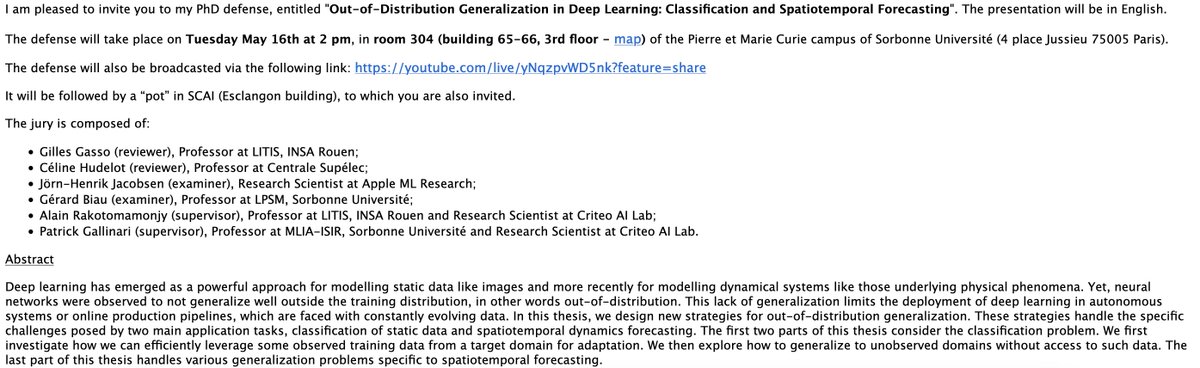
🚨 PhD defense on Tuesday May 16 at 2pm
@m_kirchmeyer will defend his thesis entitled "Out-of-Distribution Generalization in Deep Learning: Classification and Spatiotemporal Forecasting"
The defense will be broadcasted: https://t.co/pzZazPlSsG
Happy to share that DINo is accepted as a notable-top-25% at #ICLR2023 !
Interested in how implicit neural representations can be improved for spatiotemporal forecasting ?
Check out our solution for PDE forecasting #AI4Science
https://t.co/RVZlkCQ8oe
https://t.co/snMT0qQpqI
How to forecast PDEs time & space-continuously, even on complex geometries like Earth-like spheres?
Check out DINo, our new neural PDE forecaster using INRs & ODEs https://t.co/xhvPeL8SVw
With @m_kirchmeyer@jy_franceschi (eq contrib) @rakotal1 P Gallinari @mlia_isir@CriteoAILab
Ready to give your deep models a second life? Introducing model ♻️ recycling (https://t.co/ReB2ruXxsY), improving generalization by reusing weights fine-tuned on various vision tasks. Just like you recycle your bottles and cardboards, it's time to start recycling your models too!
Weight averaging strategies are super useful in deep learning, and succeed despite the non-linearities in networks' architectures. Our 2 works presented at #NeurIPS2022 analyze how they can help for out-of-distribution classification in computer vision! (1/4)
Check out our #NeurIPS2022 poster #441 tomorrow afternoon to learn more about OOD generalization and ensembling via weight averaging ! Feel free to contact @ramealexandre and myself !
In DiWA (https://t.co/oa78ZlAjlT), presented Thursday by @m_kirchmeyer, we average weights fine-tuned from a shared initialization. Also known as "Model soups", it tackles distribution shifts by approximating ensembling, but at no cost. See this 🧵: https://t.co/BdS70RMgio. (2/4)
How to forecast PDEs time & space-continuously, even on complex geometries like Earth-like spheres?
Check out DINo, our new neural PDE forecaster using INRs & ODEs https://t.co/xhvPeL8SVw
With @m_kirchmeyer@jy_franceschi (eq contrib) @rakotal1 P Gallinari @mlia_isir@CriteoAILab
Interested in understanding why weight averaging works so well out-of-distribution ?
Happy to chat on our bias-variance analysis of weight averaging at the poster session of #ICML2022 Principles of Distribution Shift (PODS) workshop Saturday !
Check out our full paper below !
Assume you are creating a team with multiple versions of the same person. Should these versions be collected chronologically, from childhood to adulthood? or rather from independent evolutions in multiple parallel universes? A 🧵about Ricks and our latest #DeepLearning paper.
📃AdaGrad, Context-informed Dynamics Adaptation, Generative Adversarial Networks Analysis, Convex Optimization, Nonsymmetric DPP, UnderGrad, "Nested Bandits"...our #ICML2022 paper line-up is exciting!
See you at @icmlconf!
More about it here: https://t.co/aFXPHiypTq
How to improve generalization of neural dynamics models to new dynamical systems seen e.g. in physics, climate and health ?
Excited to present our solution CoDA at #ICML2022 next month !
https://t.co/GPTyDKU4nS
https://t.co/axi01NOyWr
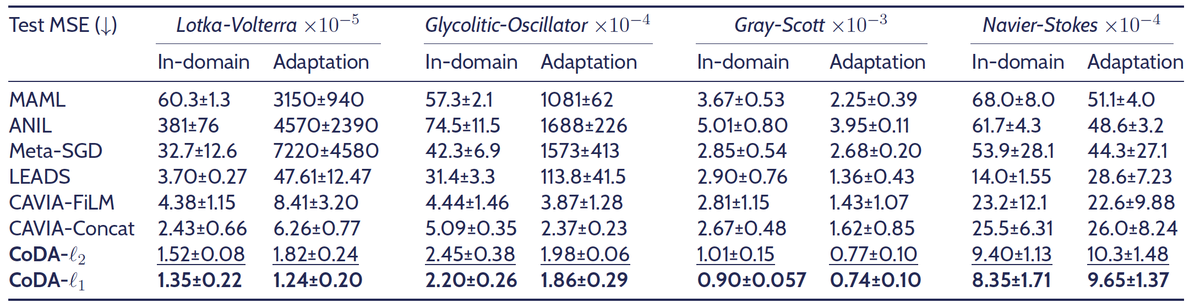
CoDA is sample-efficient, adapts in few steps, is agnostic to the dynamics model's architecture and outperforms existing baselines on challenging ODE/PDEs.
It can also be used to accurately predict unknown parameters of new physical systems and is backed by theoretical results.