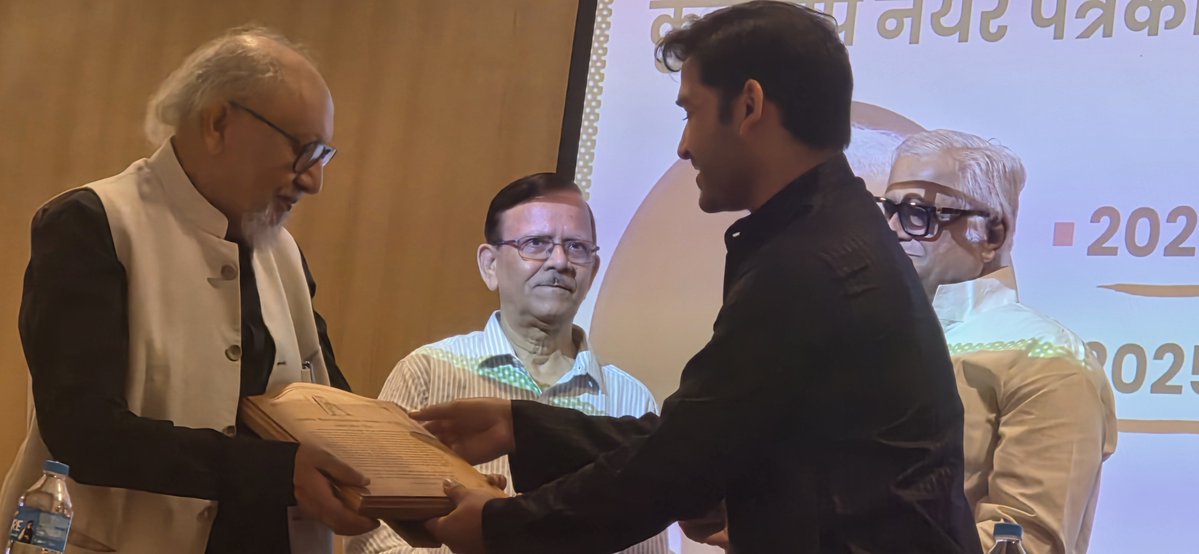
An itinerant knife-sharpener from Bhopal, Sheikh Ahmed, in Nashik. A disappearing tradesman. Says online buying has led to use and throw habit but he makes upto Rs 800/day. Restaurants look to him every fortnight, an assured work.
@IndianExpress Ttoo has this.
Would mere denial clear the former CJI?
This also underscores the point that retired judges, officials, and politicians should write books.
https://t.co/3ynE2FSBc7
An itinerant knife-sharpener from Bhopal, Sheikh Ahmed, in Nashik. A disappearing tradesman. Says online buying has led to use and throw habit but he makes upto Rs 800/day. Restaurants look to him every fortnight, an assured work.
This is one of the most famous paintings in the world, yet few people know the story of the woman holding the parasol…
It was painted by Claude Monet in 1875, and she was his wife, Camille, out for a walk with their young son Jean near their home in Argenteuil, just outside Paris. Monet painted them outdoors on a windy day, from below, so that Camille stands against the sky, her veil and dress caught by the wind, looking down at us as if we had just called her name.
It feels less like a moment a husband didn’t want to forget.
Four years later, Camille was gone. After a long illness, she died in September 1879, at just 32. Five days before the end, a priest blessed the marriage she and Monet had made in a simple civil ceremony nine years earlier. And there, at her bedside, the artist did the only thing he knew how to do: he painted her one last time. Years later, he confessed that even then, sitting beside her, he caught himself studying the colors that death was leaving on her face, a moment he never managed to forget.
By then, she had appeared in some fifty of his paintings: in a green silk dress at nineteen, standing at a window, walking through the poppies with their little boy. Without ever meaning to, he had painted the story of her whole life with him.
Monet lived almost fifty more years, but on this canvas it will always be that summer afternoon, with Camille turning to look at him in the wind…
Qureshi is free to say what he wants on platforms in India, which he does. We are both members of a high level discussion group and his views are known. Ashok Lavassa is active on the issue too.
Why does Qureshi want to reach out to foreign platforms? Promote an international campaign?
Mr @KanwalSibal You are ignoring the way the SRI was executed and the resultant disenfranchisment and confusion. The ECI had brought the ignominy on itself.
You are on a rampage against the CEC. It seems to be personal. What scores you want to settle is your business. But don’t reach and propagate definitive judgments of your own when the issue is before the SC.
You are damaging your own reputation.
I am not trolling you. I am exposing your surprising choice to defame India’s electoral system.
You should be more responsible. India has given you great opportunities in life and prestige. Be grateful. @DrSYQuraishi
@DrSYQuraishi. You deserve to be trolled because you are contributing in delegitimising the institution you once headed. We would like to know why no SIR took place in your tenure. Is cleaning of electoral roll not required? Should ASDD categories be not removed? Should ECI dispense with a basic legal requirement of enrolling only Indian citizens as voters? Should ECI disregard provisions of Citizenship Act while registering new voters?
🚨MASSIVE BREAKING : The Hindu Just drop Biggest BOMB on Traitor Gyanesh & dictator Modi🔥
(MUST Read & Share)
India's voter list now has an ON/OFF switch. And it sits in Delhi, not in your state.
→ ECINet is ECI's one portal for everything: voter list, SIR forms, officer logins.
→ An audit of its code by an IIT Delhi-IIM Calcutta data scientist found a built-in "disable" button for every State Nodal Officer.
→ The pop-up literally says: "the user will no longer be able to access the application."
→ Viewing voters' SIR forms can be switched on or off, state by state.
→ The code even has a ready message: "not enabled for selected State".
→ And in West Bengal alone, the officers responsible for the voter list are blocked from these forms.
And the joke doesn't end there.
→ How did the audit find all this? Not by hacking.
→ ECINet's login page loads a big code file before anyone even logs in.
→ Menu names, screens and API paths meant only for officials are sitting in it, readable by anyone.
→ The platform guarding almost 100 crore voters' data can't even hide its own officials-only menu.
Now the bigger shock.
This warning didn't come only from outside. It came from inside ECI.
→ Election Commissioners Sukhbir Singh Sandhu and Vivek Joshi wrote against the "gradual centralisation of the electoral roll database".
→ Sandhu wrote that he came to know about new ECINet modules "from media only".
→ Joshi asked for an outside IIT expert to audit who can change the voter database.
→ Finally, the two ECs wrote to the Cabinet Secretary.
Now connect the dots.
By law, the ERO in your area decides whose name stays on the voter list.
On ECINet, what the ERO can actually do is decided by the IT team in Delhi.
Law says decentralised. Software says one switch.
Bro, imagine.
Your society has a watchman, but the main gate lock is controlled by someone sitting in another city.
He can lock any building he wants, anytime.
And when two other committee members ask "who has the key?", nobody answers.
That's not digital transformation.
That's a remote control on democracy.
Gyanesh , if two of your own Commissioners couldn't get answers, how will the voter?
Modi, who holds the switch, and whom does he report to? 🔥🔥🔥