Excited to release new repo: nanochat!
(it's among the most unhinged I've written).
Unlike my earlier similar repo nanoGPT which only covered pretraining, nanochat is a minimal, from scratch, full-stack training/inference pipeline of a simple ChatGPT clone in a single, dependency-minimal codebase. You boot up a cloud GPU box, run a single script and in as little as 4 hours later you can talk to your own LLM in a ChatGPT-like web UI.
It weighs ~8,000 lines of imo quite clean code to:
- Train the tokenizer using a new Rust implementation
- Pretrain a Transformer LLM on FineWeb, evaluate CORE score across a number of metrics
- Midtrain on user-assistant conversations from SmolTalk, multiple choice questions, tool use.
- SFT, evaluate the chat model on world knowledge multiple choice (ARC-E/C, MMLU), math (GSM8K), code (HumanEval)
- RL the model optionally on GSM8K with "GRPO"
- Efficient inference the model in an Engine with KV cache, simple prefill/decode, tool use (Python interpreter in a lightweight sandbox), talk to it over CLI or ChatGPT-like WebUI.
- Write a single markdown report card, summarizing and gamifying the whole thing.
Even for as low as ~$100 in cost (~4 hours on an 8XH100 node), you can train a little ChatGPT clone that you can kind of talk to, and which can write stories/poems, answer simple questions. About ~12 hours surpasses GPT-2 CORE metric. As you further scale up towards ~$1000 (~41.6 hours of training), it quickly becomes a lot more coherent and can solve simple math/code problems and take multiple choice tests. E.g. a depth 30 model trained for 24 hours (this is about equal to FLOPs of GPT-3 Small 125M and 1/1000th of GPT-3) gets into 40s on MMLU and 70s on ARC-Easy, 20s on GSM8K, etc.
My goal is to get the full "strong baseline" stack into one cohesive, minimal, readable, hackable, maximally forkable repo. nanochat will be the capstone project of LLM101n (which is still being developed). I think it also has potential to grow into a research harness, or a benchmark, similar to nanoGPT before it. It is by no means finished, tuned or optimized (actually I think there's likely quite a bit of low-hanging fruit), but I think it's at a place where the overall skeleton is ok enough that it can go up on GitHub where all the parts of it can be improved.
Link to repo and a detailed walkthrough of the nanochat speedrun is in the reply.
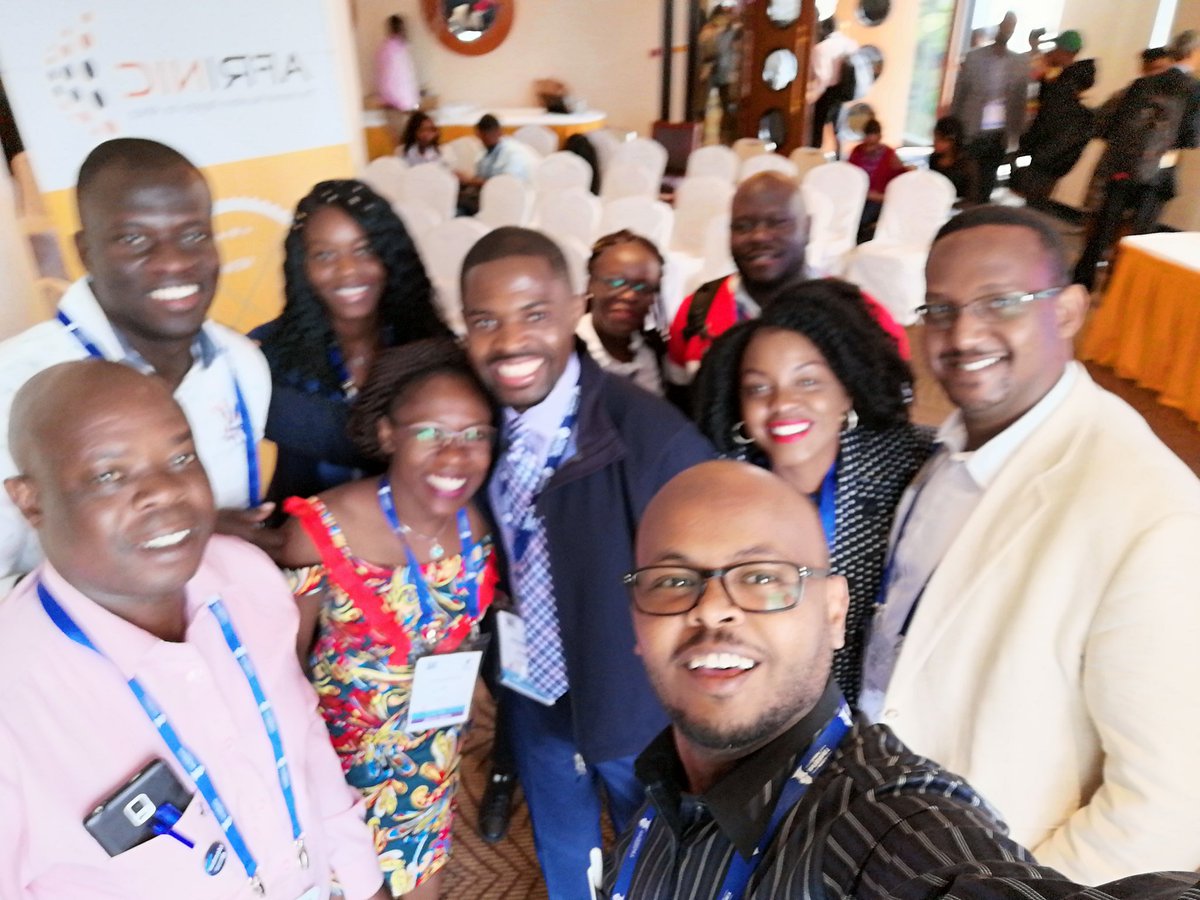
"We are more determined than ever to continue to play a leading role in the sustainable digital transformation and socio-economic development of Africa" -AFRINIC Communique. Read more here>> https://t.co/9EhnagYvQr
#weareafrinic#afrinic#Internet#switchingonafrica
Takeaway from @karpathy's CVPR talk:
The most successful ML projects in prod (Tesla, iPhone, Amazon drones, Zipline) are where you own the entire stack.
They iterate not just ML algorithms but also:
- how to collect/label data
- infrastructure
- hardware ML models run on
Swedish institute offers a fully-funded master's program scholarship for professional leaders, it's one of the most prestigious scholarships in the world, and I was lucky to be one of the selected scholars for the year 2019 :)
https://t.co/DGQFqRPvsX
Swedish Institute Scholarships for Global Professionals
Do you have the ambition to become a future leader within the sustainable development on a global platform? Then you might be who we are looking for.
@bankofkhartoum للأسف اردت تنشيط حسابي بعد ما فقدت الرمز السري و لكني لم استطع الاتصال بخدمة العملاء ببنك الخرطوم نظراً لاني بالخارج. هل يمكن تنشيط الحساب للعملاء من خارج السودان.
لكم جزيل الشكر على الخدمات التي تقدمونها
We are coming to Banjul, #Gambia to support the 11th West African Internet Governance Forum (WAIGF) which is a multi-stakeholder and multilingual discussion forum around Internet Governance in West Africa. Join us!