𝐓𝐡𝐫𝐞𝐞 𝐋𝐚𝐲𝐞𝐫𝐬. 𝐎𝐧𝐞 𝐂𝐨𝐦𝐩𝐨𝐮𝐧𝐝𝐢𝐧𝐠 𝐀𝐝𝐯𝐚𝐧𝐭𝐚𝐠𝐞. 𝐓𝐡𝐞 𝐈𝐑𝐄𝐍 𝐓𝐡𝐞𝐬𝐢𝐬.
There's been a lot happening at IREN recently.
Expansion across North America, Europe and Asia-Pacific.
The NVIDIA partnership.
The Mirantis acquisition.
New GPU deployments.
New customer discussions.
A growing global footprint.
Underneath all of it is a fairly simple view of where the world is heading, and a deliberate strategy for how we position IREN within it.
That strategy is built on three layers. Together, they compound into a structural advantage that gets harder to replicate every quarter we execute.
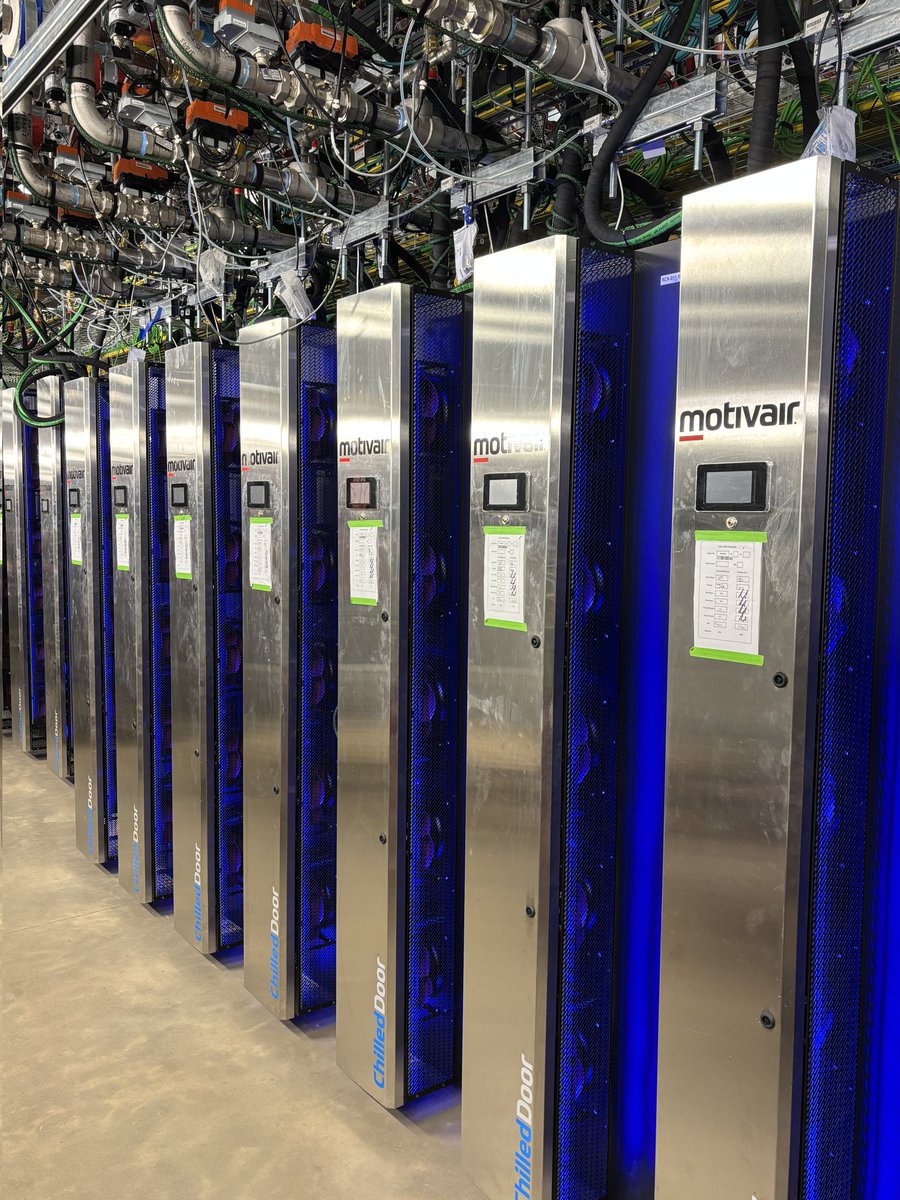
Layer 1: Physical infrastructure. Power, land, substations, data centers, cooling. The foundation that everything else sits on.
Layer 2: Compute infrastructure. The GPUs, servers and networking that go inside those buildings. Deployed at scale. Generating revenue. Building execution track record.
Layer 3: Software and operational capability. The orchestration, deployment tooling and enterprise expertise that makes the first two layers work harder for customers, and opens the door to a broader, higher-value market over time.
Layers 1 and 2 are where the overwhelming majority of IREN's value is being created today. Layer 3 is where that advantage compounds further over time, but only because Layers 1 and 2 are built, owned and controlled at scale by IREN, not subscale nor contracted from a third party.
Think of Amazon. They didn't win e-commerce by building a great website. They won it by controlling the fulfilment infrastructure at a scale nobody else could replicate. The foundation you don't control becomes the ceiling on your business.
That is exactly how we think about IREN. The physical infrastructure - the land, the power, the substations, the data centers - is owned and controlled by us. The compute deployed into it generates the revenue and execution track record. And the software, orchestration and enterprise capability we are more methodically building on top is what turns the total product into a vertically integrated AI Cloud platform that compounds over time and deepens into a competitive moat.
AI is still early. The bottleneck is increasingly physical. And we have spent eight years building the foundations.
$ONDS I KEEP COMING BACK TO THE FACTS - THIS STOCK IS TOO CHEAP 🤷♂️
At $9.25, Ondas trades at a $4.53B market cap with $1.4B in cash on the balance sheet.
Strip that out and investors are paying $3.13B in enterprise value for the actual business.
That enterprise value buys U.S. prime contractor status, $457M in pro forma contracted backlog, active global military relationships, a $PLTR partnership with programs already being co-pursued, a vetted pipeline of 25 acquisition targets representing $500M in potential 2026 revenue, and a robust, dual-use platform that checks every box that competitors can’t.
The bear case is structurally undermined by $1.4B in liquidity and no meaningful long term debt.
The dilution narrative is the primary concern holding this stock back.
It deserves a direct response.
Revenue has done a 7x while share issuance has done a 4x.
The model is deliberate: acquire fragmented, undervalued defense tech companies with real revenues, real contracts, and real pipelines at pre-scale valuations, then plug them into the Ondas platform to accelerate their growth.
Each acquisition brings more value than the dilution it creates.
Acquirees accept equity because they want upside participation in what Ondas is building, a clear signal of conviction from inside the ecosystem.
The right question is not how much dilution is occurring, it is how many times management can execute this playbook.
Every successful iteration increases revenue per share and expands the path to earnings per share as operating leverage compounds.
Your percentage ownership declines modestly while the absolute value of your position increases materially.
That distinction is the entire thesis.
The drone and autonomous systems sector is deeply fragmented and sub-scale.
Ondas has the capital, the platform, the partnerships, and the proven playbook to consolidate it.
That opportunity does not come around often. As @CeoOndas has described, these markets only organize once.
The numbers support this.
Organic backlog tripled from $68M to $177M in a single quarter before Mistral closed.
Mistral added $264M and has captured programs exceeding $1B in value.
Management guides to at least $375M in 2026, a sevenfold revenue increase YoY, using floor language that signals internal visibility well above the stated number.
Oppenheimer models revenue at $825M for 2027.
Management has strong visibility into $1.5B by 2030.
Operating leverage compounds everything.
The $53M cash operating cost base does not need to grow proportionally as revenue scales toward $375M, $825M and beyond.
EBITDA profitability timelines are specific: product companies in Q3 2026, OAS in Q3 2027, Ondas consolidated in Q1 2028.
At $1.5B revenue with 30% EBITDA margins, EBITDA reaches $450M.
On $2.92B enterprise value, that is 6.5x forward EV to EBITDA for a Palantir-backed platform actively consolidating a fragmented industry.
Catalysts are stacked.
May 14th earnings into 33% short interest with 1.6 days to cover.
FIFA World Cup C-UAS deployment June 12th.
Russell 2000 inclusion anticipated in 2026.
The proposed DAWG budget grows from $225M to $54.6B in FY27 and Ondas sits across every layer of that opportunity.
Retail sentiment is at all-time lows.
The dilution fear is being applied to a company where revenue is outpacing share issuance nearly 2 to 1 and the playbook is just getting started.
Your percentage of the pie gets smaller, but the absolute value of your slice gets meaningfully bigger.
That is what the market is missing.
6 months from now, sub-$10 prices will look ridiculous.
JUST IN: H.C. Wainwright analyst Mike Colonnese upgraded $IREN from Sell to Buy with a price target of $80
"The firm says "the stage is set for a transformative year." The firm expects the Al infrastructure trade will continue to be a major investment theme in 2026 and believes that $IREN provides "the most levered exposure across our coverage universe to this theme,"
- 3 year pay back on GPUs
- the last 2 years of MSFT contract then pay off the data centers too
- year 6 onwards = free data centers (for colo or cloud) + any residual value in the GB300s
Or, you can sign a colo deal and wait 10++ years to get your capital back on the data centers.
I'll take option 1 thanks, and keep compounding shareholder returns into the AI thematic.
$IREN IREN, Bull Flag, Higher Lows
Price Target: $74.15
IREN looks to have bottomed at the 50% retrace level. The stock is showing a Bull Flag.
The next target is set at $74.15 to challenge previous resistance/support.
"Morgan Stanley estimates that ‘time to power’ solutions could help bridge the gap, with 15-20GW from gas turbines, 5-8GW from fuel cells and 10-15GW from Bitcoin sites."
Side note: $IREN market share is expected to exceed 20% excluding its multi-GW development pipeline. 👇
⚡️The modern world has already exceeded the carrying capacity of its physical infrastructure.
AI just made that impossible to hide.
Everyone thinks the coming crisis is:
•not enough electricity
•not enough transformers
•not enough substations
•not enough nuclear
But the real issue is upstream:
The world built a digital civilization on top of a physical base layer that has not scaled in twenty years.
AI is just the match that shows the dry forest.
The system is entering phase separation
There are two civilizations now:
1. The virtual civilization
Software, AI, cloud, models, chips, data centers.
This world compounds exponentially because it is math.
2. The physical civilization
Energy, metals, grids, logistics, permitting, land.
This world grows linearly. At best.
The exponential layer has now run into the linear layer with full force.
That collision creates:
•energy shortages
•grid failures
•inflation
•political conflict
•asset repricing
•monetary instability
Why the “nuclear per week” number matters
Because it exposes a truth the system tries to suppress:
We cannot build fast enough to support the future we are demanding.
That is the real panic underneath this chart.
AI demand is not the cause.
AI demand is the revealer.
It reveals:
•the stagnation of permitting
•the decay of industrial capacity
•the fragility of the grid
•the illusion that cloud scaling is infinite
•the mismatch between political ideology and physical reality
Where this goes if nothing changes
If the exponential layer keeps accelerating faster than the physical layer can support, the system enters one of two attractors:
1. Forced rationing by governments
AI training caps.
Data center permitting freezes.
Energy price controls.
Priority allocations.
This creates black markets in compute and electricity.
2. A bifurcated system
Regions with cheap, fast, expandable energy become AI superpowers.
Regions with slow permitting and high energy costs fall behind.
This is already visible in China vs. US vs. UAE vs. Texas.
The world becomes stratified by its ability to produce electrons.
The uncomfortable truth: AI, energy, and money collapse into one axis
Here is the real recognition:
AI requires dense energy.
Dense energy requires long-term capital.
Long-term capital requires trust in money.
Trust in money is failing.
Which is why the energy crisis, the AI boom, and the Bitcoin ignition arc are not separate narratives.
They are one narrative.
The old monetary system is not built to coordinate an intelligence explosion.
The old grid is not built to supply it.
The old political system is not built to regulate it.
AI is exposing the weakness in every layer of civilization simultaneously.
So the real meaning of this chart is violent but true
The world is running ahead of its own foundation.
AI is accelerating faster than the substrate of civilization can support.
The future is arriving while the past is still in control.
That gap does not close quietly.
It closes with:
•massive capital reallocation
•geopolitical realignment
•the rebirth of nuclear
•the return of industrial policy
•a new energy order
•and a new monetary base layer
The chart is a small signal.
The truth underneath it is enormous.
If you want the one sentence version:
AI is forcing humanity to confront the fact that its physical infrastructure is already obsolete.
And once that recognition spreads, nothing stays the same.
From a chief datacenter architect at Microsoft.
"I don't think you can overbuild (datacenter) capacity. I don't think we're going to be at a tipping point of overbuilding until 2029, 2030."