$UBER today launched the next phase of a strategic partnership, allowing Life360 members to request and coordinate Uber rides for teens and other family members directly within the Life360 app.
Our next Robotaxi market in Europe with @Uber is #Zurich. 🇨🇭
Just weeks after #Madrid, we’re announcing plans to launch commercial #Robotaxi services in #Zurich – another step in scaling autonomous mobility across Europe.
In collaboration with Switzerland’s Federal Roads Office FEDRO, operations are expected later this year (subject to regulatory approval), with rides available via the Uber app. Our joint Robotaxi fleet will scale progressively in collaboration with local authorities, as we work toward rolling out fully driverless services in core urban areas. 💪
#WeRide #Uber #Zurich #AutonomousMobility #AutonomousVehicle #SmartMobility #Innovation #SmartCities #FutureOfTransport
News: @Stellantis + @Uber + @wayve_ai are developing global robotaxis
This builds on our existing partnerships with these companies and is further evidence of our industry’s growing belief in end-to-end deep learning for autonomous driving 🚀
https://t.co/CugCO30knQ
Houston, we’re on our way!
Our robotaxi fleet is already testing every day across the city. In 2027, you’ll be able to experience it for yourself.
The future of mobility is coming, and we’re building it together.
Built by @LucidMotors. Driven by @nuro. Available exclusively on @Uber.
Learn more: https://t.co/xBiNksghdQ
#autonomousvehicles #selfdriving #drivenbynuro #Texas
Thank you, @dkhos, @Sarfraz_Maredia, and @Uber for visiting @Zoox this week! It was a pleasure to host you and take some rides in our beloved SF. Looking forward to the next chapter of our partnership as we continue to work towards a safer, more enjoyable future on the road. 💚
Margins are tight today, agreed.
But two things shift the math.
First, the cost stack is on a steep depreciation curve. Lidar, compute, sensors are all collapsing in price year over year. Margin headroom opens as the stack cheapens. This happens with all technology that gets commoditized.
Second, intermediaries don't survive on margin alone, they survive on what they uniquely deliver. For AV operators, that's direct access to demand at scale, which is exactly what Amazon provides its sellers. The stack consolidates around whoever owns that access.
Fascinating indeed.
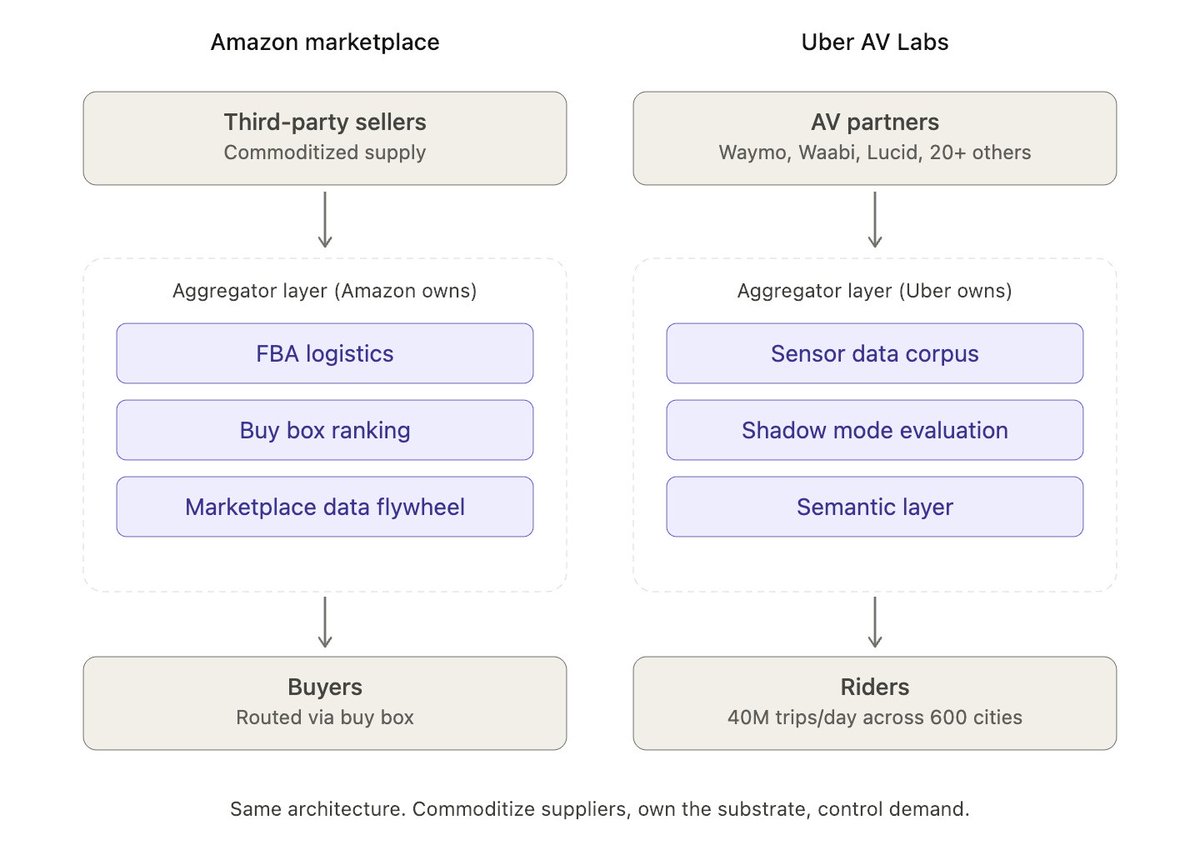
From a strategical lens, it can be stated that $UBER AV Labs is aggregation theory applied to autonomous mobility, and in my humble opinion it's the most underappreciated platform move.
Read past the "data collection" framing. This is Uber positioning itself as the indispensable data and demand aggregator for the entire AV stack. The $AMZN parallel keeps popping up in my head.
The supply-side problem: 20+ AV partners (Waymo, Waabi, Lucid) all need the same input. Real-world driving data at scale. The empirical benchmark is ~10M miles before an operator reaches its first public driverless launch. Tesla solved this with millions of customer cars. Waymo solved it with a decade of head start. Everyone else who is entering the market has a physical-limit problem and to say two manufacturers will run the world's AV ecosystem is very naive.
Now the Amazon analogy. Amazon didn't win retail by making the best products. It won by becoming the marketplace third-party sellers couldn't afford to skip, then quietly owning the layer underneath them. FBA for logistics. Buy Box for demand routing. Marketplace data feeding Amazon Basics. The sellers compete on Amazon's surface while Amazon owns the substrate.
Uber's natural advantage: 40M trips/day across 600 cities. Hundreds of sensor-kitted Ioniq 5s scaling onto the network. Critically, running paid rideshare missions, not test loops, so the data reflects the actual edge cases riders encounter every day. Trajectory: at least 2M miles/month by year-end, scaling through 2027.
Now the Amazon analogy. Amazon didn't win retail by making the best products. It won by becoming the infrastructure that made it economically viable for any seller, large or small, to reach a national customer base. FBA solved logistics. Prime solved trust. The marketplace aggregated demand sellers could not have reached on their own. The pie got bigger for everyone who plugged in.
Uber AV Labs is the same architecture pattern applied to autonomy. Collection inside real revenue trips with no constrained ODD. A semantic contextualization layer, not raw dumps. Long-tail mining of edge cases that AV stacks cannot manufacture in sim. A shared evaluation framework where partner ADS runs in shadow mode and divergences get flagged back. Think FBA for autonomy: shared rails so every partner can commercialize faster than they would solo.
The tell is the pricing decision. Uber is giving this away. Per CTO Praveen Naga, advancing partners' AV tech is worth more than any line item Uber could charge.
Classic platform logic. Grow the ecosystem, grow the pie.
In my humble opinion, this is the real thesis. The data isn't the product. It's something closer to a public good for the AV ecosystem that only Uber can produce at this scale. Every partner that taps in gets safer miles behind them, richer real-world distributions, and a faster path to commercialization than they could ever achieve alone.
Uber isn't selling shovels to the AV gold rush. Uber is building the foundation everyone gets to build on.
Not everyone is a $TSLA or a $GOOG
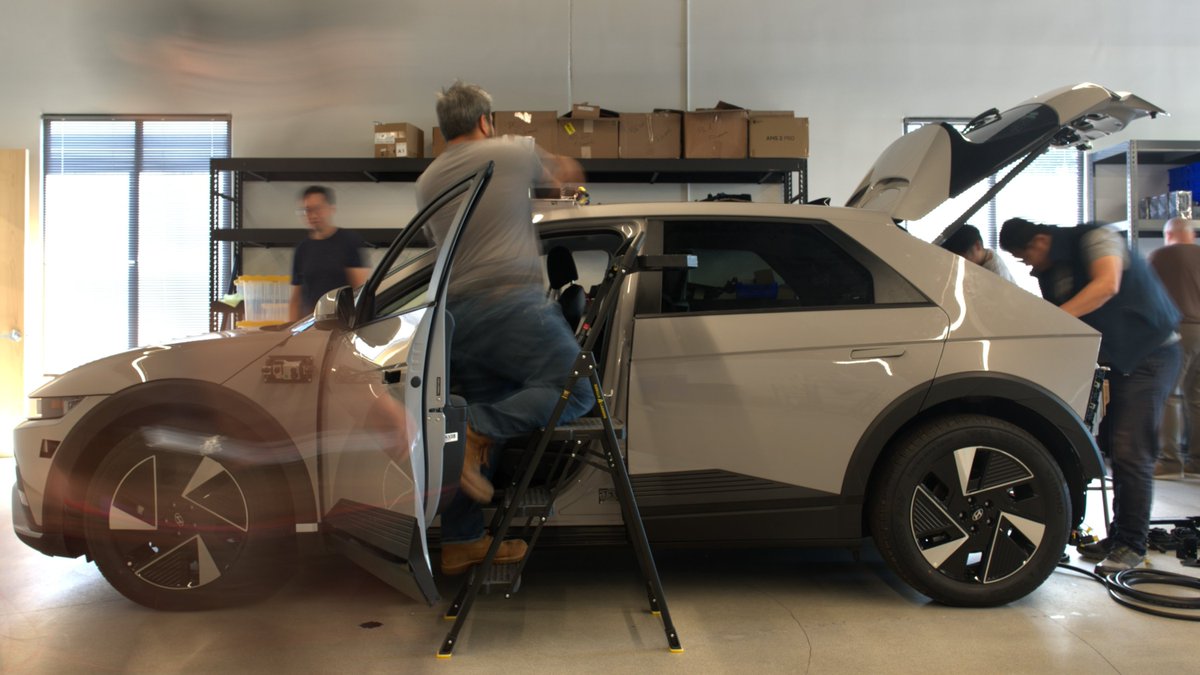
We have been busy bringing our AV Labs fleet to life. Over the coming months, many hundreds of cars fitted with a suite of sensors (cameras, lidars and radars) will be operating on Uber’s network. Importantly, these cars will be generating revenues and completing regular Uber trips - going to airports, driving through construction scenes, navigating congested downtown corridors - getting exposure to the variety of “edge” cases our network handles countless times each day, as we fulfill 40M trips daily.
A common question we have asked ourselves and our partners - how much data is enough data? One way to think about this is that AV operators globally have needed at least 10M miles of data to reach their first public driverless launch. By the end of this year, this fleet will be generating at least 2M miles each month, and will scale further from there in 2027.
For our partners, we will democratize access to data for autonomous development, and we will do so with the best in class data that only Uber can generate.
I appreciate the reply and the thought behind it.
But I think the Tesla CT example actually strengthens the thesis.
If raw data does not move cleanly across stacks, compute, and form factors (agreed, it doesn't), then whoever owns the canonical semantic layer above the raw stream becomes more valuable, not less.
$UBER explicitly says partners don't receive raw data. They receive semantic understanding plus shadow mode divergences. Platform-agnostic at the behavioral level.
On existential threat to the human-rider/human-driver model: completely agree and so does the CEO. The model will shift and be hybrid at first and the gradually more and more AVs will take over in the future. That's the strongest possible motivation for the aggregation play, not a counter to it.
On the margin stack of sensors, software, compute, charging, storage, maintenance all chasing a slice of $2/mile: also fair.
But thin margins are exactly the regime where aggregators win. Whoever routes the most demand to the most fleets survives the squeeze.
And "they don't make cars" isn't a bug of the thesis. It is the thesis. Amazon doesn't make most of what it sells either (and didn't especially when they first started).
Wayve was $UBER's preferred partner in the UK for L4 trials.
Now it's expanding to the US and working with Stellantis in Detroit.
Stellantis owns the following brands around the world:
Abarth
Alfa Romeo
Chrysler
Citroën
Dodge
DS Automobiles
Fiat
Jeep
Lancia
Maserati
Opel
Peugeot
RAM
Vauxhall
I'm in Detroit today for some big news!
Excited to work with @Stellantis to integrate our @wayve_ai Driver into their vehicles, starting in North America in 2028.
Stellantis’ scale + Wayve’s global AI = magic for customers.