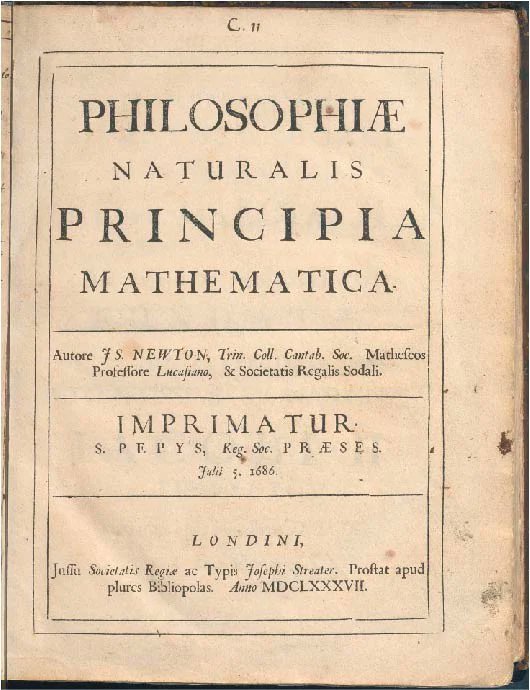
Newton's 1687 preface on Principia Mathematica ✍️
The ancients considered mechanics in a twofold respect; as rational, which proceeds accurately by demonstration, and practical. To practical mechanics all the manual arts belong, from which mechanics took its name. But as artificers do not work with perfect accuracy, it comes to pass that mechanics is so distinguished from geometry, that what is perfectly accurate is called geometrical; what is less so is called mechanical. But the errors are not in the art, but in the artificers. He that works with less accuracy is an imperfect mechanic: and if any could work with perfect accuracy, he would be the most perfect mechanic of all; for the description of right lines and circles, upon which geometry is founded, belongs to mechanics. Geometry does not teach us to draw these lines, but requires them to be drawn; for it requires that the learner should first be taught to describe these accurately, before he enters upon geometry; then it shows how by these operations problems may be solved.
Não, Zumbi dos Palmares não tinha escravos.
Aleijadinho não foi um personagem fictício.
A feijoada não é europeia.
Santos Dumont não era um picareta.
Jogue seu "Guia Politicamente Incorreto da História" no lixo e nunca mais compre nada de Leandro Narloch.
Tem episódio novo do podcast no ar. Entrevista com Margit Weise sobre a atleta recordista, a treinadora de elite e a vitoriosa equipe joinvilense.
https://t.co/EnOhw9NHuC
Philosophiæ Naturalis Principia Mathematica (Mathematical Principles of Natural Philosophy) is one of the most significant works in the history of science.
The Principia*states Newton's laws of motion, forming the foundation of classical mechanics; Newton's law of universal gravitation; and a derivation of Johannes Kepler's laws of planetary motion (which Kepler had first obtained empirically).