A GUY USED AIRPODS PRO 2 FOR 2 YEARS.
HE THOUGHT THEY ONLY DID 4 THINGS: PLAY. PAUSE. CALLS. NOISE CANCELLATION.
THEN A SOUND ENGINEER BORROWED THEM FOR 10 MINUTES.
HE GAVE THEM BACK WITH A LOOK.
“YOU HAVE NO IDEA WHAT THESE THINGS CAN DO.”
A billionaire trader has spent 40 years trying to delete a one-hour documentary. It shows him making $100 million in a single afternoon. He predicted the crash that made it possible three months in advance. He has never explained why he wants the film gone. His name is Paul Tudor Jones. The film is on YouTube.
The documentary is called "Trader." PBS filmed it in 1987, three months before Black Monday. Jones was 32 years old, working from a small New York office, wearing shorts and a t-shirt, yelling at his phones, throwing paper across the room, and sleeping under his desk. The film captures him and his research partner Peter Borish overlaying a chart of the 1929 market on 1987, month by month. The two charts tracked within one percent. Borish said this is exactly what happened in 1929. Jones said if the analog holds, October is when it breaks.
On October 19, 1987, the Dow fell 22.6 percent in a single day. It remains the largest one-day percentage loss in stock market history. That afternoon, Tudor Jones covered his shorts and made roughly $100 million. He was 33 years old. He was one of the very few traders on the street who came out ahead.
He tried to bury the tape because it made him look reckless in a professional world that punished swagger. Twenty years of legal effort did not delete it. Someone kept a copy. It is on YouTube. It has fewer views than most makeup tutorials.
The film is not really about a crash. It is about a specific philosophy of trading. Jones is shown building conviction slowly, sizing carefully, then striking hard when the setup arrives. He is never once shown making a random bet. He is shown doing the same thing five times a day, every day, for three months.
His signature line, repeated across a 45-year career:
"The most important rule of trading is to play great defense, not great offense."
He does not try to be right. He tries not to lose. He sets stops tight, cuts positions fast, and never averages down on a loser. Every trade in the film follows this template.
Tudor Investment Corp, the fund he founded in 1980, has compounded at roughly 19 percent a year for 45 years. He is 71 years old and still trading. His method has not changed since the film.
The lesson: greatness in markets is a refusal, not a talent. Refusal to be reckless. Refusal to be certain. Refusal to average down. Refusal to trust yourself in a drawdown. Tudor Jones has refused those refusals for 45 years.
The tape is free. The philosophy is repeated in every trade. Most traders will never watch it.
Amazon Prime costs $139/year.
Most members use 2 features: free shipping and Prime Video.
That's a $139 subscription doing the job of a $5.99 delivery fee.
J.P. Morgan estimates the actual value of Prime benefits at approximately $1,430/year more
than 10x the membership cost. But most of that value sits unclaimed behind tabs, menus,
and pages 200 million members have never opened.
And 4 of those benefits expire monthly. If you don't claim them by the end of the month,
they're gone. Amazon resets the clock. You paid for them. You lost them.
Amazon is counting on you not knowing.
Here are the 12 Prime benefits most members have never activated including the 4 that
vanish every 30 days 🧵
🚨 SPACEX: THE BIGGEST EXIT LIQUIDITY IN HISTORY
SpaceX is up 70% from IPO.
Everyone is FOMOing hard.
But almost nobody is talking about the real reason.
Only 4% of shares are available to the public.
So they can paint any price they want.
The playbook never changes:
Hold 96% in your pocket.
Drop a few crumbs into the market.
Pull the chart wherever you want.
But now it’s wrapped as "the biggest IPO in history."
And Wall Street has already found their FORCED buyers.
On June 13, SPCX was rushed into the MSCI indices.
This means every passive fund worldwide is now obligated to buy it.
Not because they believe in Elon Musk.
Because that's how the system works:
If it's in the index, you must buy it.
We're talking about $15–20 trillion in passive funds.
Massive forced demand + tiny float = perfect pump.
But the lock-ups are coming:
August: first 20% unlock
November: another big wave
Day 180: everything unlocked
In other words, early investors will exit in 1–2 months, not in 6 months like most people think.
And who will they sell to?
Retail and those funds that were just forced into the stock.
No one is arguing that SpaceX isn't a real company with a real future.
Moon bases, Mars, orbital data centers: all of this might happen.
But not anytime soon.
Right now, something else is happening.
The US stock market is going through a wild overvaluation of everything.
SpaceX is just the biggest example.
They are selling a dream about space today, at a price that won't make sense for another 15 to 20 years.
And as always, the crowd will buy the top just to fund the exit.
Remember, I've called every major turn for the last 10 years, including short BTC from $111K in October.
My next call will be the biggest one this cycle.
Turn on notifications. Most people will follow me too late.
Since this post a week ago:
1. $WYFI +47.25%
2. $RIOT +26.79%
3. $CORZ +24.62%
4. $IREN +37.69%
5. $TE +80.57%
6. $PUMP -11.18%
7. $SHAZ +41.32%
8. $SEI -2.80%
9. $BTDR +49.59%
10. $CLSK +45.69%
11. $HIVE +39.14%
12. $PSIX +12.12%
Ten positions up, two down. Average return of +32.57% in under two weeks. See for yourself.
Next list dropping soon.
Turn on notifications so you don’t miss the next set.
High cortisol is the real reason you wake up at 3-4 AM.
It also shaves 5 years off your life — tanks testosterone, locks belly fat, literally shrinks your brain.
If I wanted to fix it without medication, here are 8 things I'd do every day:
1. No food 3 hours before bed.
This 2 hour Stanford lecture on AI careers will teach you more about winning in the AI race than every piece of AI content you have scrolled past this year.
Bookmark this & give it 2 hours, no matter what. It'll be the most productive thing you could do this weekend.
🚨 In 2019, a MIT lecture revealed something unsettling about your own mind.
Most people never think about it.
It came from Nancy Kanwisher and instead of explaining the brain, she showed how it quietly shapes everything you experience.
Watch it once… and you won’t think the same way again.
Her core idea was simple: your brain doesn’t just process reality it constructs it. What you see, feel, and believe isn’t a direct reflection of the world. It’s your brain’s best guess.
She also explained something deeper: specific parts of the brain control specific abilities. Damage those areas, and entire skills can disappear like recognizing faces or understanding language even if everything else seems normal.
And then there’s the difference between children and adults. Kids’ brains are flexible, constantly rewiring and adapting. Adults? Not so much. As we age, the brain becomes more stable but less forgiving to change and recovery.
Her biggest insight? Your mind isn’t fixed.
It’s built, shaped, and constantly updated by the brain behind the scenes.
That’s why this MIT lecture still stands out.
Because while we trust our perception completely…
It’s often just a carefully constructed story.
INSTEAD OF WATCHING NETFLIX TONIGHT.
Spend 1 hour with this.
Claude AI FULL COURSE that teaches you how to BUILD and AUTOMATE anything.
The people who watch this tonight will wake up tomorrow with a skill that most people will not have in 2 years.
The people who skip it will still be watching Netflix next year wondering why nothing in their life has changed.
Your call.
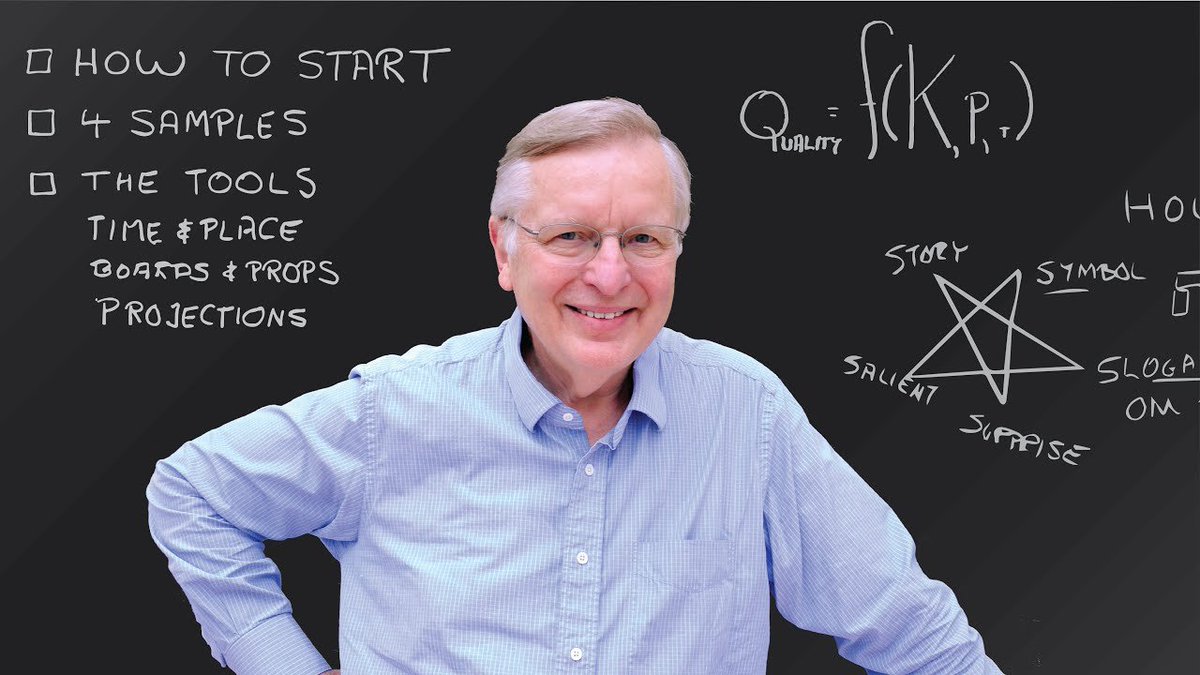
A MIT professor taught the same lecture every January for 40 years, and every single time it was standing room only.
I watched it at 2am and it completely rewired how I think about communication.
His name was Patrick Winston. The lecture is called "How to Speak."
His opening line hit like a truck: your success in life will be determined largely by your ability to speak, your ability to write, and the quality of your ideas in that order.
Not your GPA. Not your pedigree. Not your IQ. How you speak is what separates people who get heard from people who get ignored.
Here's the framework he drilled into MIT students for four decades.
He said never start with a joke. Start by telling people exactly what they're going to learn. Prime the pump before you pour anything in. He called it the "empowerment promise" give people a reason to stay in their seats within the first 60 seconds.
Then he broke down the 5S rule for making ideas stick: Symbol, Slogan, Surprise, Salient, and Story. Every idea worth remembering hits at least three of these.
The part that floored me was his "near miss" technique. Don't just show what's right show what almost looks right but isn't. That contrast is when the brain actually locks something in permanently.
His final rule before any big talk: end with a contribution, not a summary. Don't recap what you said. Tell people what you gave them that they didn't have before they walked in.
I've used this framework in pitches, interviews, and presentations ever since watching it, and the results are not subtle.
Patrick Winston passed away in 2019, but this lecture is still free on MIT OpenCourseWare. One hour, watched by millions, and it costs absolutely nothing.
The most important class MIT ever put on the internet isn't about code or math. It's about how to make people actually listen to you.
keep calling me crazy...but I will keep repeating this..
Claude + SEO is going to make more businesses millionaires in 2026 than crypto ever did.
don’t bookmark this if it crosses your timeline.
Just paste this entire thing into Claude.
thank me later.
🚨BREAKING: A former Anthropic researcher just leaked the internal Claude prompting playbook.
No speculation. No guesswork. Direct from someone who built it.
You're burning 35% of Claude's reasoning capacity with one common mistake.
Here are the 10 prompts they use that nobody outside Anthropic knows about:
🚨 Simulation Theory: The Double Slit Experiment proves particles act like waves until observed then they snap into particles.
What if our reality only "renders" when we're looking, just like a video game optimizing resources?
Check out this episode from The Why Files breaking it down, tying it to Simulation Theory. Are we in a sim?
This could be the key to unlocking the true nature of existence!
The Why Files video did a great job on explaining the Double Slit Experiment & Simulation Theory
What do YOU think—real or rendered? Drop your thoughts below!
I had dinner once with a top physicist and a top computer scientist and asked what they thought the probability was that we were in a simulation.
They answered simultaneously at 0% and 100% respectively. It was like a double-slit experiment, but with humans.
Your Parents Are Getting Older.
30 Things To Do With Them Before Time Moves On.
1. Record their voice telling a story. One day that voice becomes a sound you can never hear again.