PGY-2 at Vanderbilt University Medical Center in the Department of Pathology, Microbiology, and Immunology. My opinions are entirely my own. Be you always.
@cytopathology A5: My favorite case was actually found by my research project. The fluid was in a female with a history of breast cancer, but on examination she had a first time diagnosis of DLBCL with incredibly large, atypical cells. Subsequently, they found a mediastinal mass! #jascchat
@cytopathology A4: Although I don't think there are significantly more positive pericardial fluids in males, as opposed to females, in our patient population, anecdotally I believe I have seen more positive fluids in males. #jascchat#ascejournalchat
@cytopathology@MHoganMD A3: I would say that molecular testing is run on a case by case basis, but an overwhelming majority don't receive molecular testing. I do think this is a fascinating topic of investigation. #jascchat#ascejournalchat
@MHoganMD@cytopathology A2: In my experience on the cytopathology service, most of our pericardial fluids were involved by hematolymphoid malignancies. I was also able to get involved in some research activities where pericardial fluids involved by hematolymphoid processes were characterized! #jascchat
@cytopathology A1: Yes, we get pericardial fluids as apart of our practice at VUMC. It is one of the less frequent specimens behind pleural and ascitic fluids.
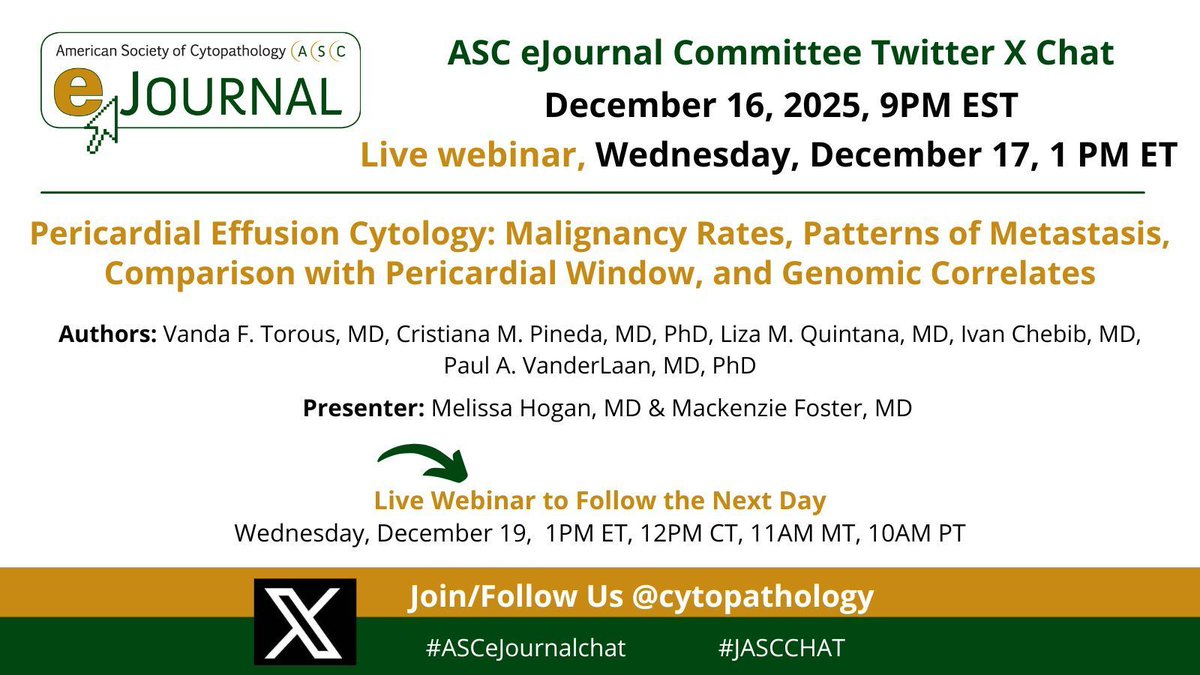
Join us on December 16 & 17, for an engaging and informative eJournal Twitter/X chat and Webinar. Don't miss this opportunity to expand your knowledge, Register now for this free webinar!
Register- https://t.co/6g10AQWM08
#cyto#cytopathology