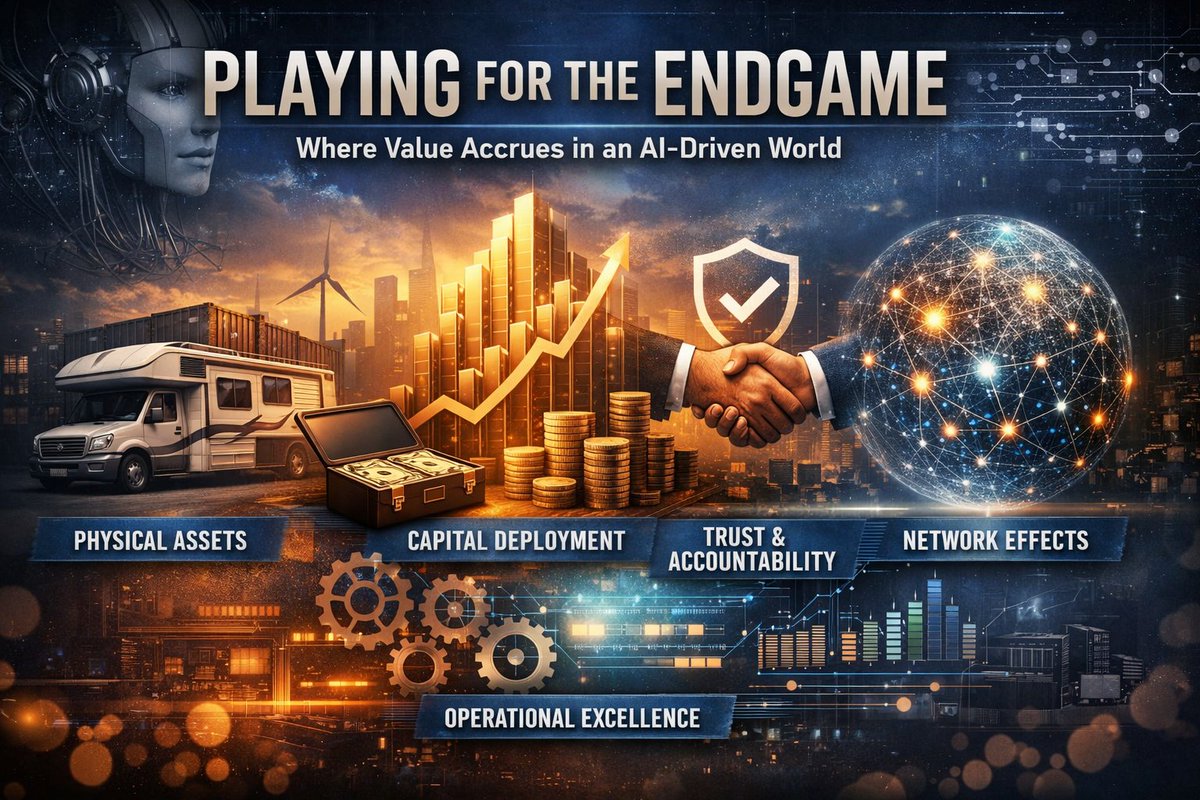
I have a hard time reconciling my bullishness for the AI sector with the massive valuation multiples we see now.
Perhaps in the short term something has to give. While remaining bullish medium-long term as these companies grow into deca-trillion dollar markets.
Meantime, what rallies? The inputs to that hyper-scaled economy is a good bet!
Most people are still playing the early game.
But the game is changing.
I recently read a piece that reframed something I haven’t been able to shake:
The middlegame is disappearing.
The best players are already playing for the endgame.
In a world where AI makes intelligence abundant, faster, and cheaper, the question shifts:
What actually becomes scarce?
A few things stand out:
• Physical assets still matter
You can’t download an RV. You can’t automate away logistics, storage, or maintenance. The real world doesn’t scale at the speed of software.
• Capital becomes a weapon
When everything is more efficient, the ability to deploy capital into real-world assets and infrastructure becomes even more powerful.
• Trust doesn’t go away
When AI can do the work, someone still has to be accountable when things go wrong.
• Network effects compound
Marketplaces win on density, not just technology. Liquidity is earned, not coded.
• Operational depth becomes a moat
AI can replicate intelligence, but not years of hard-won experience embedded in systems and processes.
---
At RV Management USA and https://t.co/ePAUwx4esj, this is increasingly how we’re thinking.
Not just about building software.
But about positioning ourselves where value accrues in the long run.
The intersection of:
• Physical assets
• Capital deployment
• Operational excellence
• Data
• Trust
AI doesn’t replace these. It amplifies them.
If you’re building right now, it’s worth asking:
Does your business get stronger or weaker as intelligence gets cheaper?
That answer will tell you whether you’re playing the early game… or the endgame.
A simple thought experiment to illustrate my point:
The year is 2045, @Strategy has just issued their weekly bitcoin buy report: 214 BTC @ USD21,000,000. (USD4,500,000,000)
All done with 0 immediate dilution through preferred shares.
They continue to do this for 52 weeks straight to generate a ~USD100B gain for the year.
The year is 2075, strategy has just issued their weekly bitcoin buy report: 90 BTC @ USD210,000,000 (USD19,000,000,000)
At the end of that year their BTC yield would be minuscule (4704 BTC) likely <1% of their total stack, but in $ terms the value accrued would be massive -> USD988,000,000,000 ~1T at almost 100% profit.
Its mind binding bit this is what awaits us on a bitcoin standard.
@PunterJeff@_adrian@saylor@dylanleclair@Croesus_BTC@AdamBLiv
A simple thought experiment to illustrate my point:
The year is 2045, @Strategy has just issued their weekly bitcoin buy report: 214 BTC @ USD21,000,000. (USD4,500,000,000)
All done with 0 immediate dilution through preferred shares.
They continue to do this for 52 weeks straight to generate a ~USD100B gain for the year.
The year is 2075, strategy has just issued their weekly bitcoin buy report: 90 BTC @ USD210,000,000 (USD19,000,000,000)
At the end of that year their BTC yield would be minuscule (4704 BTC) likely <1% of their total stack, but in $ terms the value accrued would be massive -> USD988,000,000,000 ~1T at almost 100% profit.
Its mind binding bit this is what awaits us on a bitcoin standard.
@PunterJeff@_adrian@saylor@dylanleclair@Croesus_BTC@AdamBLiv
MSTR trades at just 1.4× NAV.
Massively undervalued.
If it 3× its BTC stack to 1.8M BTC in 10y, that extra 1.2M BTC would cost >$1T.
Discount that back → ~$200–250B PV.
Add today’s $70B stack → ~$300B total value.
Fair value = 3–5× MNAV once future BTC optionality is priced in.
@PunterJeff@Croesus_BTC@ChrisMMillas@_adrian@saylor
I saw. It misses the point that when BTC monetizes and becomes a large part of the economy, incremental BTC accumulation becomes harder and harder as each coin grows in value. In a deflationary context where each coin buys you more future goods and services, you almost have to run the opposite of a DCF since the D (discounted is actually appreciating - A.
It's hard to explain but easier to graph. I'll share a visual soon!
Using Geometric Brownian Motion Monte Carlo simulations, a normal distribution, a BTC ARR of 30% and Vol of 40% there’s a 0.15% probability that at the end of 8 years (the current duration of the lowest instrument in the capital stack) that MSTR has less collateral than the notional capital outstanding.
This equates to a 1 in 667 year return period probability (incredibly unlikely).
Also assuming a normal distribution, there’s an equal probability that MSTR is holding $13.3 TRILLION on the balance sheet at the end of the duration period (8 years).
That is the probabilistic downside and upside curve, I.e. how a risk analyst would underwrite this product.
I used to think MSTR’s Bitcoin playbook would hit an asymptote—fixed supply, nothing left to buy. But the game doesn’t end there. As long as they can raise capital, they can buy back their own shares. That means Bitcoin per share can keep rising indefinitely. ♾️
the amount of founders is going to 10x in the next 10 years
it’s the perfect storm of
- white collar jobs getting decimated due AI
- non-tech people can ship ideas now
- starting a company feels safer than staying employed
- people are EATING up entrepreneurship content (vids etc) and it's motivating them
- social media makes it easier to distribute any product
- digital products are easier businesses to start than physical ones (less starting costs, stand on the shoulders of giants like stripe, shopify, openai etc)
we're returning to the default state: most humans working for themselves.
maybe employment was the historical anomaly?