50 legendary internet rabbit holes you can spend hours exploring👇
1. https://t.co/BKQKtCoHx7 — Watch the world via live satellite imagery
2. https://t.co/skHM6ihO1M — See every plane currently in the sky
3. https://t.co/3wHLr5BTqs — Track all ships at sea in real time
4. https://t.co/wneZoYkXVV — Live map of winds and storms
5. https://t.co/th5qTv4uYt — Watch lightning strikes hitting Earth in real time
6. https://t.co/ugJruuA2MX — Live list of recent earthquakes
7. https://t.co/KjzFm8Mv5H — Ocean cables carrying the internet
8. https://t.co/ihBKAFPlqM — Watch forests disappear from space
9. https://t.co/QO76fqkPBq — The world's statistics, second by second
10. https://t.co/6aNOFkpEaE — Current number of tweets and searches being posted
11. https://t.co/Ng5YgeOtoO — Compare the true sizes of countries
12. https://t.co/8nxdhZQnea — Maps from centuries ago
13. https://t.co/KxBUC8vkvs — Archive of 150,000 historical maps
14. https://t.co/jCKAhsYH7r — World map drawn by volunteers
15. https://t.co/d5QWs5njpu — Look out the window of a random person around the world
16. https://t.co/RKjjmyqV5D — Virtual walks through cities
17. https://t.co/foY7sojylA — Teleport to a random spot on Earth
18. https://t.co/ZJ889iuSUd — Catalog of the world's strangest places
19. https://t.co/wVGZkiJ20o — Interactive knowledge experiences
20. https://t.co/j1VNMfYDcy — Scale journey from atom to universe (Updated HTML5 link)
21. https://t.co/CvOBtl9Vm8 — Explore the solar system in 3D
22. https://t.co/RnlofaWs0Q — Real sky map in your browser
23. https://t.co/1PlQgAjbMU — NASA's astronomy picture of the day
24. https://t.co/2RuTZvWdt3 — NASA's entire visual archive, free
25. https://t.co/beEkHBgT5l — Visual articles told through data
26. https://t.co/RMccQyBARG — The state of the world with real data
27. https://t.co/gNH6mlzyjF — What we mistakenly think we know about the world
28. https://t.co/ZrVElnYKY2 — Visualizing complex data
29. https://t.co/ahtXNpo1de — World Bank's open data
30. https://t.co/ShMYouw5GP — Turkey's official statistics database
31. https://t.co/GqEd2SxdGe — Archive of millions of books, films, and software
32. https://t.co/8ijFqv85Ff — 70,000 free books whose copyrights have expired
33. https://t.co/Gt6dp7gGNG — Record of every book in the world
34. https://t.co/LogFrI4LvX — U.S. Library of Congress digital archive
35. https://t.co/O9XxbTPkbZ — Europe's cultural heritage archive
36. https://t.co/lQg0HnHYrx — America's digital library collection
37. https://t.co/TcOIZ5l4tt — Tour museums from home
38. https://t.co/6wMBrfTaPl — Download artworks in high resolution
39. https://t.co/trYjdzxThm — Archive of 250,000 artworks
40. https://t.co/Jgz9Abg2UC — Forgotten visual treasures of history
41. https://t.co/y4axNFEMBi — Free archive of culture and education
42. https://t.co/wkw7PgTFlB — Met Museum's open collection
43. https://t.co/AZ98yxOlXC — Family tree of music genres
44. https://t.co/UWyCzSQMRQ — Pick a country and decade to listen to that era
45. https://t.co/Q0NMpm9XqQ — Turn Wikipedia edits into audio
46. https://t.co/lT2YvOjawm — Random knowledge well
47. https://t.co/tukI2JCMXp — Time, sunrises, and sky events
48. https://t.co/A8xsuxYqHd — Live stream of science news
49. https://t.co/RrqPEgwNK3 — Free preprints of scientific papers
50. https://t.co/4ZyBN6Hpdk — Visualize data with live code
Save this. You’ll definitely need some of these later. 🔖
Follow @justinbrave21 for more useful websites, AI tools & tech resources.
Secret to the Iran war? Take a listen to Lindsey williams in 1991 author of the energy non-crisis (a book @QuiteFranklyTV mentioned)
↗️↗️Iran was going to break the petrodollar and show oil is unlimited.
https://t.co/tOmlNopk4M
https://t.co/6QdfvGwlCe
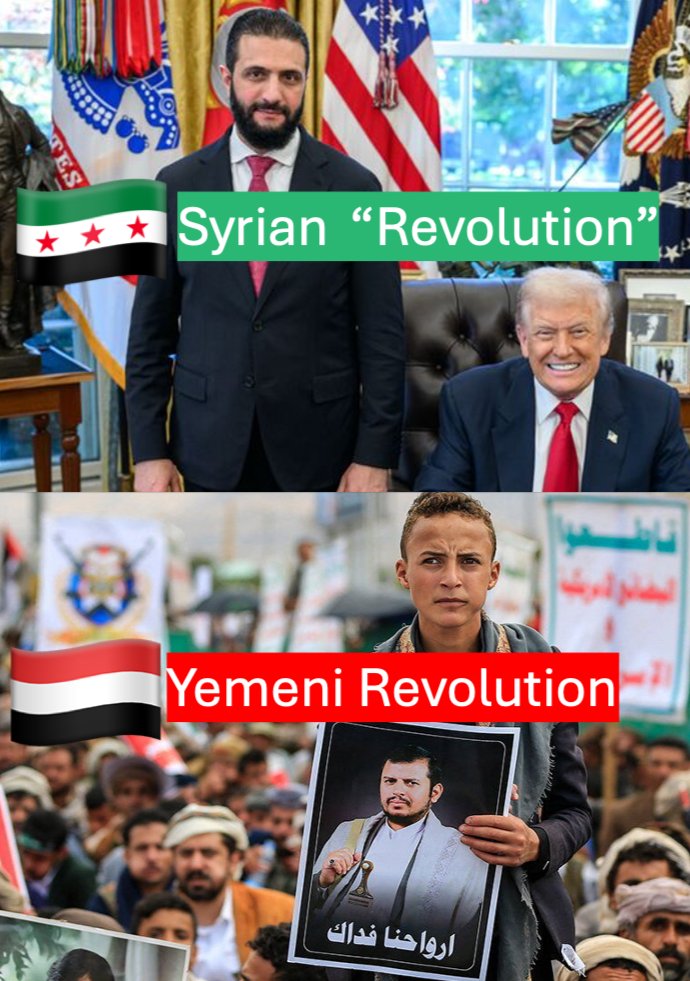
🇸🇾 🇾🇪 There's no greater contrast between REAL and FAKE revolution than the contrast between Ansarullah in Yemen and al-Qaeda in Syria.
In Yemen, the revolutionaries never took up arms against the state, the state took up arms against them by killing Hussein al-Houthi because they hated his speeches against the US and Israel.
In Syria, the "revolutionaries" went straight to insurgency in March 2011 with very little politics in between, and with significant foreign support in terms of weapons, salaries, foreign fighters, and sanctions.
In Yemen, the state launched wars against the revolutionaries because their message was gaining in popularity, which only made them more popular, to the point where around 70% of the Yemeni state and army accepted Ansarullah's bloodless march on Sana'a.
In Syria, the "revolutionaries" waged war against the Syrian state for 13 years, sending ~240k Syrian men into the meat-grinder on both sides, and received weapons, funding, foreign fighters, and sanctions on Syria al-Assad to help them do it.
In Yemen, Ansarullah's justification for taking power in Sep 2014 was that Hadi was committed to giving 14% of the population (all Sunnis) something like 90% of the natural resources, which would deprive the majority of Yemenis; and also that Hadi cut fuel subsidies.
In Syria, al-Qaeda never articulated a coherent national or class interest case against Assad's govt. Their justification for waging war against the state was the accusation that Assad is an Alawite and therefore an apostate because Alawites believe Ali equals God or something - obscurantist 'takhaluf' basically.
In Yemen, most of the death-toll came from the attempts of the US-GCC coalition to reverse the gains of the revolution by starving Yemen with a blockade. As a result, 377k Yemenis were killed from 2015 to '21 - 70% children under five according to the UN.
In Syria, most of the death-toll came from the war against Assad's government - 600k Syrians killed, but maybe 89% of them were armed combatants on both sides - if you assume adult male non-combatants equals the number of adult female non-combatants.
In Yemen, people living under the rule of the revolutionaries were starved by the US-GCC coalition, whereas in Syria, people living under the rule of the government were starved by sanctions intended to aid the "revolutionaries" - which they did.
In Syria, the "revolutionary" war by al-Qaeda against the Assad's government severely degraded and weakened the Syrian state and army.
By 2011, Syria had 600k soldiers, dense air defences, chemical weapons, and a nascent nuclear program. Today Syria has probably 80k militia at best, no air defences, no missiles, no chemical weapons, no nuclear program, no conscription, and cannot recruit Alawites or Druze.
In Yemen, Ansarullah strengthened Yemen's military capabilities, pioneered drone warfare, then took direct action for Palestine against Israel.
Front 1: Within Israel (WB+Gaza)
Front 2: Lebanon
Front 3: Syria
Front 4: Yemen
Front 5: Iraq
Front 6: Iran (Hormuz, etc.)
Front 7: North Korea
How deep does the US want to go?
🇬🇧 Netflix tiene unas cuantas series británicas estupendas que han pasado bastante más desapercibidas de lo que merecen.
Thrillers, espionaje, misterio y hasta superpoderes con acento londinense.
👇 Aquí van 6 para descubrir.
@KennedyMmari Mzee how about the cost??...
U pump in those thousands of troops then what??.... iran yes wanaweza kujilia mafuta.. bt Afghanistan faida ilikuwa nin?? As the day goes then we realise not Taliban who was behind 9/11...