We're proud to announce that Ripple USD ($RLUSD) is now officially available in Japan, following approval from the Japan Financial Services Agency (JFSA): https://t.co/ChkYMQ6kxW
Through our partnership with SBI Group and @sbivc_official, $RLUSD will be accessible to both institutional and retail users via the VCTRADE platform, serving as a bridge for payments, tokenization, and collateral management.
With $1.7 billion in market cap and a 10-year relationship with SBI, this is a significant milestone in advancing regulated stablecoin adoption across Asia.
🚨 JPMORGAN JUST FILED FOR "DIGITAL SHARES." 🚨
The filing states:
"Digital Shares are expected to be purchased and held primarily through financial intermediaries that intend to use blockchain technology to maintain a record or mirror record of share ownership for their customers."
READ THAT AGAIN.
Digital Shares.
Blockchain technology.
Ownership records.
SEC filing.
JPMorgan.
If this sounds familiar, it should: enter BLACKROCK
Last year: BlackRock introduced DLT Shares for its Treasury Money Market Fund.
Today: JPMorgan filed a Money Market Fund prospectus containing remarkably similar language.
Not a crypto startup.
Not a blockchain conference.
Not a whitepaper.
JPMorgan. SEC filing.
The filing references:
• Digital Shares
• Blockchain technology
• Cryptography
• Electronic-trading platforms sponsored by JPMorgan
• Blockchain-based ownership records maintained by financial intermediaries
The phrase that jumped off the page to me:
"...record or mirror record of share ownership..."
Why does that matter?
Because it suggests a hybrd model.
Traditional books and records remain in place while blockchain-based records operate alongside them.
Old system + New System.
Running together.
Which is exactly how major financial infrastructure migrations typically happen.
For months, I've been saying these aren't separate stories:
Stablecoins= the cash layer.
Tokenized Money Market Funds = the yield-bearing cash layer.
Tokenized Treasuries = the collateral layer.
The market keeps treating them as separate trends.
The filings increasingly suggest they're becoming one system.
Stablecoins are largely backed by Treasuries.
Money Market Funds increasingly hold Treasuries.
Tokenized Treasury products are built on Treasuries.
At some point, these stories converge.
The real battle isn't XRP vs ETH, ETH vs. SOL.
It's ownership records.
Collateral.
Liquidity.
Settlement.
The plumbing.
BlackRock put blockchain-based ownership records into a Treasury MMF structure.
Now JPMorgan is using very similar language in its own filing.
That's infrastructure. Not reinventing the legal wheel.
That's the world's largest financial institutions silently building the next version(s) of our financial system—one ownership record at a time.
$BTC $XRP $SOL $ETH #crypto
🚨NEW: Some color on Wednesday’s meeting between law enforcement groups, administration officials and Congressional members and staff on the Clarity Act:
📌 The meeting was hosted by @patrickjwitt and the White House Crypto Council in the Eisenhower Executive Office Building. Around 20 attendees were present, including @GOPMajorityWhip and @DavidSacks who delivered opening remarks before departing. Also in attendance were officials from @USTreasury, @FinCENnews, Senate staff and @DAGToddBlanche office.
📌 On the law enforcement side, attendees included the Fraternal Order of Police (@GLFOP), National Association of Police Organizations (@NAPOpolice), International Association of Chiefs of Police (@TheIACP), the National District Attorneys Association (@ndaajustice), and the National Association of Assistant U.S. Attorneys (@WeAreNAAUSA). The National Sheriffs’ Association (@NationalSheriff) was invited but did not attend.
📌 Sources tell me the meeting consisted of almost 90 minutes of substantive discussion and debate, much of it focused on the Blockchain Regulatory Certainty Act (BRCA).
📌 Potential solutions to strengthen crypto crime reporting and enforcement tools were also discussed as lawmakers and stakeholders continue working to build support for the legislation.
Ultimately, these groups will need to signal to Democratic senators like @CortezMasto and @MarkWarner that they are not opposed to the bill’s parameters, including the BRCA, to secure their votes on the floor.
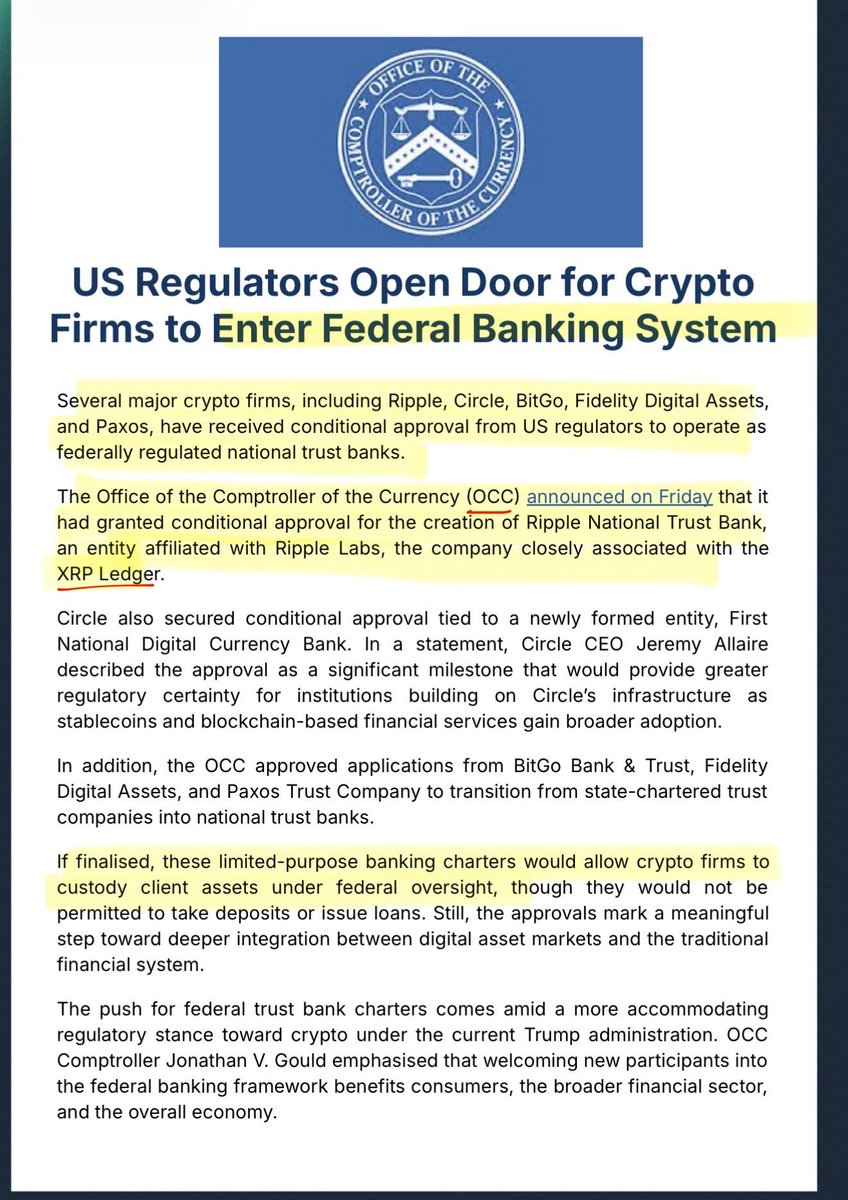
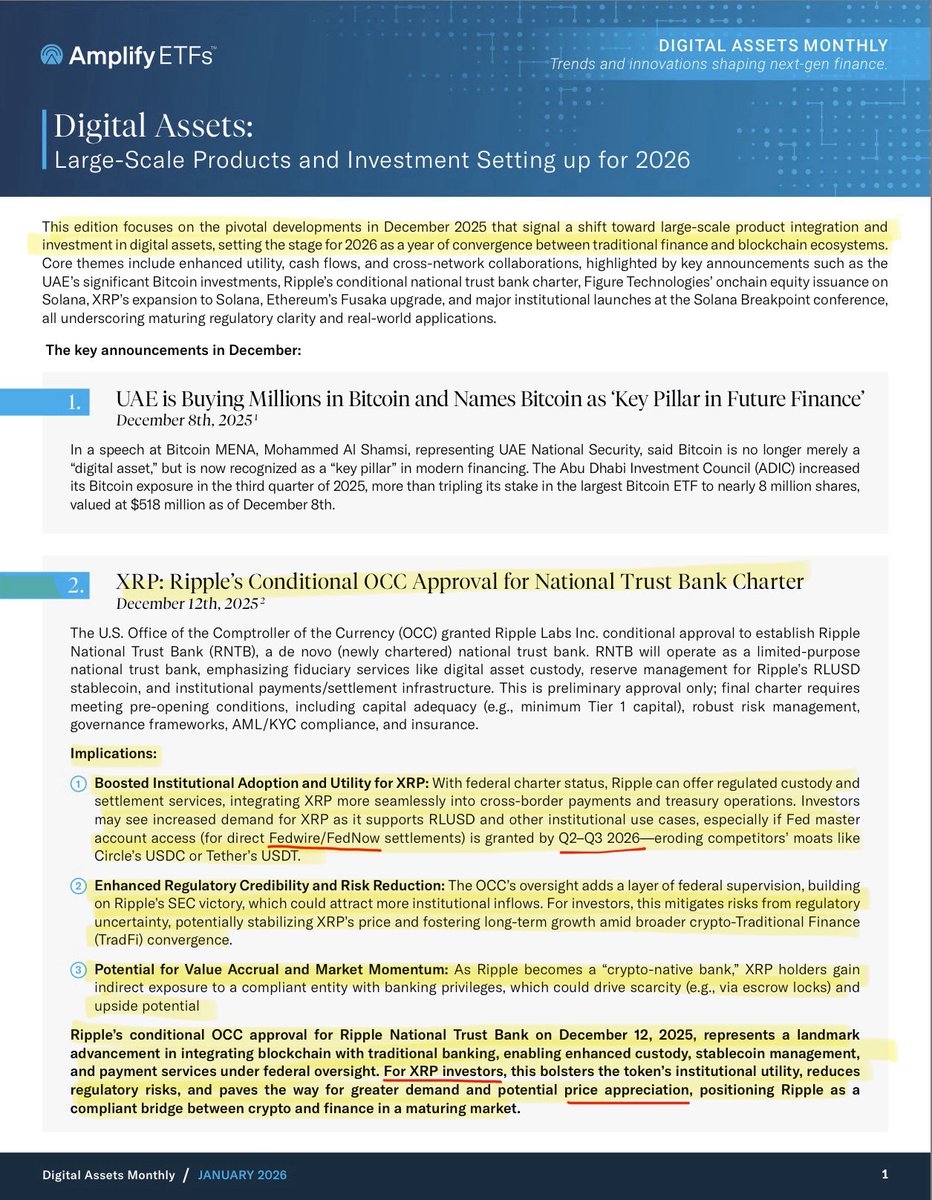
‼️ THE APPROVAL OF RIPPLE’S BANK CHARTER WILL ENABLE XRPL INTEGRATION WITH FEDERAL SERVICES BY Q2–Q3 2026‼️
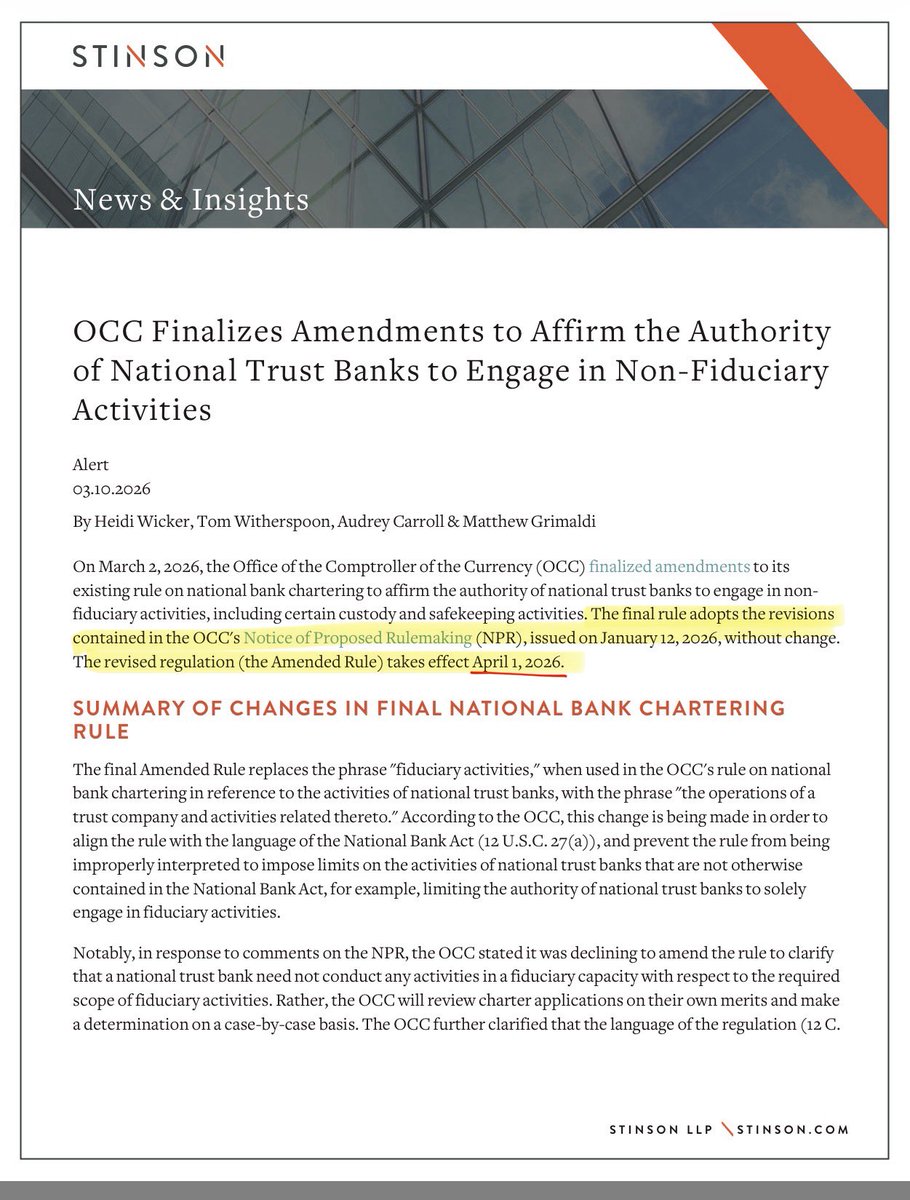
Remember, the OCC is introducing new digital asset amendments April 1st 2026.🙇♂️
April 1st is the first day of Q2 2026.😏💨
Meanwhile, Amplify ETF forecasts that XRP will undergo significant integration into Federal Payment rails such as FedNow and FedNow in Q2-Q3 2026.🎯
Right on schedule.⏰
This is all documented below.📝👇
🚨 BREAKING: U.S. SENATORS REACH BIPARTISAN DEAL WITH WHITE HOUSE ON STABLECOIN YIELD DISPUTE
The CLARITY Act just cleared its biggest hurdle.
Senator Thom Tillis (R-NC) and Senator Angela Alsobrooks (D-MD) confirmed Friday they have an agreement in principle with the White House on stablecoin yield language that stalled crypto market structure legislation for months.
"Sen. Tillis and I do have an agreement in principle," Alsobrooks said. "It will allow us to protect innovation, but also gives us the opportunity to prevent widespread deposit flight."
Tillis added: "In working with the White House, I think we have an agreement. Now we have to vet it with industry, because they are a party to an ultimate deal."
The bill could now move to a Senate vote within weeks. If passed, it would end regulation by enforcement and bring clearer rules on token classification, intermediary standards, RWA tokenization, and small transaction tax clarity.
The House passed the CLARITY Act in July 2025. The Senate version has been stuck in Banking Committee over the stablecoin yield fight between banks and crypto firms. That fight may now be over.
After more than a decade of uncertainty, this interpretation will provide market participants with a clear understanding of how the SEC treats crypto assets under federal securities laws.
This is what regulatory agencies are supposed to do: draw clear lines in clear terms.
3 continents, 4 global office visits, 5 days. Crossed too many time zones to count...
Recently, @MonicaLongSF and I (along with others on the Ripple leadership team) traveled to Dublin, London, Singapore and Sydney to meet with the Ripple Team (many of whom joined from our acquisitions of GTreasury, Hidden Road, Rail, Palisade and Solvexia).
A few notes from the road -
1/ centers of gravity (business and/or employee) are never stagnant, and getting out of the US coastal mindset is imperative. It was incredibly energizing to hear from new and longtime Ripplers on what moves the needle where they are.
2/ Culture cannot be taken for granted. More than ever, we’re championing a maniacal focus and eliminating bureaucracy for employees to be owners. Don’t confuse activity with progress.
3/ Adoption doesn’t happen overnight. Platforms > point solutions. Meet customers where they are, not where they might be in a couple years.
4/ AI is becoming a fundamental part of our products – especially in cash forecasting and liquidity management in real-time for the office of the CFO. Employee productivity may be where AI starts, but the end goal is much bigger.
5/ 2026 is shaping up to be another defining year. We’re in the right markets with the right capabilities across payments, custody, liquidity and treasury management. There's a huge opportunity ahead, and we are making sure XRP is at the center of it.
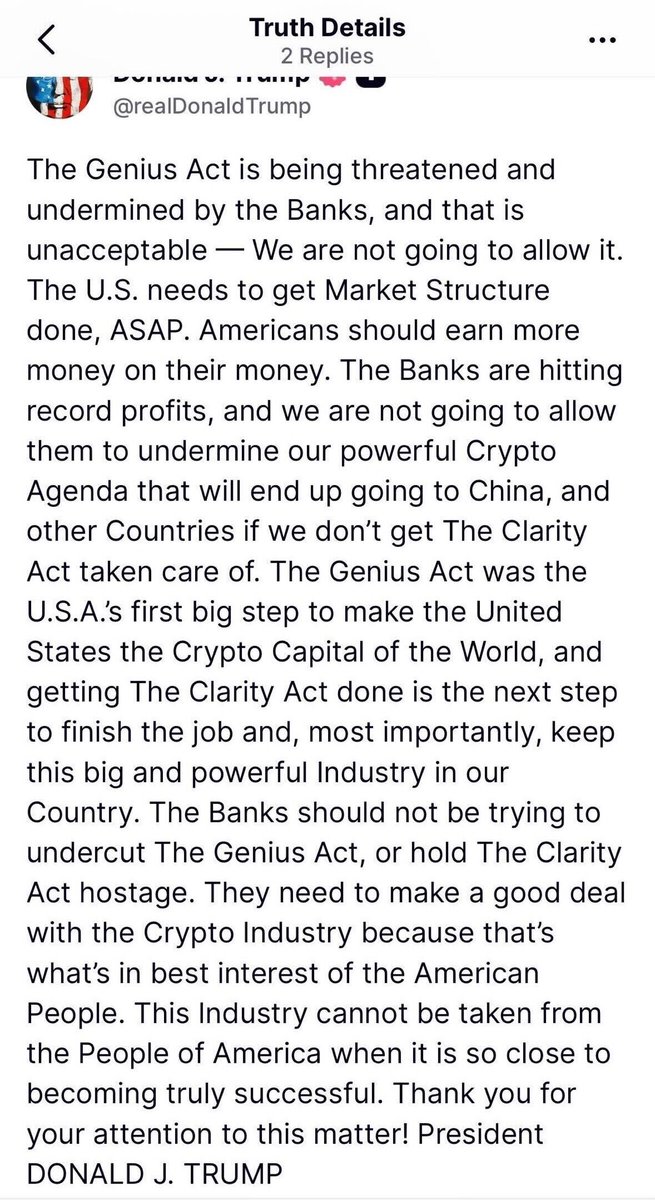
An extremely pointed message from @POTUS to those who are dragging their feet on CLARITY.
This is, and always has been, about what’s in the best interest of the American people.
In 2016, I worked on NDA drafts and briefing materials where banks and government stakeholders were already discussing the long term implications of quantum computing. The concern was specific and technical. Public and private key cryptography, as it underpins most blockchains today, was understood to be vulnerable once quantum capability reached a certain threshold.
There were structured papers outlining attack surfaces, timelines, and systemic risk. The conclusion was uncomfortable but clear. Any ledger that relied exclusively on static secret keys as the sole proof of control would eventually face an existential problem.
What stood out in those documents was a distinction made around the XRP Ledger. It was not presented as fixed architecture, but as an adaptable system. There were detailed discussions around moving away from keys as the ultimate authority and toward identity based proofs. Human linked credentials. Verifiable identity acting as the access control layer to the ledger itself.
At the time, many in the room viewed that idea as premature. Conceptually elegant, but far ahead of what technology and regulation could support. Some dismissed it as unrealistic.
Today, that assessment looks very different.
Identity, credential frameworks, and advanced authorization models are now actively being developed on the XRP Ledger, with Ripple and some emerging protocols playing a central role in that evolution. What once appeared theoretical is now being engineered in practice.
What was discussed quietly in 2016 is now visible in the direction of development.
From a risk and resilience perspective, that matters. When quantum computing becomes operationally relevant, systems that cannot evolve beyond key based security will be under pressure. Systems designed to transition toward identity anchored control will be far better positioned.
Based on what I read then and what I see being built now, I remain confident that the XRP Ledger was designed with that future in mind.
Guys, I got grilled today by a few people asking why the hell I would sell XRP at $27.
Bro, I am 100% taking profits on XRP at $10, $27, and at higher targets beyond that.
Crypto has consumed my life for the last five years, and at times it’s taken me out of the real world, so I am intentionally laddering out certain portions to put actual cash / RLUSD in my accounts and live in reality.
You have to take profits at some point.
If you think that’s crazy, that’s fine > you can go on the journey of never selling > but one of the biggest mistakes I made over the last five years was not taking profits, and I regret that deeply.
I’ll be laddering out at certain points for my own life, while still keeping a position. I’m not selling everything > I’m just being disciplined and laddering out along the way, moving portions into RLUSD so I have capital to buy a home, look after my family, and build in the real world.
The moral of the story here > there is nothing wrong with taking profits. Having negativity toward someone for securing gains is strange behavior. The whole point of this journey is to actually improve your life, not just watch numbers go up on a screen.
@Bird_XRPL You will never go broke taking profits!!! Same set up, 5% @ $10
5% @ $25 10% @ $40 etc and Hold A Forever Bag at least 50%
Those who have held for years will understand. Nice Bird 🐦