Yes, fair point, but given earnings have been the highest of the three “locks” in 5 of the last 7 years (I.e. post Covid) it’s probably fair to think that earnings is the most expensive lock to keep.
Thinking out loud I’d have thought that wage demands are more aligned to RPI (which has been ~1.5% over CPI on average over the past 5 years)…with an obvious caveat around bargaining power due to labour market tightness.
The cynical side of me thinks the reason for picking CPI and 2.5% is that the OBR forecasts 2% long term inflation and so forward calculations will be based off 2.5% going forward, much lower than recent years and in turn see Burnham/Healey being “awarded” more fiscal space.
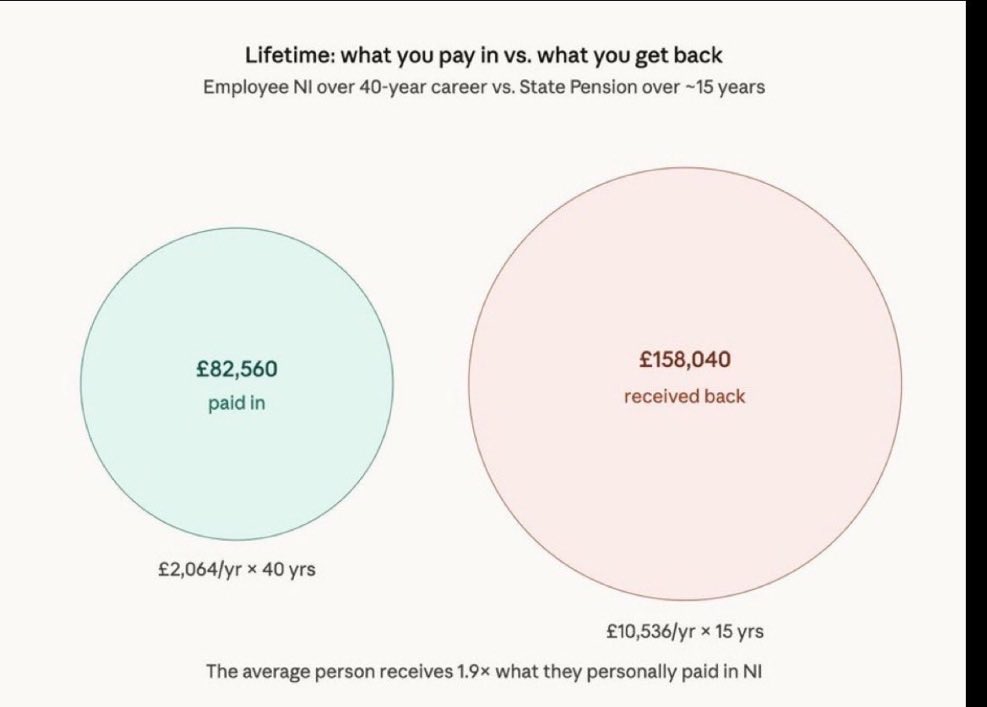
1. The notion that what you pay in creates a pot you get paid out is false (see chart below). If that’s the case we should be reducing state pensions to match what goes in.
2. State pensions are a form of benefits. People who have “paid in” generally don’t need more money from the government and it sounds like your view is that people that haven’t paid in probably shouldn’t get more anyway?
Only about 5% of UK pensioners rely solely on the state pension. A further 7% rely on state pension + additional benefits.
70% rely on state pension + private pension (as a result of employer contributions from having worked).
What you seem to be saying is we should form national policy around 5% (or maybe 12%) of the pension age population? And that is a group that are likely to have not contributed during their working age life…contrary to your first reply, your viewpoint sounds pretty socialist/communist to me!
And I reiterate. State pension is estimated to cost the govt £168.7 billion a year by 2029/30. Foreign aid will be 0.3% of GNI, so around £10 billion. Just cutting foreign aid doesn’t fix the problem. Whether you agree with cutting foreign aid or not isn’t the point, the point is that even if you do want to cut it to zero, there are other cuts that need to be made.
@kennym1958@tomhfh That’s a separate issue, but this is not a case of either/or. The current fiscal situation is totally out of hand and savings need to be made across the board, it should be an “you should also” discussion rather than an “alternatively” discussion.
I never said it was a living wage. That said, why should it be? Pensions are a form of state benefit, not a wage made in exchange for work.
It has nothing to do with the dead? And if anything is “robbing” the young to give to the elderly.
A pension system is a form of socialism, and your desire to make it larger sounds like a move towards a more communist solution. Your argument seems confused.
I never said I was talking in absolutes, just the relative differences (hence indexing). By nature, a rule that includes CPI and “A.N.Other factor” in a double/triple lock has to outperform inflation. For what it’s worth, CPI using the same indexation is 155.4, so the real terms increase has been solid too.
Although I don’t disagree with the sentiment, YoY wage growth for a single month is a pretty arbitrary measure. Public sector pay has lagged that of private sector for a while so some “catch up” could even be argued as “fair” (in some roles).
The issue I think is that levels of competence across much of the public sector “trade under” those in the private sector. So there’s a chicken and egg situation if you want to attract better people.
Rather than paying public sector workers less, I’d suggest a better first step would be to reduce the number of people. In most cases cutting the bottom 10% would probably achieve better outcomes anyway!
A more punchy solution is, adjust pensions so they get paid more up front, rather than in retirement (net cost of zero), give a further 10% pay rise and then cull the bottom 20% (of course this doesn’t work across police, NHS, etc. but would likely do a good job in the civil service!)
Isn’t questioning this implicitly a gross oversimplification? The absolute level of rates differentials matters as does the relative level (vs other currencies) but also other factors including investment income, growth differentials, equities, psyche/perception, terms of trade, volatility, etc all play a part (the list goes on)
Agreed. Today's whacky report is a good example of the need to look across various measures. Aside from recent shifts in population, excessive focus on UR also opens analysis up to noise via LFPR (something weird going on in the 25-34 category in today's data) which likely made the UR look better than it "should" while making Prime Aged EPOP look worse than it "should".
If nothing else, the widening wedge between the employment level in the Establishment vs Household surveys should be enough to make all of us think a wider lens is needed in analysis at the moment. Obviously differences in definitions, scope and estimates/assumptions/models, but even so, open mindedness required
The modal age at death in the UK is 86.7 years for men and 89.3 years for women. So say 88, in which case the rate is ~42%.
Also, as much as you're arguing that the rate is not impacted by inflation or rate of return, what matters is the tax take over time and that is impacted by rate of return.
So yes, a fair point that his rough calc is a bit off, but the broad point still stands.
As a side note, for a supposedly "world beating trader", Gary Stevenson's lack of understanding of stock vs flow is hilarious.
First of all, what matters is Iranian oil as a % of Chinese imports (which are ~13%). Second are you implying China is going to get involved kinetically? I see a scenario to Chinese involvement diplomatically or via “REE restrictions due to military use” but direct military involvement is highly unlikely.