The Reserve Currency Doom Loop (and Why Gold & Silver Win) 🧵
The US debt problem isn’t a spending problem.
It’s a reserve currency problem.
And it ends the same way it always has—with currency debasement and hard assets outperforming.
What’s really going to bake your noodle later on, is realizing that rate hikes are not nearly as effective at dealing with deficit-driven inflation as they are at dealing with lending-driven inflation.
Look, I know none of this stuff matters anymore. But my G*d.
This will be the 4th time the S&P 500 $SPY has hit a record high while 5% of its members fall to 52-week lows.
1. July 1929
2. January 1973
3. December 1999
4. Today
Paul Tudor Jones says the US is more dependent on equity prices than ever, and explains what a 35% correction would trigger in the economy:
"We're 252% of stock market cap to GDP. In 1929 we were 65%. In 1987 we got to ~85-90%. In 2000, 170%.
If you think about the periodicity of significant bear markets. Since 1970, we get a mean reversion about every 10 years.
Let's say mean revert to the past 25 or 30-year PE. That would be a 30, 35% decline. Well, 35% on 250% of GDP is 80, 90% of GDP.
10% of our tax revenues are capital gains, they go to zero. So you can see the budget deficit blowing up. You can see the bond market getting smoked. You can see this kind of negative self-reinforcing effect.
In the stock market, we're over-equitized as a country. We have the highest individual equity weightings in the history of the country.
And then the real problem is if you look at private equity in 2007-2008, that was about 7% of institutional portfolios. Now it's about 16% of the institutional portfolios. We're so much more illiquid than we were in 2008.
The problem is that if you buy the S&P at this current valuation, the 10-year forward return is negative when you buy the S&P with a PE of 22. That's what history shows.
So yes, the S&P is spectacular long-term, if you have a hundred-year view. But that's because that's an average of a hundred years, including times when the S&P 500 PE was 6, 7 and 8, or one third of what it is right now.
Valuation matters a lot, and the stock market's really high and it's gonna be really hard to make money from here with any kind of long-term view."
That + Opex give equities a bullish bias for this week. When inflation shows up in the numbers from Oil supply shock expect them to selloff again, the later growth/demand shock that will come as consumer spending numbers look worse and inflation drops due to this will likely prompt a policy response that reignites inflation along with a labor market that is hurting and send equities way down and boost stagflation fears again.
Watch bank stocks (XLF/XLU at 52-week low) vs credit (HY OAS 3.17% widening but complacent).
Equity bank weakness leads credit stress historically.
If Financials continue to struggle, HY OAS can widen quick and broader equities should re-rate lower fast.
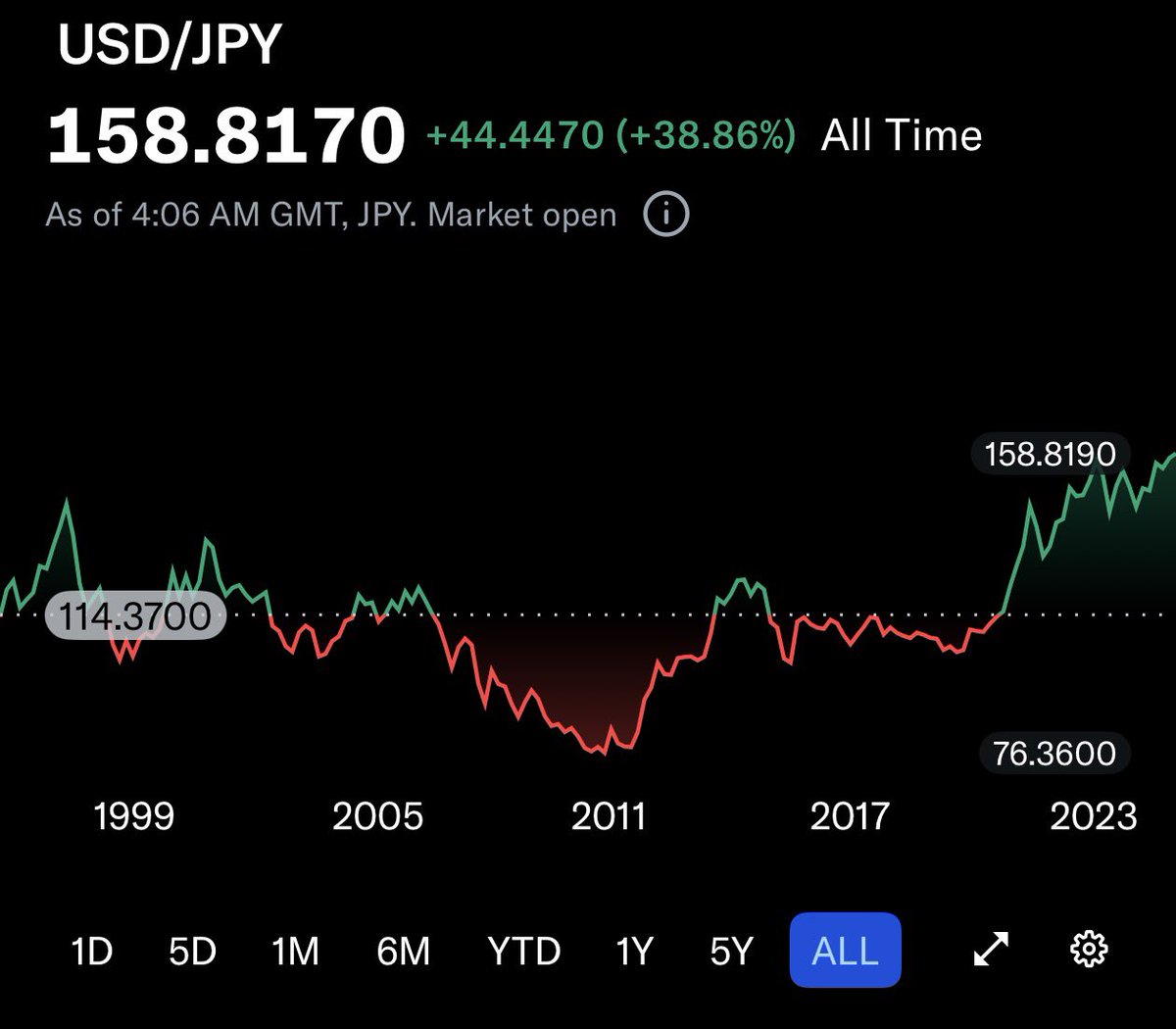
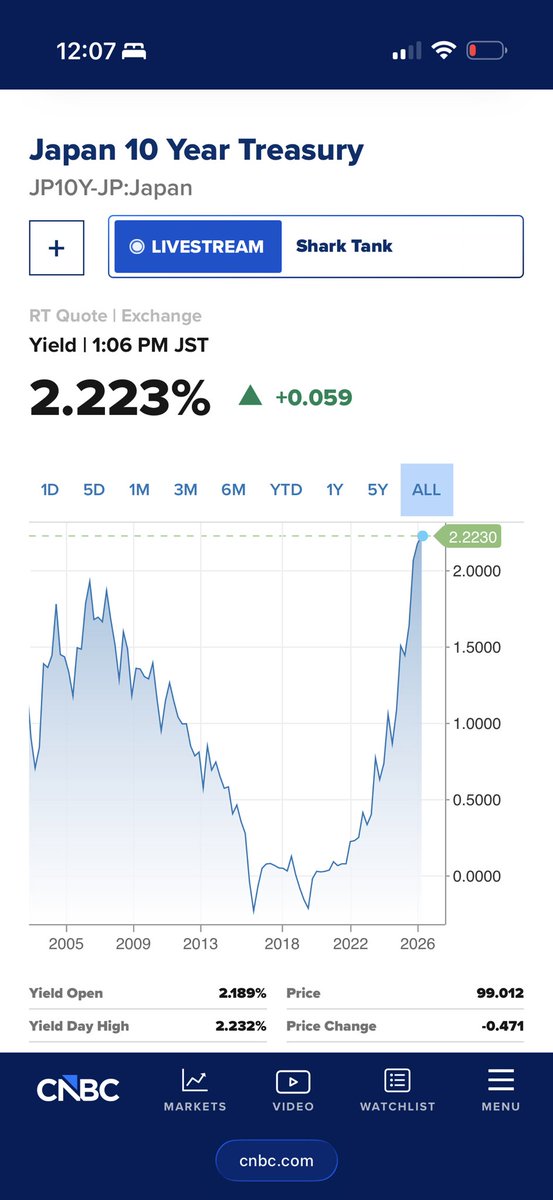
Many focused on the war, but Policy pressure on the BOJ to tighten should build as imported energy inflation rises and FX weakness becomes costly.
JGB 10Y yields climbing. USD/JPY near multi-decade extremes.
A shift could pressure $EWJ, lift $JPY, and trigger a carry unwind with global implications.
Think stocks are a good buy here on the divergence despite demand destruction priced in, feels like they have more upside.
If the war does de-escalate significantly more downside for $USO here than producers, I like a paid trade with the two.
Longer term, still bullish on oil and expect to see $200-300 in the coming years, but that’ll come on the policy response to demand destruction, not this war, IMO.
While everyone is focused on $USO $WTI at the moment, I am adding to my $GLD LEAPS as this is a long term structural trade that is not going away anytime soon.
CFTC data shows smart money is still accumulating here, along with many central banks, of course.
These have all played out quite well with these sectors leading YTD.
The only thing that hasn’t come to fruition yet is $HYG - credit seems to be the only asset pricing pure complacency (still near decade tights) - meanwhile commodities and equities are pricing in a rotation away from risk and duration.
One of my high conviction puts right now and expect this to age quite well.
I am long $XLB for the same reason but as exposure through equity beta.
$XLP - the average consumer is weak right now. Staples should outperform if this continues.
$XLE - energy is my largest long right now across a few other names such as
$XOM, $USO, $OXY, and $URA (a bit broader). I view energy as a nice way to maintain beta exposure while being relatively short duration (unlike Tech), relatively cheap compared to other equities, and significant tailwinds that may help (US shale in decline, Geopolitical risk). Uranium I view as AI exposure, without AI exposure.
$HYG puts - credit spreads are the tightest they’ve been since ‘07 pre GFC. I am not a fan of investing when complacency is on the moon. Credit markets seem fragile at the moment, defaults should tick-up, BDCs (PC) have the same loans marked all over the place. It seems many firms are not doinf their DD. The CLO market is a forced buyer of leveraged loans, meaning spreads might be artificially forced tighter than they otherwise should be.
$VIX - at this point I’m a broken record, but I can’t comprehend why someone wouldn’t have exposure to Vol. I have been preaching it over the last month, and we’ve had quite a few spikes. A nice tail hedge if nothing else, especially if you are ultra levered beta like 97% of Fintwit.
None of this is financial advice of course, just my 2 cents. My positions can change at any moment. This is for fun.
$XLE vs $USO could be the divergence trade of the year.
If the war dies down over the coming weeks $USO gets smoked alot harder than $XLE, and from here it feels like $XLE (adjusting for IV) has more upside than $USO at this point, especially with the entire Fintwit crowd chasing.
Will see how tomorrow plays out given more chasing could occur, but I like this trade.
Still in 2028 calls for both (though have taken some off - we don’t try to time tops over here).
These would be a shorter term play.
Long term, still bullish oil but moreso on the policy response after we get demand destruction and could see $200-300 in the coming years.
@TicTocTick@DeskOfJethro Rates are still high and a recession may be nearing, yet real rates are realistically neutral or maybe negative… Fed is in a tough spot.
@TicTocTick What is funny about these comments is in the short term it is inflationary, but the second level effect is demand destruction elsewhere and lower inflation. The policy response to this demand destruction is probably what really ignites inflation and sets us up for stagflation…
@the_chart_life Define “pays attention”.
I’ll occasionally watch CNBC guests I like… would I ever trade based on what the mainstream talkshow hosts? Absolutely not.
Some of the guests have good POVs, though many just give consensus trades and play it safe like typical sell-side strategists.