Two charts, one point.
The first one is our cumulative performance across all client accounts this year. Some clients are sitting at 15%. Others are closer to 7-8%. The difference is not luck. It comes down to when they entered the market and at what price. Timing and entry price matter more than people give them credit for.
But look at the shape of that line. It was down more than 5% in April. Nobody panicked. Nobody pulled out. That dip is now part of a portfolio that is up close to 10% YTD.
That is not an accident either. It is asset allocation done right, tactical bets placed with conviction, security selection that holds up, and rebalancing done at the right time, not after the fact.
The second chart is one real client account. In absolute numbers, this one hurt more to look at. Down over 35,000 dollars at the worst point. That is the kind of number that makes anyone want to hit sell.
We did not sell. We rebalanced into the weakness. We stayed with the positions we had conviction on. Today that account is up more than 30,000 dollars from where it started.
This is what we mean when we say we do not panic in drawdowns. It is not a slogan. It is what actually happens in the account when the market tests you.
Stay invested. Stay disciplined about the process. The rest tends to take care of itself.
@MICSWealth
#StayInvested #MarketVolatility #PortfolioManagement #MarketCycles #GlobalInvesting
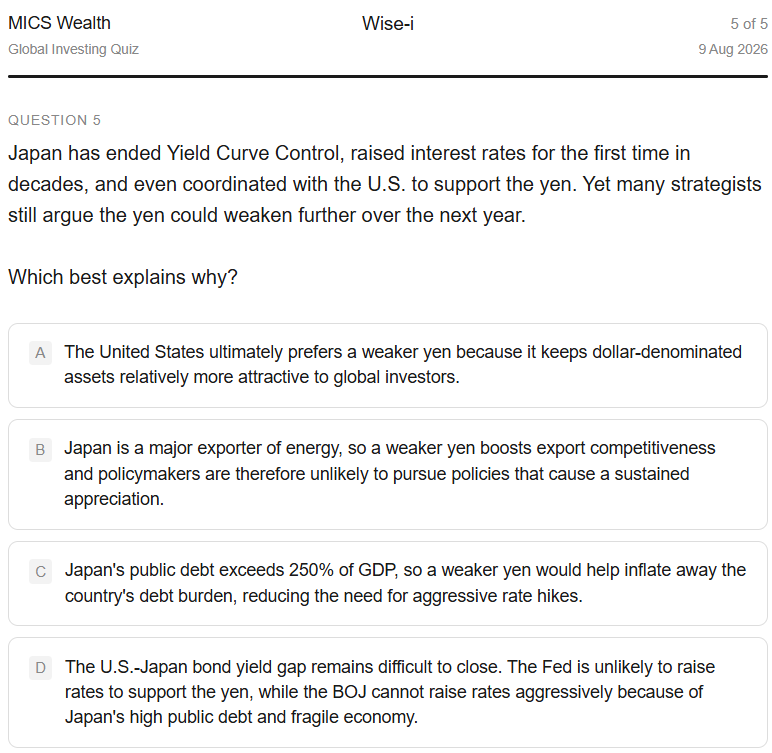
Every week, we drop a finance quiz in our WhatsApp community.
Here's one question to test yourself. Solve the rest (and join the community) via the link below - https://t.co/thcSQYHbIC
WhatsApp community - https://t.co/Zo3ayRaXXo
@MICSWealth#InvestingQuiz#GlobalMarkets #WealthManagement #FinTwit #PersonalFinance #InvestSmart #MarketKnowledge #FinanceForAll #CFA #WealthForum #StockMarket #SP500 #Nasdaq #DowJones #MarketRally #RecordHigh #WallStreet #Nifty50 #Yen #Japan
One HNI client onboarded with us in the middle of the war, back in March.
The market had already slipped substantially, so the post-war 1-month returns were significant too. The client was impressed seeing the portfolio's performance.
But Trump had (has) other plans. In June, the market fell another 10%, and most of the portfolio's gains were wiped out.
The client called, worried, asking for the reason. My response was, "I understand, sir. This is normal in markets like these, and your gains will be back soon. And I promise you, this won't be the last time. This year, we'll face many such instances."
The market returned to previous levels soon after.
He's a good client, and he invested more with us. But again, as we saw in the last two weeks of July, global markets fell, and the portfolio went back into the red.
The client called again: "Firse?"
I said, "Sir, I just need a 2% upward move in one of our positions, and all our returns will be back."
And it happened. The portfolio is now at its highest profit level since inception. Today evening, the client messaged me: "Portfolio is doing well now."
All I want to say is this:
𝗧𝗵𝗲 𝗹𝗼𝗻𝗴 𝘁𝗲𝗿𝗺 𝗶𝘀 𝗺𝗮𝗱𝗲 𝘂𝗽 𝗼𝗳 𝗺𝗮𝗻𝘆 𝘀𝗵𝗼𝗿𝘁 𝘁𝗲𝗿𝗺𝘀. 𝗪𝗲 𝗻𝗲𝗲𝗱 𝘁𝗼 𝘀𝘁𝗮𝘆 𝗱𝗶𝗹𝗶𝗴𝗲𝗻𝘁 𝘁𝗵𝗿𝗼𝘂𝗴𝗵 𝘁𝗵𝗼𝘀𝗲 𝘀𝗵𝗼𝗿𝘁 𝘁𝗲𝗿𝗺𝘀. 𝗩𝗼𝗹𝗮𝘁𝗶𝗹𝗶𝘁𝘆 𝗶𝘀 𝘁𝗵𝗲 𝗽𝗿𝗶𝗰𝗲 𝘆𝗼𝘂 𝗽𝗮𝘆 𝗳𝗼𝗿 𝗯𝗲𝗶𝗻𝗴 𝗶𝗻 𝘁𝗵𝗲 𝗺𝗮𝗿𝗸𝗲𝘁.
What the hell is happening to the Indian stock market?
Dear @SEBI_India & @NSEIndia@BSEIndia
How many times do you expect traders to rebuild their entire business?
> December 2020 – 50% leverage removed
> March 2021 – 75% leverage removed
>September 2021 – 100% leverage removed
We adapted.
Yes, leverage is a double-edged sword. But thousands of genuine traders with smaller capital were affected. Still, we adapted.
> September 2023 – Bank Nifty expiry was shifted from Thursday to Wednesday, while BSE launched Sensex weekly expiry on Friday. Suddenly, we had expiries almost every trading day.
Many traders, especially algo and 0-DTE traders, redesigned their entire systems.
We adapted.
> November 2024 – Weekly expiries of FinNifty, Bank Nifty and other indices were removed. Only Nifty and Sensex weekly expiries remained.
Again, thousands of traders had to change their strategies.
We adapted.
> February 2025 – Expiry-day margin benefit was removed.
STBT traders were hit badly.
We adapted.
> 1st September 2025 – Nifty expiry shifted from Thursday to Tuesday.
Again...
We adapted.
> Jane Street reportedly made billions of dollars from Indian markets over the years. Later, regulatory action was taken, and subsequently trading restrictions were lifted after payment of regulatory dues/settlement.
How exactly did all of this benefit Indian retailers?
Meanwhile...
- Option STT has increased massively over the last few years.
- Bid-ask spreads have widened.
- Slippage has increased.
- Global volatility has increased.
- Transaction costs keep rising.
We adapted to everything.
And now...
Closing Auction Session (CAS).
Seriously?
Every few months there's another structural change.
Every few months traders are forced to rebuild their systems.
Every few months liquidity takes another hit.
You say these changes are for retail investor protection.
Then please show us the data.
Can you show even one report proving that retail trading losses have actually reduced because of all these interventions?
If not, then what exactly are these constant changes achieving?
Instead of making markets more efficient, you're making trading more expensive, more complicated, and pushing serious traders towards crypto and international markets.
As a full-time trader, my inner soul genuinely cries today seeing the direction our markets are heading.
We survived leverage removal.
We survived daily expiries.
We survived removal of daily expiries.
We survived expiry changes.
We survived removal of expiry margin benefits.
We survived higher STT.
We survived wider spreads and slippage.
Now we are expected to survive CAS as well?
Enough is enough.
I request SEBI and the exchanges to reconsider this rule.
Before implementing such major structural changes, consult the trading community. There should be proper communication, public discussion, and representation from active traders.
I also request every trader to raise their voice through the proper channels. If you genuinely believe these changes are hurting market participants, please send your feedback or complaint to SEBI through its official grievance mechanism. And if anyone from the industry has a direct channel to the exchanges or regulators, please help convey the concerns of the trading community.
Please Retweet this so our voice reaches the right people.
Enough of silent adaptation. It's time the trading community is heard.
@AnilSinghvi_@_anujsinghal@SarangSood@PRAFULKULKARN18@adigitalblogger@iarjuntandon@JayneshKasliwal@sunilgurjar01@piyushchaudhry@SantoshPasi@RakeshPujara1@TanmayKurtkoti@justnottamomma@AshishGupta325
Assuming a minimum 9x leverage, the $36 billion figure means the actual equity contribution from NRIs is only around $4 billion. That's honestly not very impressive, especially when you compare it with 2013, when there was no such leverage and the RBI received $26 billion during the scheme.
Given the much better infrastructure we have today, I would have expected much higher participation from NRIs.
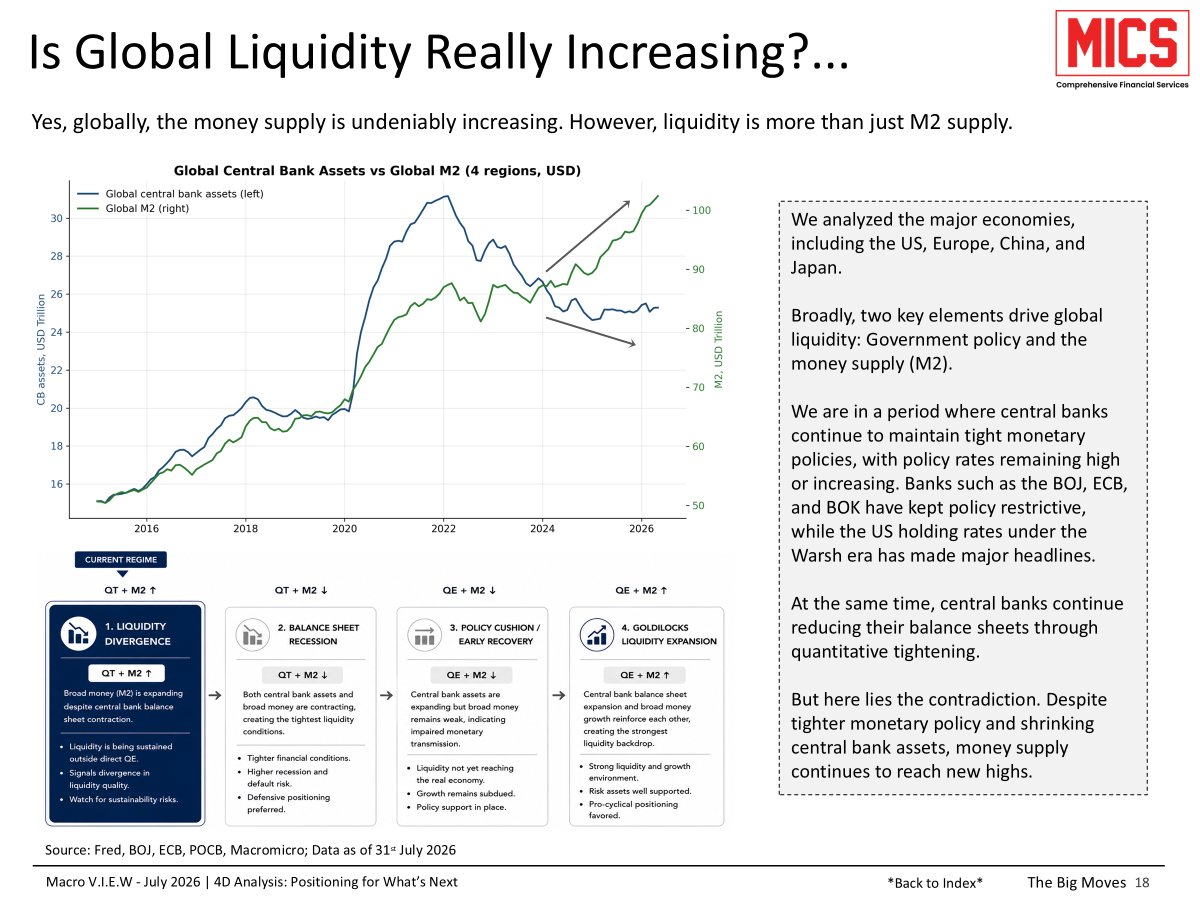
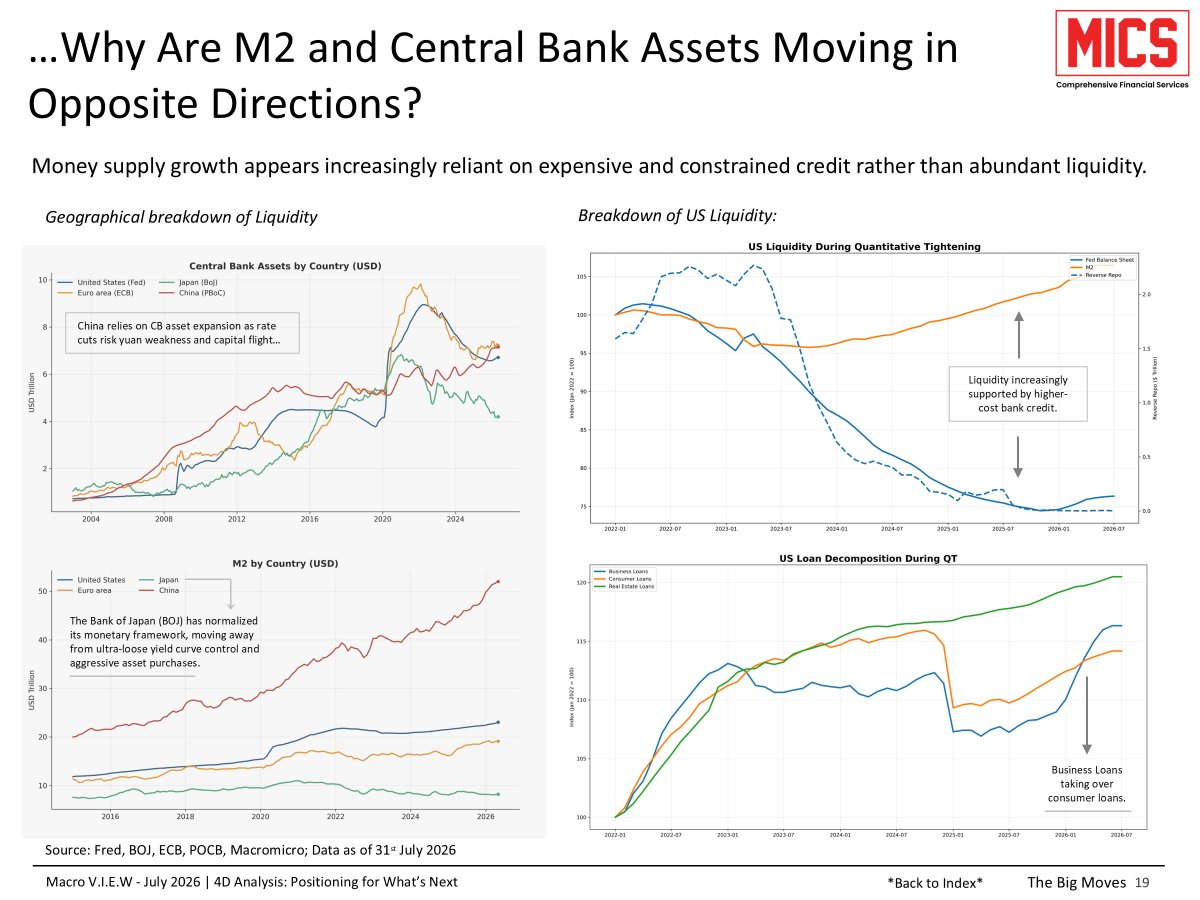
In our latest Monthly research report, we discussed the divergence between central banks assets and global money supply.
We are in a period where central banks continue to maintain tight monetary policies, with policy rates remaining high or increasing. Banks such as the BOJ, ECB, and BOK have kept policy restrictive, while the US holding rates under the Warsh era has made major headlines.
At the same time, central banks continue reducing their balance sheets through quantitative tightening.
But here lies the contradiction. Despite tighter monetary policy and shrinking central bank assets, money supply continues to reach new highs.
Access to full report - https://t.co/0xV3euNGOk
@MICSWealth
16% is an inflated number shown by most banks. This is a simple interest p.a.
For 5Yr - 12.5% CAGR
For 3Yr - 13.50% CAGR
This is what I have observed to be the highest, that too without considering the upfront/process fees on the borrowed amount.
Apart from that, this is only when the leverage given is 14x, which is tough for most investors to get.
FCNR deposit as collateral itself, I feel, sir, is only paper. And that helps only when both the lending and deposit banks are the same, which is possible with very few banks right now.
We have a huge network of NRIs, HNIs, and family offices, yet no one is able to close any deal with any bank.
Banks are just asking clients to bring money to India without confirming the rates. (Whatever we are seeing online is just indicative returns, final rates will be finalized on the day of booking.)
I feel FCNR is an overhyped product when the leverage risk is on the investor.
Wealth creation gets all the airbrushing. Nobody writes about wealth sustenance, and the numbers say they should. 70% of rich families lose it by the second generation, 90% by the third.
The usual suspects are real: lavish living, weak succession, risk beyond capacity, heirs who never learned the numbers. But the Williams Group tracked over 3,000 wealthy families and found the killer isn't bad investing, it's bad communication and no governance. Add sudden wealth syndrome to the list too, the identity crisis that hits founders and heirs alike when money shows up faster than the person can adjust to it.
Here's the part that surprised me: it's not just succession. A 2026 Campden Wealth survey found nearly half of family offices now have a formal "purpose of wealth" framework, up from a third last year, and where it exists it drives succession planning, not the other way round.
Andrew Carnegie, the steel tycoon who became one of the richest men of his era, made the same case back in 1889. In his essay Gospel of Wealth, he argued the rich are just custodians of their money, not permanent owners, and that dying rich without putting the money to use is closer to a failure than an achievement. The industry is just catching up to him.
Advisory firms are starting to build for this. They train advisors to run values conversations with next-gen heirs. Family offices are setting up next-gen councils instead of just handing over the keys one day. In India, the same gap is showing up as ₹40-60 lakh crore moves across generations this decade, and lawyers are openly saying a will and a trust deed aren't enough, someone has to train the person receiving the money too.
That's the real story here. Wealth management sells the accumulation half. Almost nobody sells the using-it-well half, and that's exactly where families fall apart.
FCNR(B) leveraged deposits are being pitched at 15-27% returns right now. Run the actual math and that number shrinks fast, and nobody's showing you why on the slide.
SBI's own example: a 9x leveraged, 5-year deposit marketed at 13.83%. Compounded properly (there's no interim payout, so it compounds silently year to year) the real return is 11.09%. Axis quoted 17.30% on a 3-year, 19x version. Real IRR: 15.17%. The gap isn't rounding. It's most of the pitch.
And that 11% isn't coming from the deposit itself. The actual FCNR(B) rate is only 6 to 6.5%. Everything above that is borrowed leverage. So you're not buying an 11% deposit. You're buying a personally guaranteed, 5 year dollar carry trade, and the deposit is just the collateral.
You hold all of it too: the loan, the SBLC, the triparty agreement. A 12 month lock-in, with exit after that at the bank's discretion, not your right. Five years is a long time to depend on one foreign bank keeping the same terms open.
Not a bad product. Just a specific one: a personal balance sheet trade dressed up as a deposit, sold on a number you won't actually get.
Compare that to Silverdale Capital, MAS licensed in Singapore. Same basic trade, different structure: the leverage sits on the fund's balance sheet, not yours. Post leverage yields around 11%, over a 3 year horizon instead of 5.
You buy units. The manager runs the leverage and the credit selection. No personal loan, no SBLC, no margin call with your name on it. It's a different risk, not a smaller one (NAV volatility, credit risk, none of the FEMA protection), but one you can exit two years sooner without personally guaranteeing anything.
So which wins? No clean answer, and I'd distrust anyone who gives you one. Want guaranteed, tax free, FEMA protected, and fine carrying the leverage yourself for 5 years? FCNR(B) at a real 11-12% still beats most NRI alternatives at that risk level. Want similar yield without carrying the loan, over 3 years instead of 5? The fund structure is doing something genuinely cleaner.
Either way, ask for the compounded return in writing before you trust the number on the slide. On a 9x, 5 year deposit, that gap is worth 2 to 3 points, the difference between a product that's actually competitive and one that only looks that way.
https://t.co/fXZltHDp7h
I made a quiz on Global Taxation.
Fair warning, it's a bit technical, but then again, so are taxes.
Give it a shot and share your score. Let's discuss the tricky ones together.
Gold’s Death Cross Is Not The Whole Story
Gold’s death cross matters because it confirms momentum has broken, but the deeper story is macro. Gold had a massive run into early 2026, with spot prices pushing above $5,500 before correcting toward the $4,000 area. After a move that large, the market became crowded, emotional, and vulnerable to any shift in rates, dollar strength, or geopolitical risk premium.
The Dollar And Real Yields Did The Damage
The biggest pressure came from the dollar and real rates. DXY near 101 tightened global liquidity and made gold more expensive for buyers outside the U.S. Treasury yields also stayed elevated, with the 10 year around 4.3% to 4.4% and real yields near 2.1%. That matters because gold pays no income. When investors can earn a positive real return in Treasuries, gold has to compete on fear, inflation protection, currency debasement, or crisis risk.
The problem for gold in June was that inflation did not create the clean bullish setup people expected. May PCE inflation was still hot, with headline around 4.1% and core around 3.4%, but instead of helping gold, it strengthened the case for a Fed that stays restrictive. The Fed held rates at 3.50% to 3.75%, while the market started treating another hike as possible. That is toxic for gold in the short term. Inflation helps gold when central banks are trapped and real yields fall. It hurts gold when the market thinks inflation forces tighter policy.
The War Premium Faded
The Middle East risk premium also started coming out. Earlier in the year, gold benefited from fears around Iran, energy supply, and the Strait of Hormuz. By late June, oil had fallen back toward the low 70s and the market was no longer pricing the worst case.
This is why gold can fall even when the world still looks unstable. Markets do not price danger in the abstract. They price the change in danger. If the market moves from energy blockade panic to chaotic but improving shipping conditions, gold loses some of the safe haven bid.
Flows Turned Against Gold
Gold ETF flows slowed and turned negative in parts of the Western market, while capital rotated back toward equities, especially AI and tech. That matters because the prior rally was not only about central banks and de dollarization. It also had a heavy speculative and ETF component.
Central banks still provide the strongest structural support. Many continue to diversify reserves and expect official gold holdings to rise. But central banks buy slowly. They do not stop a sharp liquidation when ETFs, futures traders, and trend followers move at the same time.
Physical demand also weakened because prices moved too far too fast. Jewelry demand in China and India was hurt by record local prices, while recycling increased as holders sold into the spike. That did not cause the selloff by itself, but it reduced the cushion underneath the market.
The Technical Break Matters
The death cross shows that short term momentum has rolled below the longer term trend. Once gold broke below key levels near $4,200 and then $4,000, selling became more mechanical. Trend followers reduced exposure, momentum traders exited, and late buyers started protecting capital.
That is how a correction becomes an air pocket.
The Late Cycle Read
This selloff does not kill the long term gold thesis. Gold often weakens while the Fed is still hawkish, the dollar is strong, real yields are high, and risk assets are squeezing higher. Then it becomes attractive again when tightening finally breaks something, the dollar rolls over, or real yields fall.
Gold sold off because the market stopped paying for immediate war panic, Fed easing, and speculative momentum at the same time.
The long term bull case is not dead, but the short term trade is damaged. Gold needs a weaker dollar, falling real yields, renewed ETF inflows, or clear credit stress to regain control. Until then, rallies can be sold and the $3,800 to $4,000 zone becomes the battlefield.
"Long-term is made up of many short-terms. We need to be diligent about those short-terms."
I heard this line yesterday in an event and it stuck with me.
Everyone talks about being a long-term investor. But long-term isn't a single decision you make once. It's hundreds of small ones: Rebalance on schedule, markets drift and one winning stock can quietly take over your portfolio. Set exit rules in advance, decisions made calm are always better than decisions made in a rally or a crash. And stay away from hype, every cycle has a story that looks unmissable, capital is protected by the ones who stayed cautious.
The long-term compounds. But only if you get the short-terms right, again and again.
𝗨𝗻𝗰𝗲𝗿𝘁𝗮𝗶𝗻𝘁𝘆 𝗶𝘀 𝘁𝗵𝗲 𝗯𝘆𝗽𝗿𝗼𝗱𝘂𝗰𝘁 𝗼𝗳 𝗶𝗻𝗻𝗼𝘃𝗮𝘁𝗶𝗼𝗻.
I keep coming back to this line, especially watching the AI space right now. Innovation, by definition, moves into territory with no precedent. If the future were certain, it wouldn't be innovation, it would just be execution. So the uncertainty we're all feeling isn't a side effect to be eliminated. It's the signal that real change is happening. We're not confused because something's wrong. We're confused because something new is actually happening.
Here's what I think most people get wrong about it: 𝘂𝗻𝗰𝗲𝗿𝘁𝗮𝗶𝗻𝘁𝘆 𝗶𝘀𝗻'𝘁 𝘁𝗵𝗲 𝗿𝗶𝘀𝗸. 𝗠𝗶𝘀𝗽𝗿𝗶𝗰𝗶𝗻𝗴 𝗶𝘁 𝗶𝘀. Markets don't hate uncertainty, they hate being wrong about it. Rail, electricity, internet, mobile, every major tech cycle had the same fog. The money was made by people who took positions under uncertainty, not by people who waited for clarity that never arrives on schedule.
There's a reason for that. 𝗨𝗻𝗰𝗲𝗿𝘁𝗮𝗶𝗻𝘁𝘆 𝗰𝗿𝗲𝗮𝘁𝗲𝘀 𝗼𝗽𝘁𝗶𝗼𝗻𝗮𝗹𝗶𝘁𝘆. When nobody knows the winning architecture or business model yet, capital and talent flow into many parallel bets at once. That's noisy and expensive, but it's also exactly how breakthroughs get found. You can't optimize your way to a paradigm shift. You have to explore your way there. And in that kind of environment, the edge shifts too: it's no longer about pure execution, it's about adaptability and surviving long enough to be right eventually.
So where does that leave the "who wins" question?
If uncertainty equals optionality, betting on who wins the application layer is actually the highest-uncertainty bet you can make. Nobody knows which model, product, or company captures the end-user value yet. That's precisely what's still being contested.
What's far more certain is the supply chain feeding that contest. Whoever wins the AI race will need the same upstream inputs to get there: compute and chips, energy and power infrastructure, data pipelines, capital to fund the burn, and the talent and tooling that every lab depends on regardless of which one comes out on top.
So the winners aren't predicted by picking the eventual champion. They're predicted by mapping the chain of dependencies that every contender must pass through, regardless of who wins.
But locked-in yield only matters if you can get in. At $1M+ minimums with relationship AUM asks, most investors in this bracket never see that 15%+ anyway.
What are they supposed to do?
There's been a lot of noise around the FCNR(B) product, but no retail bank has actually given clarity on what the structure looks like.
SBI is the only bank that's come out with full clarity, offering ~11.5% XIRR. But at that rate, the product doesn't look lucrative.
(1/n)
Meaning you need to bring in additional capital beyond the FCNR amount, which gets deployed into other bank products. So private banks have the limits. Retail banks don't have the clarity. And the investor sitting in the $100k–1M bracket is left with nothing built for them.
3/n