Facts:
- Firms with less than 20 employees make up 90% of all companies in the US
- Small and medium-sized firms employ half of all workers in the US
- Small and medium-sized firms generate half of all revenue in corporate America
- Small firms create around 3mn jobs every year
"demand remains resiliant" despite fare hikes. That said, they have only been able to offset 25%-40% of the hit from higher jet fuel prices >
Air New Zealand plans for elevated fuel costs into 2027
Air New Zealand has offset only 25% to 40% of the hit from higher fuel prices through hedging and fare increases, Chief Executive Nikhil Ravishankar told Reuters on Saturday, as the carrier plans for elevated fuel costs going into its 2027 financial year.
The airline is planning around $150 per barrel jet fuel out of the Singapore Jet Index, Ravishankar said on the sidelines of the International Air Transport Association's annual meeting in Rio de Janeiro. Air New Zealand is not facing fuel supply shortages, he said, but the price shock remains the main challenge.
The airline has already imposed two rounds of fare increases and could look at further tactical hikes in markets where demand remains resilient, Ravishankar said. (Reuters)
Hmm looks like this really is a bearish flattening of the curve! Should confirm a 'Speculative' investment regime = high vol, low returns in risk assets? @gnoble79@JackFarley96@fejau_inc
Every Cargo Has Its Own Ship🚢🌍
Global trade does not move on one kind of vessel.
It moves through a specialized fleet.
Bulk carriers move coal, grain, and minerals.
Oil tankers move crude and refined products.
LNG ships move gas at extreme cold temperatures.
Container ships move manufactured goods.
RoRo ships move cars and trucks.
Heavy-lift vessels move oversized equipment.
That is the hidden architecture of globalization.
Energy, food, minerals, vehicles, chemicals, and infrastructure all depend on the right ship showing up at the right port.
Shipping is not just transport.
It is the operating system of global trade.
MS sees $230 Brent in a prolonged Strait of Hormuz disruption scenario, which would result in a significant growth headwind, risking recession
The Beat June 2026
10-2 Yield Curve 🏛️ — 0.387% — still in decline, but nearing a key level 👀
The curve flattening is generally bearish for precious metals, as we have seen since February. Now, it is closing in on the January 2025 top at 0.380% for potential support.
A turn around in the yield curve here would likely mean the bottom is in or close for precious metals priced in USD.
If the curve breaks down below 0.380%, the February 2025 low is at 0.202%. It could turn around anywhere in that range.
Patience and persistence will be rewarded.
For the good of the order 🫡
🇧🇭🇰🇼 2 Gulf carriers have bounced back toward pre-war flight levels, while the rest of the industry is still on its knees.
Gulf Air and Kuwait Airways are the fastest-recovering airlines in the region, operating closest to pre-conflict capacity as of June 6.
Gulf Air rerouted through Dammam when Bahrain was disrupted. Kuwait Airways came back the moment Kuwaiti airspace reopened in late April.
The rest of the sector is still absorbing airspace closures, infrastructure strikes, and a collapse in demand. These 2 are positioning to own the rebound.
Source: Flightradar24
The throngs of aggressive debt restructuring deals that have been forced onto creditors in recent years may have created a $165 billion opportunity for distressed investors. Read more in The Brink. https://t.co/5tfmf7M9Y2
The 2-year real interest rate has now climbed to its highest level since the Trump administration took office.
At the same time, we are living through the deepest and longest drawdown in the history of the Bloomberg US Aggregate Bond Index.
We are moving in the wrong direction and I doubt Scott Bessent is thrilled about either development.
This is the exact opposite of inflating your way out of a debt problem.
Yet investors are increasingly pricing in the possibility of another rate hike.
I suspect policymakers will be forced to address that reality.
When they do, the implications for hard assets could be substantial.
https://t.co/CErNysNiBQ
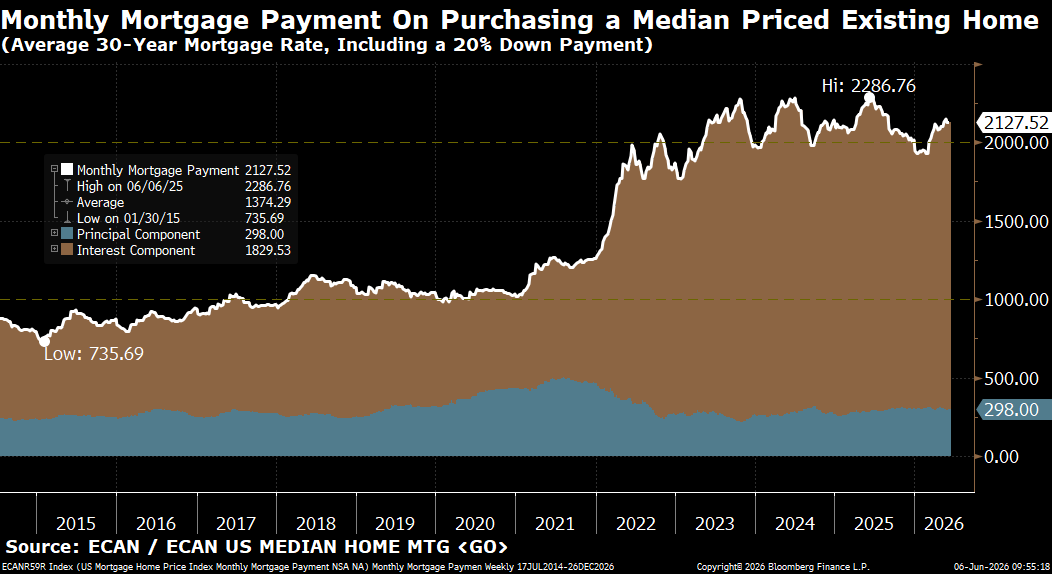
Mortgage affordability remains under pressure.
A median-priced existing home with 20% down now carries an estimated ~$2,128/month P&I payment — still elevated since the 2022 rate shock and back above recent lows.
The problem: inflation pressure is reaccelerating, and markets are increasingly pricing the risk that the Fed���s next move is a hike, not a cut.
🇺🇸🇨🇳 China's green tech exports, solar panels, batteries, EVs, now exceed US oil and gas exports by $40 billion in a single half-year period
In 2021 the gap barely existed. By H1 2025 China was at $120 billion in cleantech exports against the US at $80 billion in oil and gas.
The US energy dominance narrative and the China clean energy narrative are actually the same story told from opposite ends:
One country bet on fossil fuel export value and got hit by price volatility, the other built manufacturing scale in technologies whose costs keep falling.
Trump said this week that countries using coal are successful and countries using wind are failures.
The chart disagrees fairly loudly.
Source: Ember Engery, Ian Bremmer (appearing on The Ezra Klein Show)