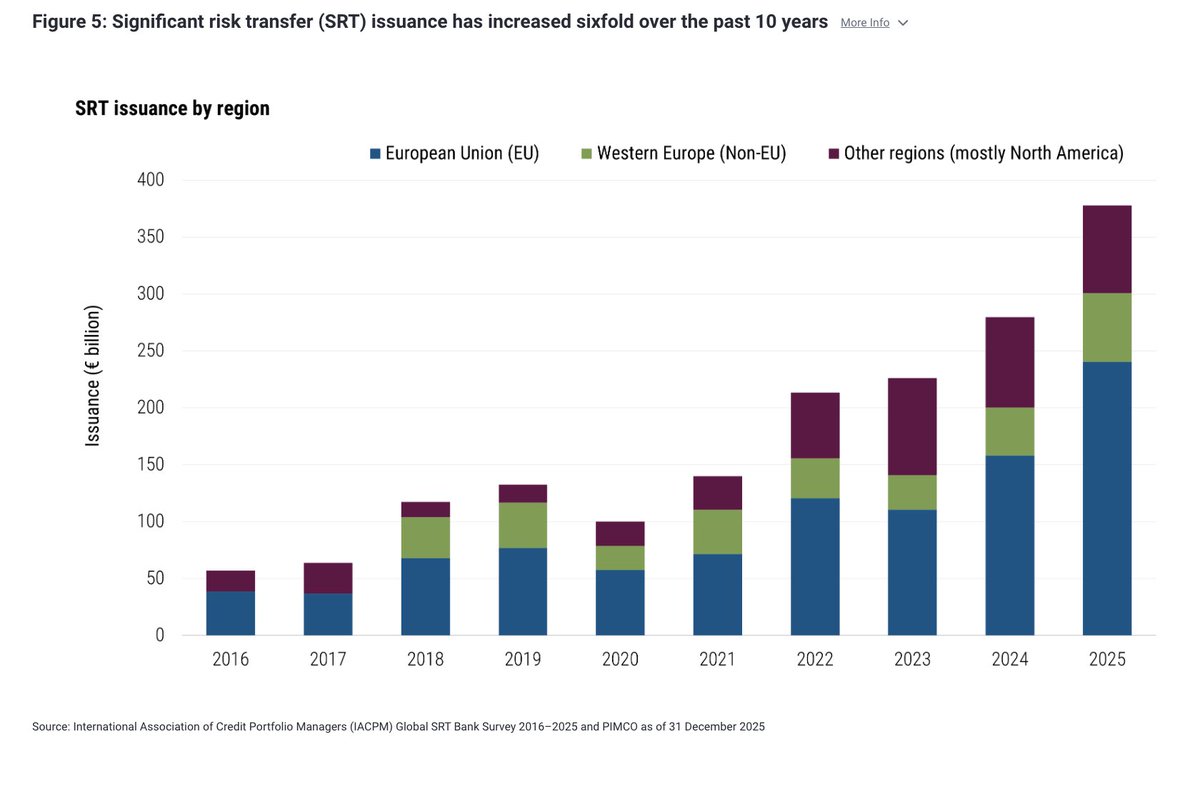
A powerful commentary and chart by way of Pimco detailing that when spreads compress and traditional sources of return become scarce, investors and intermediaries often respond by creating new ones. Aka-Financial Engineering
👇
“Banks have materially increased their reliance on significant risk transfer (SRT) transactions to shift credit risk on loan portfolios to insurers and institutional investors. In some cases, the investors ultimately exposed to the underlying risks are affiliated with the same private equity firms that sit elsewhere in the financing chain – as borrowers or sponsors. The result is an ecosystem in which risk is not so much spread across the system more broadly as redistributed among closely linked participants. This means the diversification benefits SRTs are intended to provide can become less meaningful when exposures remain concentrated within a tightly connected network. Put differently, risk may appear to move off bank balance sheets, but at the system level it often remains within the same financial orbit.”Lotfi Karoui of PIMCO
Read Lotfi’s last sentence twice.
Have a wonderful Wednesday! 😊
Chart source: PIMCO
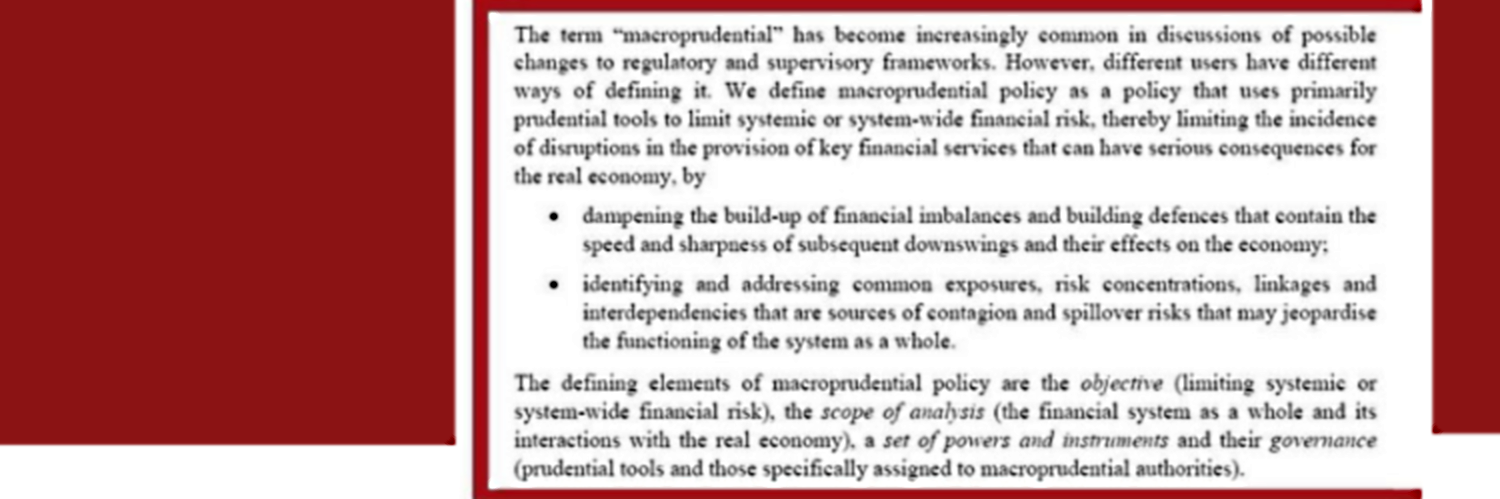
"Lessons learned on #macropru policies Tools are proving their worth although use cases vary by country; role in over-arching frameworks remains a challenge" #macroprudential https://t.co/CrsQSMB4wY @CentralBanking_
Terrific from @HyunSongShin et al. My interpretation
Emerging market central banks should carefully craft macro-prudential policies
Build defenses against the damaging whiplashes of global financial markets
Prioritize long-term global capital that brings technology & expertise
Central Bank Musings
https://t.co/C6cMm039hq
Central banks cannot guarantee financial stability through interest rate adjustments alone due to inevitable policy trade-offs, making macro-prudential regulation essential
[archive 2014]
Existing frameworks — joint ventures, long-term leases, private credit, offtake mixes, securitized lease cash flows, etc. — concentrate risk within the same handful of companies.
This level of high-risk circular financing raises the prospect of another 2008-level blowup.
"Absent such anchors, tokenization risks amplifying financial instability through speed, concentration, and fragmentation ..." -- Tobias Adrian #FinancialStability@IMFNews
Highly recommended!
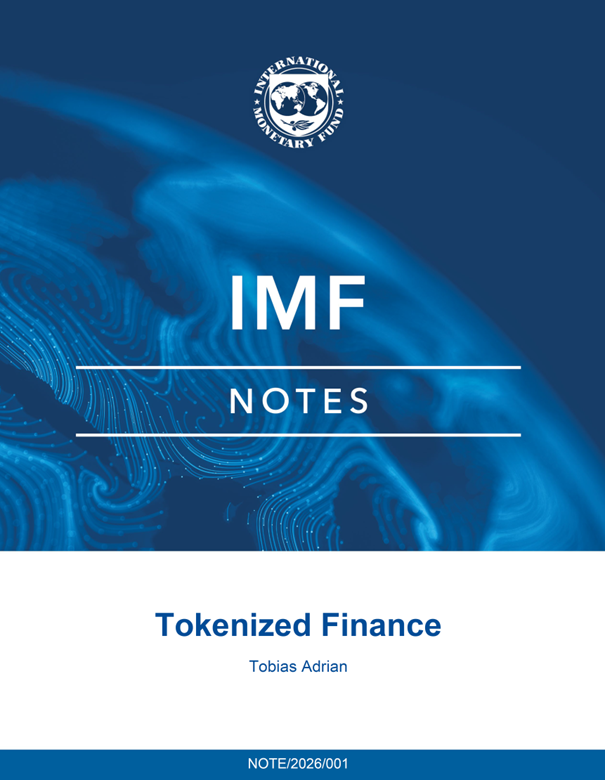
"Tokenized Finance" by Tobias Adrian.
"Tokenization—the representation of financial assets and liabilities on programmable digital ledgers—is increasingly shaping financial system developments. The most consequential transformation is occurring within the regulated financial system, including banks, asset managers, and financial market infrastructures, where tokenization can enable atomic settlement, continuous liquidity management, and embedded compliance. This paper argues that tokenization constitutes a structural shift in financial architecture rather than a marginal efficiency improvement. It describes how permissioned shared ledgers, programmable financial assets, and smart contract-based risk management alter the nature of settlement, liquidity, and systemic risk. The paper emphasizes that the long-term success of tokenization depends on anchoring digital finance in public trust through clear policy frameworks and safe settlement assets, robust governance of code, legal certainty, and international coordination. Absent such anchors, tokenization risks amplifying financial instability through speed, concentration, and fragmentation, as contract-based risk management alter the nature of settlement, liquidity, and systemic risk."
https://t.co/MkVCmbmPoB
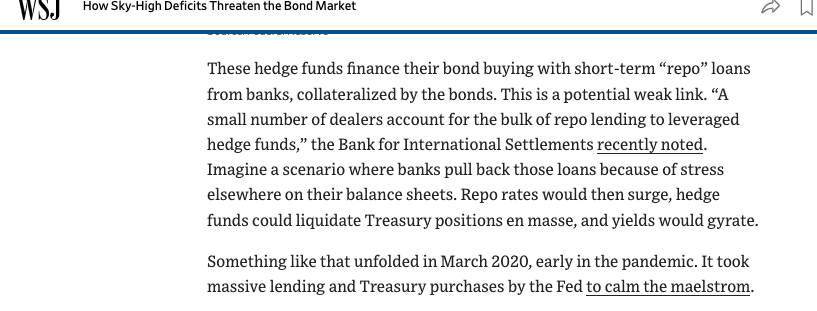
The formidable @greg_ip identifies another #SystemicRisk: "hedge funds finance their bond buying with short-term “repo” loans from banks, collateralized by the bonds. This is a potential weak link." https://t.co/QIJOJdkRgD (gift link)
"Less than 20 years after the financial crisis, credit rating agencies are once again at the centre of concerns about a systemic risk in finance — this time about how they are now grading the private credit market." https://t.co/X1I0sUBR1Y #SystemicRisk https://t.co/syyuvm6FPN
These are true but incomplete. The missing factor here is the distinctive law of insurance, which places the downside risk of insurer failure at the feet of taxpayers without a macro-prudential financial regulatory scheme to keep large insurers from taking on excessive risk.
Nearly 20 years after the fall of Lehman, we still face the same sources of explosive instability.
But only few remember the ferocious lobbying that defeated attempts to regulate repos.
Highly relevant!
"The evolving nexus: sovereigns, banks and NBFIs" by Stefan Avdjiev, Bryan Hardy, and Maximilian Jager.
"This paper documents that the traditional sovereign-bank nexus has morphed into a broader nexus that now also includes non-bank financial institutions (NBFIs): the sovereign-bank-NBFI nexus. The classical sovereign-bank nexus has been a major financial stability concern following the eurozone crisis. Since then, sovereign debt levels have increased substantially in many major economies, while NBFIs' footprint in sovereign bond markets has grown significantly. This paper examines the transmis sion of risks among banks, sovereigns and NBFIs using European bank-level data and global country-level data. We find that banks' direct sovereign exposures have recently become less important in explaining the co-movement between bank and sovereign risk. By contrast, banks' exposures to NBFIs have become a significant determinant of the bank-sovereign risk co-movement. We also find evidence that NBFIs' sovereign debt holdings have become important drivers of the co-movement between NBFI and sovereign risk."
https://t.co/WsVDOmZwuW
The formidable @greg_ip identifies another #SystemicRisk: "hedge funds finance their bond buying with short-term “repo” loans from banks, collateralized by the bonds. This is a potential weak link." https://t.co/QIJOJdkRgD (gift link)