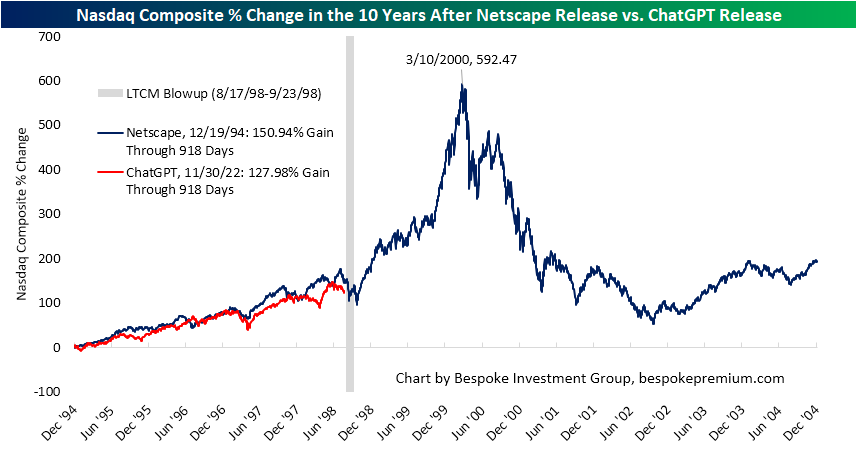
Crazy how this Situational Awareness blowup is right inline with the Long Term Capital Management blowup on the Netscape/ChatGPT timeline. Gray shading is When Genius Failed...
Past performance is no guarantee of future results.
My timeline is filled with comments that the whole sell-off is overdone and every seller is crazy. Me thinks short bounce yeah but bottom in the former momentum stocks hmmmm
Question for followers.
Your best estimate of the absolute average hit rate (% trades closed positive) for the average fund manager over a complete track record? I did some research on this but still doubting what I find.
Your best estimate of the relative hit rate.
One of @Silicon_Data‘s oldest datasets is secondary-market GPU sales.
Combined with forward pricing, it allows us to estimate the residual value of GPUs across their lifecycle.
I’m still surprised how many people assume a GPU is worth almost nothing by year three. The data tells a very different story so far.
Don't ignore the Semiconductor (SOX) seasonal pattern. Following its June high, SOX historically enters a period of weakness that can last into October. The risk of SOX’s mean reversion accelerating is on the rise. https://t.co/GJpbkAYOk9
People inventing and looking for all kind of narratives that explain the AI-selloff. It’s really that simple: it’s a momentum crash. These things happen. We ALL knew momentum was crowded as a style. There is nothing fundamental going on or whatever. It’s just crashing MOM.
Today, I shared my thoughts on how CXMT’s listing could affect the three major memory companies.
The full article is available for free on both X and Substack.
Substack: https://t.co/5bWQMmOG0T
Nomura’s latest DRAM forecast is on another level.
They are projecting DRAM revenue to explode past 2 trillion dollars by 2030. Yes, that is trillion with a T. From around 80 billion dollars in 2022 to over 2.06 trillion dollars in 2030.
Here is the full supply demand picture they published. Production is expected to grow from 29.3 billion GB in 2022 to 128.4 billion GB by 2030.
Shipments rise from 24.7 billion GB to almost 126 billion GB. Utilization rates stay extremely high, often above 100 percent in the later years, and inventory even turns negative in absolute terms. That is a clear sign of structural tightness in the market.
The price story is just as dramatic. After the big crash in 2023 when prices fell to 1.9 dollars per GB, Nomura sees a strong recovery. They forecast 13.7 dollars per GB in 2026, peaking near 18.6 dollars per GB in 2027, and then settling around 16 to 17 dollars per GB through 2030.
The combination of much higher volume and these sustained high average selling prices is what drives that massive 2 trillion plus revenue number.
This is not a normal cyclical recovery. The forecast assumes AI and data center demand will keep running ahead of supply for years.
Wafer capacity is growing, but not nearly fast enough to match the bit demand.
High bandwidth memory, or HBM, is the big driver here. It brings higher density, higher prices, and much better profitability than regular commodity DRAM.
For some context, most mainstream long term forecasts still see the entire DRAM market staying well under 300 to 400 billion dollars by 2030.
Nomura is basically saying it could be 5 to 7 times larger than those conservative estimates if AI infrastructure spending keeps going at the current pace.
The implications are huge for the big three players: Samsung, SK Hynix, and Micron.
If even part of this comes true, memory chips could become one of the biggest profit pools in the whole semiconductor industry.
Capex will need to speed up, but the pricing power looks very favorable in this scenario.
Of course these are aggressive assumptions. AI spending could slow down, new capacity could come online faster than expected, or Chinese producers could close the gap quicker. But the overall direction is clear.
The old idea that DRAM is just a pure commodity cycle is being completely rewritten by AI.
A 2 trillion dollar DRAM market by 2030. That is the big number Nomura is putting out there.
#DRAM #Semiconductors
Ferrari is a good short against more interesting longs in the high-end luxury sector such as Zegna (staying true to quiet luxury) or Richemont (jewelry strongest)
@BobEUnlimited Incremental ROC over 20%ish is not good enough of a return? No matter how you slice the financials. Change in nopat versus change in invested capital on a R&D adjusted basis even taking into account M&A as capex is 20%ish plus incremental. Still decent
Today will be used by future historians to refute the efficient market hypothesis. Oil prices went down while the oil market was at its weakest point in modern history, on the news that the only Hormuz bypass with any real volume capabilities was being embargoed by the Houthis.
Despite US TMT stocks' massive outperformance since late March, US relative equity performance versus the rest of the world has not broken above its 200-day moving average (Chart).
The odds are that the 200-day moving average - that previously acted as a support in US structural outperformance - is now becoming a systematic resistance.
This technical chart pattern suggests the next big move is for US equity underperformance.
The scariest chart on Wall Street isn't saying what people think it is.
The Morgan Stanley Tech Momentum Index just printed a 17-day rate of change of -35.9% — the worst reading in its 27-year history.
Most investors are reading this as the AI trade breaking.
I see a factor unwind, not a fundamental one.
Momentum is one of the most successful investment factors ever discovered. Decades of research have shown that stocks with the strongest price trends tend to keep outperforming.
That's why it has become the foundation of countless quantitative strategies.
When everyone owns the same baskets, it doesn't take much: a quarter-end rebalance, thin summer liquidity, or a headline taken the wrong way for everyone to rush through the same exit.
This time, we had all of the above, on top of one of the strongest momentum runs in years.
The problem isn't momentum.
The problem is that too much capital is now chasing the same momentum signals.
But factor investing is very different from fundamental investing.
For fundamental investors, these periods often create the best opportunities because the edge isn't in owning the broad theme. It's in understanding what each company actually does within the value chain.
During times like this, we revisit every part of our coverage universe and ask a simple question:
What's actually getting stronger?
- Cheaper AI models may pressure AI lab economics, but they also drive higher adoption, more inference, and ultimately more hardware demand.
- More memory capacity may eventually normalize memory pricing, but every new wafer requires billions of dollars of semiconductor manufacturing equipment.
- AI spending isn't ending; it's broadening. Leadership is rotating from one part of the value chain to the next.
The market is confusing forced selling with deteriorating fundamentals.
Those are two very different things.
Link in comments for the latest Tech Edge that includes a primer on quant vs. fundamental investing.
Imho this is all a Nice good old fashioned bull correction in tech. Nothing goes up in a strait like. Market seems very rational. Even healthy. All good. Seasonal mid-terms weakness also in play, some rate fears and general AI doom mongering by the boomers. Post mid term bull
There is nothing as pathetic as bears taking victory laps on a 20% drawdown after hundreds of percents of returns for those on the Long side of the same bets in the past year