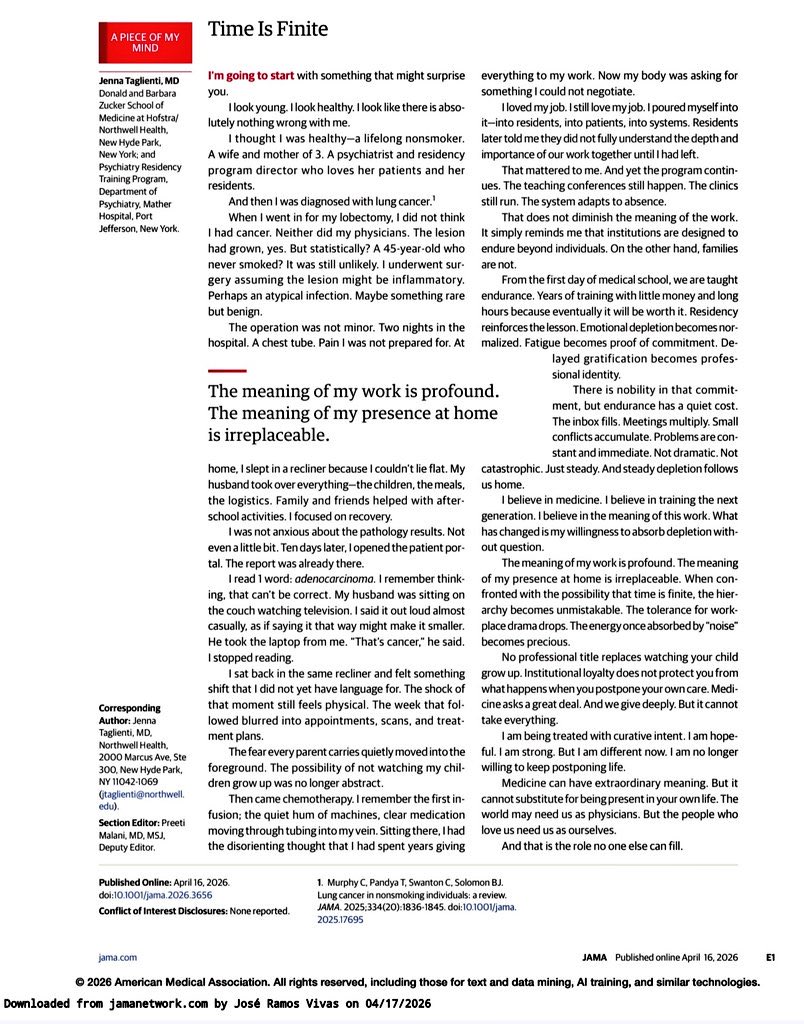
Anyone wanna have a conversation?
If you're a Dr in public service, am up for a virtual coffee chat. We can talk career, parenting as a provider, exchange experiences, just spitball ideas? No strings attached, no judgement, just a safe space to connect.
DM me.
In theory, consistency is about being disciplined, determined, and unwavering.
In practice, consistency is about being adaptable. Don't have much time? Scale it down. Don't have much energy? Do the easy version. Find different ways to show up depending on the circumstances. Let your habits change shape to meet the demands of the day.
Adaptability is the way of consistency.
Responsibility has been reduced to individual load bearing. Can you carry the rent, debt, insecurity, and fear of falling out? The question rarely asked is whether any social structure should be placing that much survival weight on ordinary human beings in the first place.
Why "communication" and "persuasion" are insufficient approaches to change across an organisation or system.
Communication campaigns can build awareness, but they rarely change behaviour at scale. Persuasion works well when our audience is already open to change. But when we lead any significant change effort, we work across the full spectrum: people who proactively advocate for change, those who passively accept it, and those who actively resist it. For a large portion of that population, even the most sophisticated argument will not shift their position.
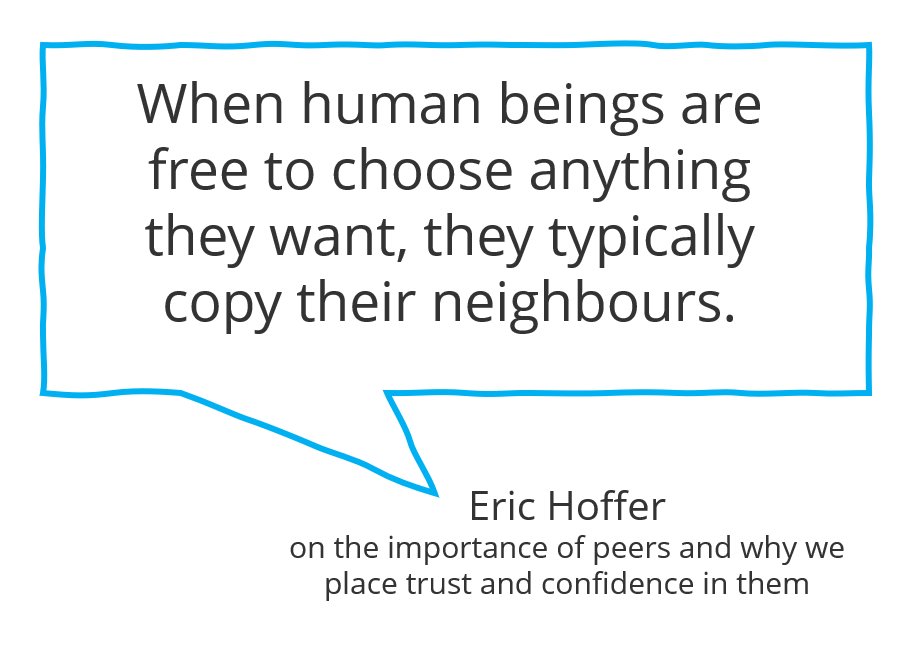
We change through our relationships.
I've learnt greatly from @Digitaltonto (link at the bottom of this piece). Decades of social science research shows we're profoundly shaped by the people around us: our colleagues, peers and professional community. This influence extends not just to our immediate connections but three degrees out: to their networks and the networks beyond. When researchers have studied people who made major shifts in their thinking (e.g., leaving long-held beliefs, changing deeply ingrained ways of working), they consistently find that change followed a shift in their social environment, not exposure to a better argument. People did not think their way into new behaviour. They were drawn into it by those around them.
This has profound implications for how we lead change. The real levers are not in our communications strategy. They're in our social architecture.
Five things we can do as leaders of change to build our social architecture:
1) Find the people who are already moving: People who already believe in what we are trying to do and are quietly making it happen. Find them and connect them to each other. We are not creating energy for change — we are locating it.
2) Create the conditions for peer-to-peer spread: People adopt new ways of working when they see colleagues they respect doing things differently. Prioritise proximity over broadcast. Small group conversations, site visits, and shared learning across teams carry more influence than organisation-wide communications.
3) Make progress visible at the local level: Transformation does not announce itself top-down and cascade neatly through an organisation. It spreads when people can see it working nearby, in their context, for people like them. Celebrate local progress loudly and often.
4) Connect people to the difference their work makes. Creating regular opportunities for people to hear from, or spend time with, those they ultimately serve is one of the most underused and most powerful tools we have as leaders of change.
5) Put our energy where it will travel furthest. Build on the readiness that exists, make it visible, and let success do the persuading that arguments could not.
None of this makes effective change communication redundant. People need clarity, honesty and a coherent narrative about where we are heading. But that is the scaffolding, not the structure. Change travels through people, through trust, through the invisible threads that connect one person's conviction to anothers.
See: https://t.co/k6JJkHhO7X.
On the lack of compelling evidence that medical AI is improving patient care, and what to do about it, a @NatureMedicine editorial https://t.co/kQiN6L2ai7
The smartest thing the system ever did was convince people that choosing between internal options was the same thing as challenging the whole arrangement.
Most public morality is not morality. It is compatibility theatre. A managed performance where people signal virtue just enough to preserve identity, status, and belonging, while never touching the conditions producing the harm in the first place.
“Experts” & “expertise” can be very dangerous to change interventions.
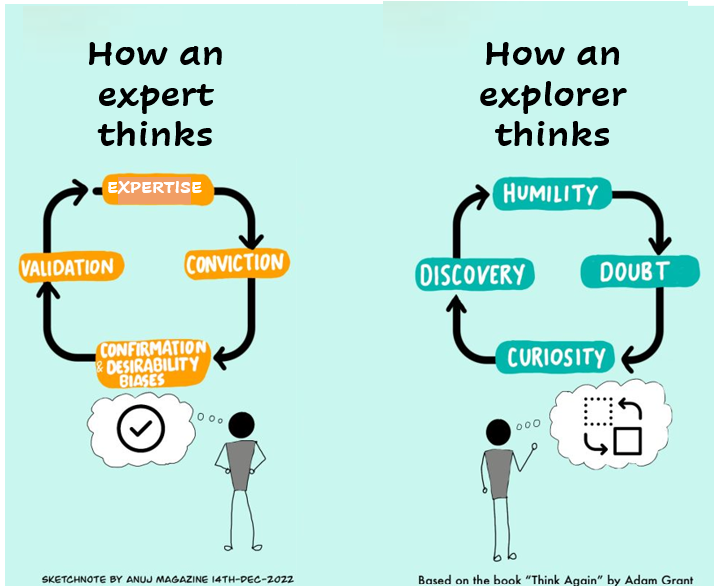
In leading change, it’s better to think like an explorer than an expert. See the graphic below.
An “expert” way of thinking can become a loop where knowing a lot turns into strong certainty. That leads us to mainly look for information that backs up what we already know, which then makes us feel confirmed. Experts can become oriented toward being right & getting affirmed, which can make their thinking narrower & more self-sealing over time.
An “explorer” way of thinking is a loop focused on learning. It starts with being humble enough to admit we might not have the full picture, then asking questions, staying curious & trying to find out more - so new information keeps shaping our views & change practice over time.
One of the greatest dangers in change experts (especially prevalent in external change experts coming into an organisation) is bias. Common biases are:
- Confirmation bias: we search for information/evidence that supports what we already think & overlook anything that contradicts this.
- “Solutioneering”: We jump quickly to a preferred intervention (new structure, operating model, digital tool etc) before fully understanding the local context & constraints.
- Authority bias: we can give extra weight to the opinion of the most senior person (or the loudest “expert”) & discount what others (especially people closer to the work) are seeing or can contribute.
- Overconfidence effect: we can be too sure we’ve got this under control, so we plan as if the future is predictable & leave too little room for learning & adaptation.
- One-size-fits-all / template bias: we over-apply what worked elsewhere (reusing change models, templates & assumptions) even when culture, incentives, capability or demand patterns differ.
- Case-study trap: We lean too heavily on successful past engagements & familiar sectors (“this looks just like Y”) & under-sample what is unique about this organisation.
In a relatively stable world, expert-led change can deliver results. But as AI accelerates the pace of disruption, the edge shifts from having the answers to staying open to better ones. The most effective change leaders will be those who keep their curiosity switched on, run experiments, learn quickly & humbly adapt when the evidence changes. In other words, the future belongs to explorers - because in an AI-shaped world, agility is likely to beat expert ability when it comes to change.
For experts/explorers see Joey Davis: https://t.co/Ya2L36fAPO
For more on biases, see the review by @grahamkmann of the work of Rolf Dobelli: https://t.co/54H7jtZBPs
Graphic adapted from one by @anujmagazine.
I do not like the term “empowerment”.
“Empowerment” is everywhere in the world of change leadership. It’s in the top three of the most commonly used leadership terms globally according to @DigitalDefynd. Personally, I never use “empowerment” unless I’m working with someone who is doing so already.
When organisations or leaders seek to "empower" people, it's often them choosing what's best or how much control others can have. This puts the person or group doing the empowering above everyone else & doesn't really give true freedom to those on the receiving end. Empowerment suggests that power is something that “we” give to “them,” reinforcing the status of the “giver” & (often unintentionally) making others feel weak or dependent, which is the opposite of what empowerment is supposed to do.
“Agency” is a better principle than “empowerment”. It means recognising people's innate ability to contribute & lead rather than relying on managers to bestow permission. People with agency decide what to do, take action & shape what happens. It’s their own drive & ability, not because someone else says they can. Agency makes people active collaborators in change & leads to better, more sustainable change outcomes.
As leaders, we can give people empowerment, by granting permission or sharing authority. We cannot give people agency: people have to build it for themselves through practice, experience & reflection. But leaders can create a climate for agency to thrive through encouragement, resources & space.
Being “agentic” means acting with or displaying agency. This term has become popular recently because of the development of “agentic AI” – AI systems that can act autonomously & make decisions, rather than just react to commands, prompts or rules. We don’t just need agentic AI; we need agentic people too.
“Agentic” is beyond “empowered”; it means shifting from a top-down model of control to one that trusts & supports people to make their own choices, solve problems & shape their own work. This shift requires us to let go of rigid structures, foster open dialogue & design systems that enable autonomy & collective discovery. When teams operate with agency, they become active collaborators, driving innovation & resilience in the face of uncertainty. The future belongs to leaders who encourage agency - rather than empowerment - where people don’t wait for permission, but act with purpose & ownership.
“Designing for agency: how leaders move past empowerment”: https://t.co/S5ehHIHqqA. By Daniel Gagnon & Pete Behrens.
Graphic adapted from “Agency is the highest level of personal competence”: https://t.co/EwXlsbdvC4. By @ThomasSBateman.
@Bealoquebea I don't understand how employers can get away with paying a highly trained medical professional minimum wage when demand is high and supply is low. Have the laws of economics stopped working?
Not that one could even have the energy to care at this point. Just can't be helped. When sh*t hits the fan, guess who's gonna be forced to clean up the mess.
Fly-on-the-wall R*k*n K*M update:
Concern after concern raised. Repeatedly fallen on deaf ears (what else is new?). Financial corners getting cut (austerity measure!). EMR vendor under contention (Let's use existing HIS. Oh wait, what about PDPA?!!)
Doomed to be a disaster.
@MuhammadAshraff I applaud your moral conscience.
There's arguably folks with lesser integrity who'll go "Nope, not my problem!" and happily catch up on in-flight entertainment instead.
(The Q we kept coming back to... Is regulation of Drs merely a money-making exercise then? 🤔)
Someone help us understand WHY non-clininal, purely admin, non-practicing doctors still are required to have a valid APC?
Do MMC regulations apply, even?
Is it because of the title alone?
(Genuine question. Colleague was wondering out loud, can't figure out the point)
@MuhammadAshraff If JIC, shd be some sort of min requirement to the no of practicing days/yr, no?
At least, to ensure there's fitness to practice. Since it's Annual Practicing Certificate.
Coz got ppl saying they're not competent enuff to practice. Left clinical too long. But then have APC 🤔
Reliability is a quiet generosity. I wrote a note on why cities should be reliable and why they should be designed for the tired.
https://t.co/pSjxqPB1zx
Please read and share. 🙏🏾