We've worked with Guardian since the 246 Club days.
Every engagement has been sharp, thorough, and adversarial in the best way, so choosing them for IRIS was easy.
Grateful to the @GuardianAudits team for a thorough, adversarial review of IRIS.
Two review rounds with 0 Critical and 0 High.
One step closer to launch.
Our review of @iris_credit’s lending contracts is complete, and our audit report is now live.
The contracts bring fixed-rate, fixed-term borrowing to variable-rate lending venues.
Fixed-Rate Lending: Market Structure and Protocol Design
A report on the protocols building fixed-rate and fixed-maturity credit products.
Read the full report here: https://t.co/Vtk7QvHeLH
@vmihov thanks i got it now.
so the sequence is:
1. seize PT at lower price + liquidation incentive
2. sell YT to make the PT price to rebound
3. borrow USDC using the PT
and the profit is roughly "borrowed USDC - (PT acquired at lower price + lb) - small loss on selling YT"
if that works well for you that's good 😱😱
I thought the goal was to avoid Javascript and the supply chain risk. if that was the primary reason, imo it's like creating higher risk to solve a medium risk. we know a single misconfiguration in offchain can lead to an incident: https://t.co/JbnWpl5YtK
You probably heard that I don't like Javascript.
So I vibe-coded a @CurveFinance UI in Python running in your browser, and reinvented how routing can be done.
Swaps are calculated as electric circuits using laws of Physics + EVM running in the browser.
Unprofitable to sandwich
Is leveraged loopoing really worth when a curator treats borrowers effectively fisrt loss capital for an attack?
The PT-reUSD/USDC market was deployed by @SteakhouseFi and they included TWAP to the oracle to protect their vault/lenders. Consequently their vault and lenders are safe (no bad debt, no loss) and maybe their reputation as well. Whereas the borrowers got rekt and lost part of their life savings.
I know the system worked as expected but this is brutal.
Update on this morning's PT-reUSD markets on Morpho. No lenders in Steakhouse vaults are affected and no bad debt is incurred. The underlying reUSD asset is unaffected.
At around 04:30 UTC, price action around the PT-reUSD (10 Dec maturity) asset caused a number of large and highly levered positions to liquidate. This is increasingly likely with trade size.
The PT asset price moved 2.8% with high volumes. Leveraged positions with health factors less than 1.03 were susceptible to have their positions liquidated.
Combining 15min TWAP and linear discount is generally good practice for Pendle oracles to mitigate the possibility of bad debt in the event of an impairment in the underlying asset. This is consistent with configuring PT oracles for lender protection.
Steakhouse curates markets that accept this asset as collateral. As a cautionary move, our systems withdrew liquidity from all affected markets while evaluating. We are now restoring liquidity back into the markets.
Lender positions on vaults allocating to these markets are not impacted.
Some said Morpho overpaid for the Robinhood integration. But with $800M of Robinhood chain’s $1B in deposits already on Morpho, the bet is starting to make sense.
The bigger opportunity is the flywheel.
Coinbase and Robinhood give Morpho distribution and proven integration paths. That pulls offchain capital and users onchain, making Morpho more attractive to the next fintech or institution.
Midnight strengthens that loop. Institutions don’t just want onchain yield. They need to price risk and Midnight gives them the market structure to do that.
If this compounds, I wouldn’t be surprised to see Morpho become number one Defi protocol by tvl next year.
As of today:
✔️ Internal Testnet is up
✔️ IRIS Solver is quoting
✔️ Two venue integrations are ready
✔️ End-to-end tests are running on SDK / Infra
Therefore, IRIS Club, which has been a private room for a while, is opening today while we wait for the testnet.
Welcome to the club.
https://t.co/EqK9STugwb
Certainty is a symptom of running a single model; calibration comes from an ensemble.
Tetlock's forecasting tournaments found that hedgehogs (experts with one big theory who filter all evidence through it) predict worse than "foxes" who hold many small, partial models and aggregate them, despite (in fact because of) the hedgehog's greater confidence.
That is precisely why ensemble methods beat single models in statistics. A random forest outperforms one deep decision tree, model-averaging beats any single estimator because averaging many independent, individually-mediocre views cancels their uncorrelated errors.
The fox is an ensemble; the hedgehog is a single over-committed model; the felt experience of certainty is the sensation of having stopped averaging. You know your forecast is degrading at the exact moment it starts to feel clean.
A borrowing rate is a forecast too. Each lending venue is a single model - one utilization curve, one governance regime, pricing its own local noise as if it were the cost of capital. Accept a fixed rate from any single venue and you've trusted a hedgehog: it feels clean, one number from one source, which is the tell.
IRIS prices across venues at once. A solver's fixed rate isn't Aave's estimate or Morpho's but it's what remains once each venue's idiosyncratic noise cancels against the others: the systematic cost of capital, no longer padded for any single venue's local shocks. The ensemble, not the hedgehog.
The rate that survived aggregation.
https://t.co/yAEhtjuNwH
A bank does not write a thirty-year mortgage, fund it once with matched thirty-year debt, and forget it.
The rate the borrower pays is fixed. Everything beneath that rate stays in motion. Short-term paper rolled against long bonds, deposits repriced, positions hedged and re-hedged continuously to hold the cost of carrying that loan as low as it will go.
GOFR is a great example of active liability management. Galaxy sources across lending markets and hands the client a single optimized rate.
IRIS points the same machinery at a different target.
A solver does the same continuous cross-venue work but the number you hold is the one you set: fixed, at origination. The variability doesn't reach you. It stays with the solver, who took the job by winning your quote.
Before IRIS opens Exclusive Mainnet, we’re opening a small glimpse of the intent-driven borrowing experience.
After submitting an intent, you’ll also see a portal to request access to Exclusive Mainnet.
https://t.co/LX8Pqx8MPr
Over the past few months, we’ve been thinking not only about how a borrower-centric credit protocol should work, but also how it should feel to use.
With this demo portal, you can submit the kind of borrow intent you would want IRIS solvers to price later - collateral, debt asset, size, duration, and preferred conditions.
Try it out today, and tell us how it feels.
Despite borrowers being the primary users of lending protocols, innovation has been concentrated on the supply side because liquidity competition has dominated market priorities for too long.
We have seen numerous supply side innovations layered on top of lending markets - vaults, tranche products ( @roycoprotocol and @strata_markets ), and duration tranching ( @infiniFi ) - yet comparatively little effort has been made / innovation has happened on the composable, borrower‑facing layers.
And therefore borrowers have been underserved.
IRIS is explicitly focused on remedying this asymmetry and building the infrastructure borrowers need starting with fixed rate use cases.
We’ve reached a point where the DeFi credit layer is mature enough to support more advanced credit primitives.
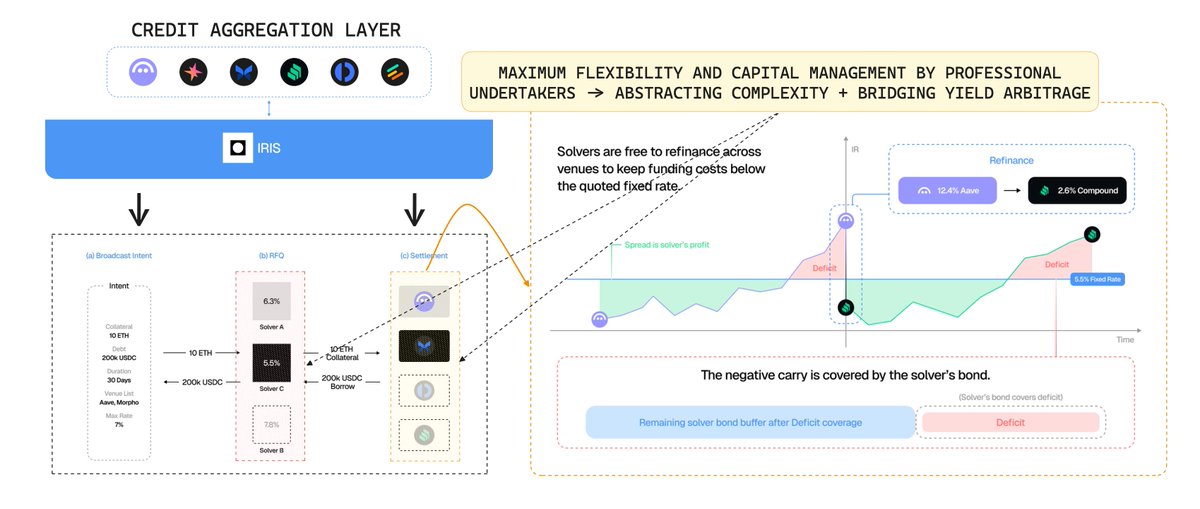
Wanted to highlight @iris_credit here, which introduces a fixed-rate credit aggregation layer powered by solvers.
Fixed rates (as seen in TradFi) are fundamental to predictability in financing costs and long-term capital planning, and this is something DeFi has yet to deliver effectively at scale.
The key innovation lies in the intent-based model, which introduces flexibility and abstraction, allowing solvers to operate without being constrained by rigid, single-venue structures.
This unlocks a workflow much closer to how TradFi institutions manage long-term fixed-rate loans.
Banks don’t fund loans by perfectly matching liabilities with equivalent fixed-rate deposits. Instead, they actively manage liabilities over time via continuously adjusting funding sources to optimise cost + control risk.
That’s exactly what IRIS brings into DeFi.
With IRIS, solvers are no longer bound to a single venue’s rate. They can tap into a broader opportunity set across multiple integrated lending markets.
This fundamentally changes loan pricing.
Rather than anchoring to a static rate at a single point in time, loans are priced based on a solver’s ability to actively manage the liability across its full lifecycle.
That includes:
1. refinancing across venues (illustration eg. in diagram)
2. dynamically rebalancing positions
3. capturing rate differentials wherever they arise
All of which leads to greater capital efficiency and a more optimised cost of funding.
With meaningful lending activity + participation across accredited funds/institutions, it's obvious that the liquidity depth and diversity of robust lending venues provides a plausible environment for IRIS to build on top of this.
You can view this as introducing a meta-layer of aggregation and competition that leverages multi-venue liquidity to push credit markets into their next phase.
This marks the beginning of a broader shift towards a dynamic, actively managed credit system imo.
Disclosure: investor