@qwen_cloud Alibaba charged me for their Token Plan, issued an API key, and THEN told me it was useless without KYC — including uploading my passport.
Seriously, Alibaba? Maybe mention that BEFORE taking the money?
I use multiple US API providers and none require this nonsense.
Never again.
@alibaba_cloud Alibaba charged me for their Token Plan, issued an API key, and THEN told me it was useless without KYC — including uploading my passport.
Seriously, Alibaba? Maybe mention that BEFORE taking the money?
I use multiple US API providers and none require this nonsense.
Never again.
@alibaba_cloud Alibaba charged me for their Token Plan, issued an API key, and THEN told me it was useless without KYC — including uploading my passport.
Seriously, Alibaba? Maybe mention that BEFORE taking the money?
I use multiple US API providers and none require this nonsens. Never again.
@alibaba_cloud Alibaba charged me for their Token Plan, issued an API key, and THEN told me it was useless without KYC — including uploading my passport.
Seriously, Alibaba? Maybe mention that BEFORE taking the money?
I use multiple US API providers and none require this nonsense.
Never again.
@alibaba_cloud Alibaba charged me for their Token Plan, issued an API key, and THEN told me it was useless without KYC — including uploading my passport.
Seriously, Alibaba? Maybe mention that BEFORE taking the money?
I use multiple US API providers and none require this nonsense.
Never again.
Social media vs reality:
Megadose creatine (20+ g/day)
Reality: most people don't need more than 100 mg/kg/day
Protein every meal, eat a lot of protein
Reality: most people don't need more than 1.5 g/kg/day
Sleep 8 hours no matter what
Reality: 7 hours appears to be enough
Avoid all stress
Reality: stress is more harmful if you perceive it as harmful and stress is a necessary component to a lot of the benefits of exercise etc.
No carbs after 6 PM
Reality: total calories and body composition matter more than carb timing
Never eat processed food
Reality: overall diet quality matters more than occasional processed food
Blood sugar spikes are dangerous
Reality: in healthy people, temporary glucose rises after meals are normal and don't cause long-term harm
Plant toxins (lectins, oxalates, phytates, etc.)
Reality: most people who aren't allergic or medically sensitive don't need to avoid them; some of these compounds actually have anti-cancer effects
Never eat fruit because of sugar
Reality: whole fruit is associated with better metabolic health.
One "superfood" will transform your health
Reality: overall dietary pattern matters far more than any single food. There are no irreplaceable foods.
There's one optimal diet for everyone
Reality: several dietary patterns can support excellent health if they emphasize whole foods and adequate nutrition.
@tonbistudio I’ve found it really useful to feed ChatGPT a raw idea and ask it to write a specific, goal-oriented prompt based on OpenAI’s official docs
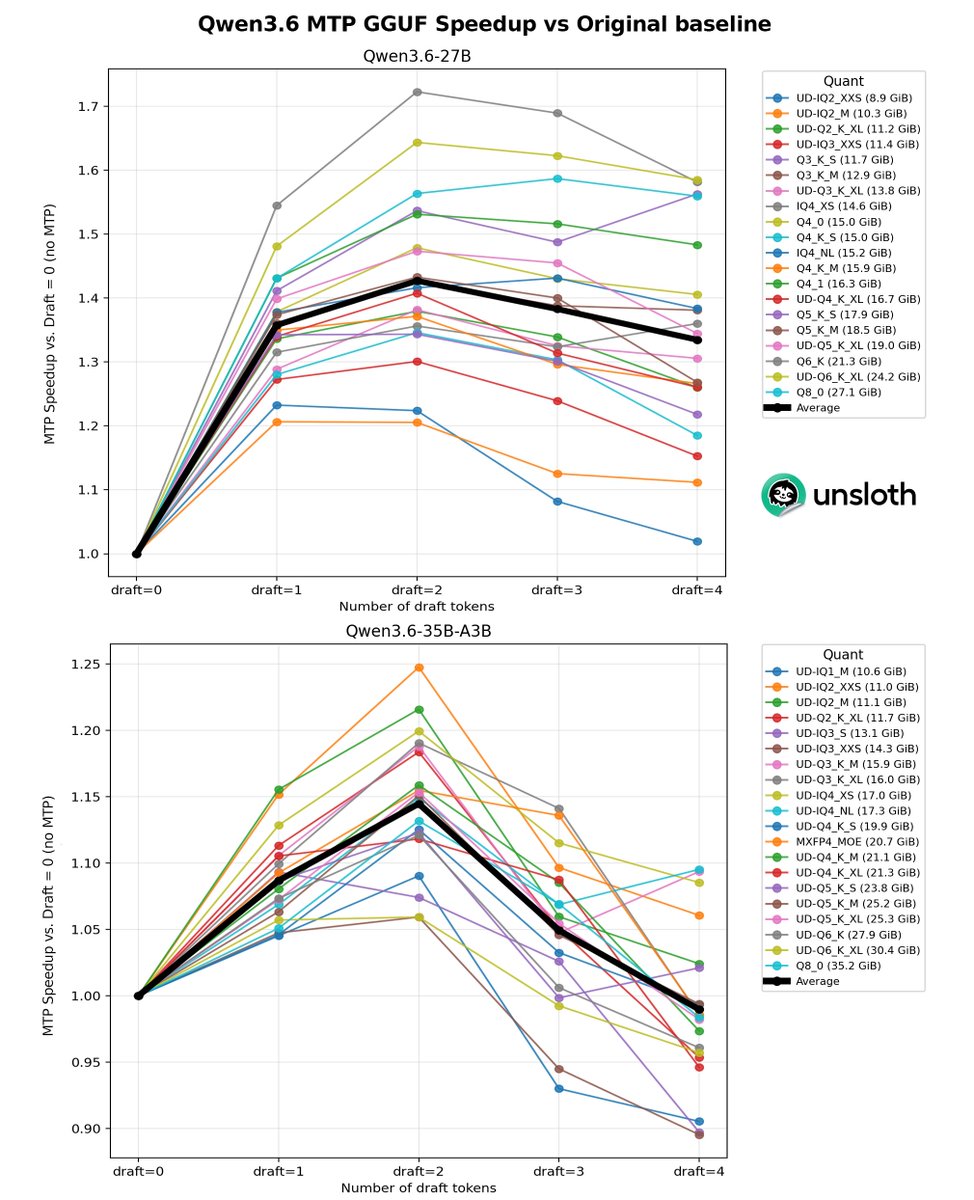
We released experimental MTP Qwen3.6 Unsloth GGUFs!
Qwen3.6 27B MTP now runs at 140 tokens/s. Qwen3.6 35B-A3B MTP gets 220 tokens/s generation on a single GPU.
Qwen3.6 27B and 35B-A3B have >1.4x speed-up over the original GGUFs without any change in accuracy.
Guide + GGUFs + Benchmarks: https://t.co/x9BYC3iXCL
In terms of average speedup, we see a 1.4x for dense models at draft tokens = 2 and for the MoE around 1.15 to 1.2x.
We do not recommend more than 2 draft tokens because the acceptance rate drops precipitously from 83% to 50% with 4 draft tokens, and the forward passes for MTP become less beneficial.
Use `--spec-type mtp --spec-draft-n-max 2`
Thanks to Aman for https://t.co/0WKkIC0kyW!
@wiedymi@sudoingX You can always escalate to frontier models when needed, even with automatic routing.
I personally bought a Tesla V100 32GB SXM2 from China and have never regretted it.
@wiedymi@sudoingX Yes, local models are definitely still behind frontier models. But as an everyday driver for Hermes Agent and similar workflows, they’re a solid remedy.
I can burn through my weekly ChatGPT Plus limit in a single day, so local-first makes sense.
MTP in llama.cpp on a single Tesla V100 32GB is not a toy.
Qwen3.6-27B MTP @ 262K ctx:
→ ~49 tok/s server
Qwen3.6-35B-A3B MTP @ 262K ctx:
→ ~134 tok/s server
Old datacenter GPUs are not dead.
They just needed the right kernels, quant, and MTP.
https://t.co/QSc45TiSqi
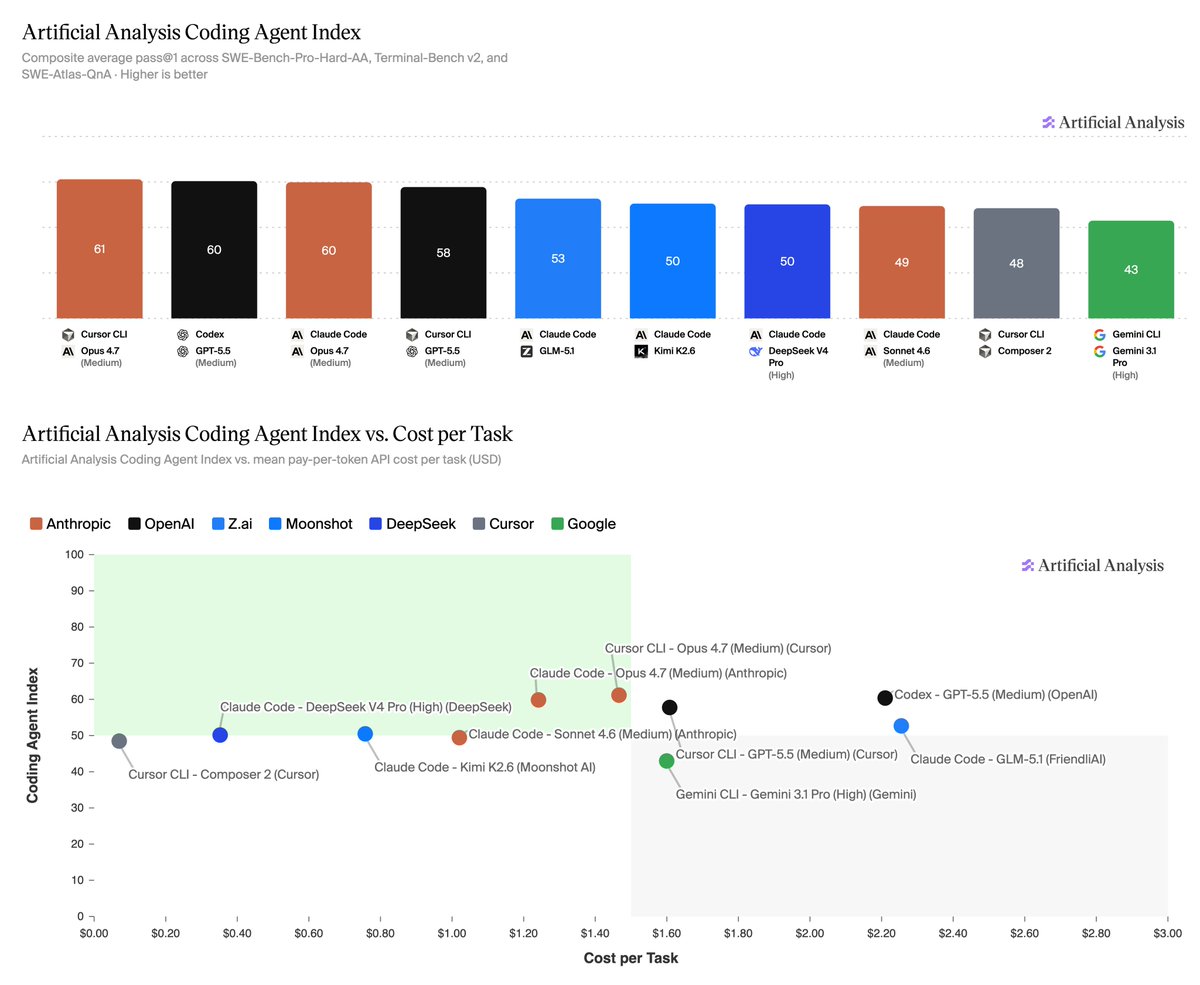
Announcing the Artificial Analysis Coding Agent Index! Our new coding agent benchmarks measure how combinations of agent harnesses and models perform on 3 leading benchmarks, token usage, cost and more
When developers use AI to code they’re choosing a model, but also pairing it with a specific harness. It makes sense to benchmark that combination to understand and compare performance.
The Artificial Analysis Coding Agent Index includes 3 leading benchmarks that represent a broad spectrum of coding agent use:
➤ SWE-Bench-Pro-Hard-AA, 150 realistic coding tasks that frontier models struggle with, sampled from Scale AI’s SWE-Bench Pro
➤ Terminal-Bench v2, 84 agentic terminal tasks from the Laude Institute and that range from system administration and cryptography to machine learning. 5 tasks were filtered due to environment incompatibility
➤ SWE-Atlas-QnA, 124 technical questions developed by Scale AI about how code behaves, root causes of issues, and more, requiring agents to explore codebases and give text answers
Analysis of results:
➤ Opus 4.7 and GPT-5.5 lead the Index: Opus 4.7 in Cursor CLI scores 61, followed closely by GPT-5.5 in Codex and Opus 4.7 in Claude Code at 60. GPT-5.5 in Cursor CLI follows at 58.
➤ Open weights models are competitive, but still trail the leaders: GLM-5.1 in Claude Code is the top open-weight result at 53, followed by Kimi K2.6 and DeepSeek V4 Pro in Claude Code at 50. These are strong results, but still meaningfully behind the top proprietary models.
➤ Gemini 3.1 Pro in Gemini CLI underperforms: Gemini 3.1 Pro in Gemini CLI scores 43, well below where Gemini 3.1 Pro sits on our Intelligence Index, highlighting that Gemini’s performance in Gemini CLI remains a relative weak spot for Google’s offering.
➤ Cost per task (API token pricing) varies >30x: Composer 2 in Cursor CLI is cheapest at $0.07/task, followed by DeepSeek V4 Pro in Claude Code at $0.35/task and Kimi K2.6 in Claude Code at $0.76/task. At the high end, GPT-5.5 in Codex costs $2.21/task, while GLM-5.1 in Claude Code costs $2.26/task. For both models this was contributed to by high token usage, and in GPT-5.5’s case by a relatively higher per token cost.
➤ Token usage varies >3x: GLM-5.1 in Claude Code uses the most tokens at 4.8M/task, followed by Kimi K2.6 at 3.7M/task and DeepSeek V4 Pro at 3.5M/task. GPT-5.5 in Codex uses 2.8M tokens/task, substantially more than Opus 4.7 in Claude Code at 1.7M/task. In GLM-5.1’s case, higher token usage, cost and execution time were partly driven by the model entering loops on some tasks.
➤ Cache hit rates remain high but vary materially: Cache hit rates range from 80% to 96% across combinations. Provider routing, harness prompt structure and cache behavior can materially change the economics of running the same model given cached inputs are typically <50% the API price of regular input tokens.
➤ Time per task varies >7x: Opus 4.7 in Claude Code is fastest at ~6 minutes/task, while Kimi K2.6 in Claude Code is slowest at ~40 minutes/task. This is contributed to by differences in average turns per task, token usage and API serving speed. Opus 4.7 had materially lower amount of turns to complete a task than all other models while Kimi K2.6 had the most.
➤ Cursor made real progress with Composer 2: Composer 2 in Cursor CLI scores 48, near the leading open-weight model results, while being the cheapest combination measured at $0.07/task. Cursor has stated Composer 2 is built from Kimi K2.5, showcasing they have made substantial post-training gains.
This is just the start. We are planning to add additional agents (both harnesses and models). Let us know what you would like to see added next.