They adamantly took my credit information to show me this ? And also I couldn’t find a way to not export my data. I couldn’t only find a way to delete it all or export it. #meta#chor
@SmartScience Can't really get away from it, can reduce it exposure maybe. The way PFAS was covered up back in the day, I have no trust in PTFE either and that extends to plastics too. Replaced all my cookware with Stainless steel/cast iron and plastic containers for glass. Back to basics!
Imagine trying to teach someone how to swim just by letting them read books about water.
That is how we have been training AI on physics, using text descriptions.
To really learn, you need to get in the water.
"The Well" is that water.
Polymathic AI has released a massive 15TB open-source library of physics simulations. It allows AI models to experience physical phenomena directly.
Instead of reading about a supernova, the model processes the actual data of the explosion. Instead of reading about aerodynamics, it analyzes the fluid flow.
This moves us from [Generative AI] (making things up) to [Scientific AI] (discovering truth).
A huge step forward for open science.
GitHub Repo: https://t.co/xgUdqncyRH
Wow. Incredible amount of SOTA training data now just available to China thanks to @mercor leak. Every major lab. Billions and billions of value and a major national security issue.
- Drafted a blog post
- Used an LLM to meticulously improve the argument over 4 hours.
- Wow, feeling great, it’s so convincing!
- Fun idea let’s ask it to argue the opposite.
- LLM demolishes the entire argument and convinces me that the opposite is in fact true.
- lol
The LLMs may elicit an opinion when asked but are extremely competent in arguing almost any direction. This is actually super useful as a tool for forming your own opinions, just make sure to ask different directions and be careful with the sycophancy.
“Where are the best engineers in Chicago?”
I hear this everyday from startups
So I built https://t.co/cNAZK6adf8 to connect engineers with a curated list of Chicago startups that are hiring 🤝♾️
Sign up, post a role, lmk what you think
Karpathy is describing the exact same failure mode that killed every search engine before Google.
Early search ranked by keyword frequency. Ask about “python” once, and every result was python forever. Google’s insight was relevance to the current query, not historical frequency. LLM memory systems in 2026 are running the AltaVista playbook. Store facts about the user, retrieve what’s semantically close, inject it into context. The retrieval is getting better. The problem Karpathy is pointing at is downstream of retrieval.
Wang et al. presented “Contextual Distraction Vulnerability” at ICLR and NeurIPS last year: adding semantically coherent but task-irrelevant context to a prompt causes performance drops over 45% in mainstream models. Yang et al. at EMNLP 2025 confirmed it with GSM-DC: irrelevant context corrupts reasoning path selection and arithmetic accuracy. The distraction isn’t a vague qualitative annoyance. It’s measurable, reproducible degradation in capability.
OpenAI published the Instruction Hierarchy to train models to ignore untrusted context from third parties. They followed it with IH-Challenge, which improved prompt injection robustness on GPT-5-Mini. The architecture can now deprioritize malicious instructions from adversaries. But memory is trusted context injected by the system itself. It arrives in the same position as system instructions, wrapped in the same formatting, with the same implicit authority. The instruction hierarchy doesn’t help when the distraction is coming from inside the house.
Liu et al.‘s “Lost in the Middle” showed models over-attend to content at the beginning and end of context. Memory gets placed at the beginning. Positionally, it’s indistinguishable from instructions.
RLHF penalizes wrong answers, refusals, tone failures. It does not penalize “incorporated a correctly retrieved memory when the query didn’t call for it.” Until the reward model includes examples where correct behavior is generating as if the memory isn’t there, models will keep trying too hard with whatever context they’re given.
One common issue with personalization in all LLMs is how distracting memory seems to be for the models. A single question from 2 months ago about some topic can keep coming up as some kind of a deep interest of mine with undue mentions in perpetuity. Some kind of trying too hard.
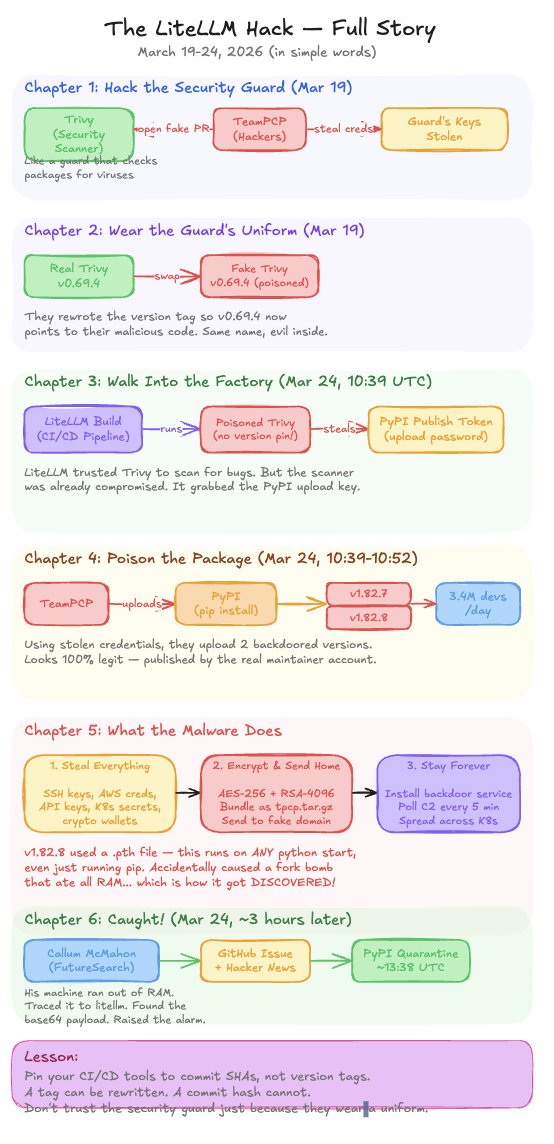
This was a very spooky attack.
Chapter 1 — Hackers open a fake Pull Request on Trivy (a security scanner). A misconfigured workflow gives their code access to the repo's secret keys.
Chapter 2 — With stolen keys, they swap the real Trivy v0.69.4 with a poisoned version. Same name, evil inside.
Chapter 3 — LiteLLM's build pipeline runs Trivy as a security check, but doesn't pin to a specific version. It pulls the poisoned one, which steals the PyPI upload token from the build environment.
Chapter 4 — Hackers use that token to upload two backdoored versions of litellm to PyPI. Looks completely legit because it's published with real credentials.
Chapter 5 — The malware steals every credential it can find, encrypts and sends them to a fake domain, installs a permanent backdoor, and spreads across Kubernetes clusters.
Chapter 6 — A developer's machine ran out of RAM because the malware accidentally fork-bombed itself. He investigated, found the payload, and raised the alarm. PyPI quarantined it ~3 hours later.
@0x0SojalSec 👏These are important baby steps to develop improved foundation for the slight increases in productivity. Not to mention, It was good to read something non AI slop pub :)
Kudos to the team for not running behind the hype!
Chinese scientists have developed,
The best shortest-path algorithm in 41 years!
A team from Tsinghua University has broken Dijkstra's "sorting barrier" - the first improvement since 1984.
Just use for a world-map 🤯
Paper - https://t.co/0AhR5O7vl4
https://t.co/a9KMVRuYGx