How would you design a pretrained LLM that preserves output diversity AUTOMATICALLY after finetuning?
Our method: learn a diverse “annotation” distribution from the pretraining data that conditions the generations, and then **don’t touch it when fine-tuning**!
1/
You have: dataset X, query access to some function f
You want: a differentially private estimate of f(X)
A thread on new work with Ephraim Linder, Mahbod Majid, and Vikrant Singhal. (1/9)
Just released a new pretraining paper with some interesting takeaways:
- sharpness minimization is important but it doesn’t show its benefit until *after* you post-train
- increase your learning rate!! (this is free!)
read Ishaan’s thread but I’ll also add my 2 cents below
1/n
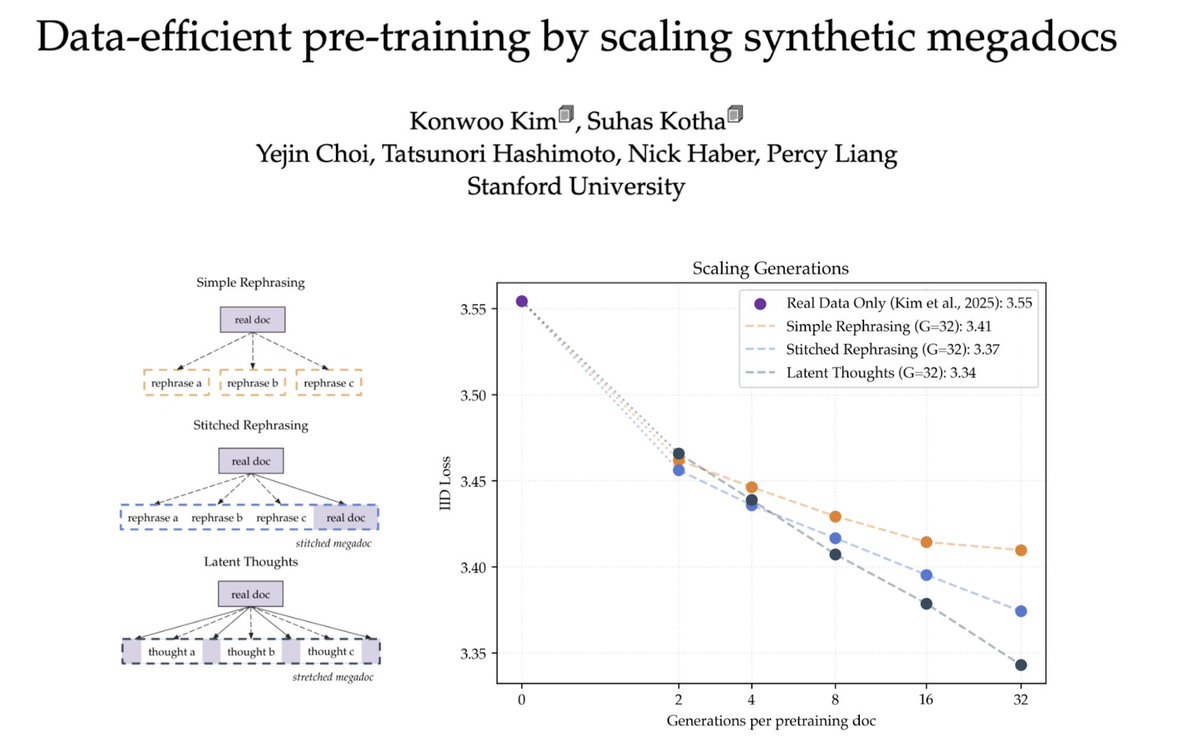
for data-constrained pre-training, synth data isn’t just benchmaxxing, it lowers loss on the real data distribution as we generate more tokens
for even better scaling, treat synth gens as forming one long 𝗺𝗲𝗴𝗮𝗱𝗼𝗰: 1.8x data efficiency with larger gains under more compute
Since compute grows faster than the web, we think the future of pre-training lies in the algorithms that will best leverage ♾ compute
We find simple recipes that improve the asymptote of compute scaling laws to be 5x data efficient, offering better perf w/ sufficient compute
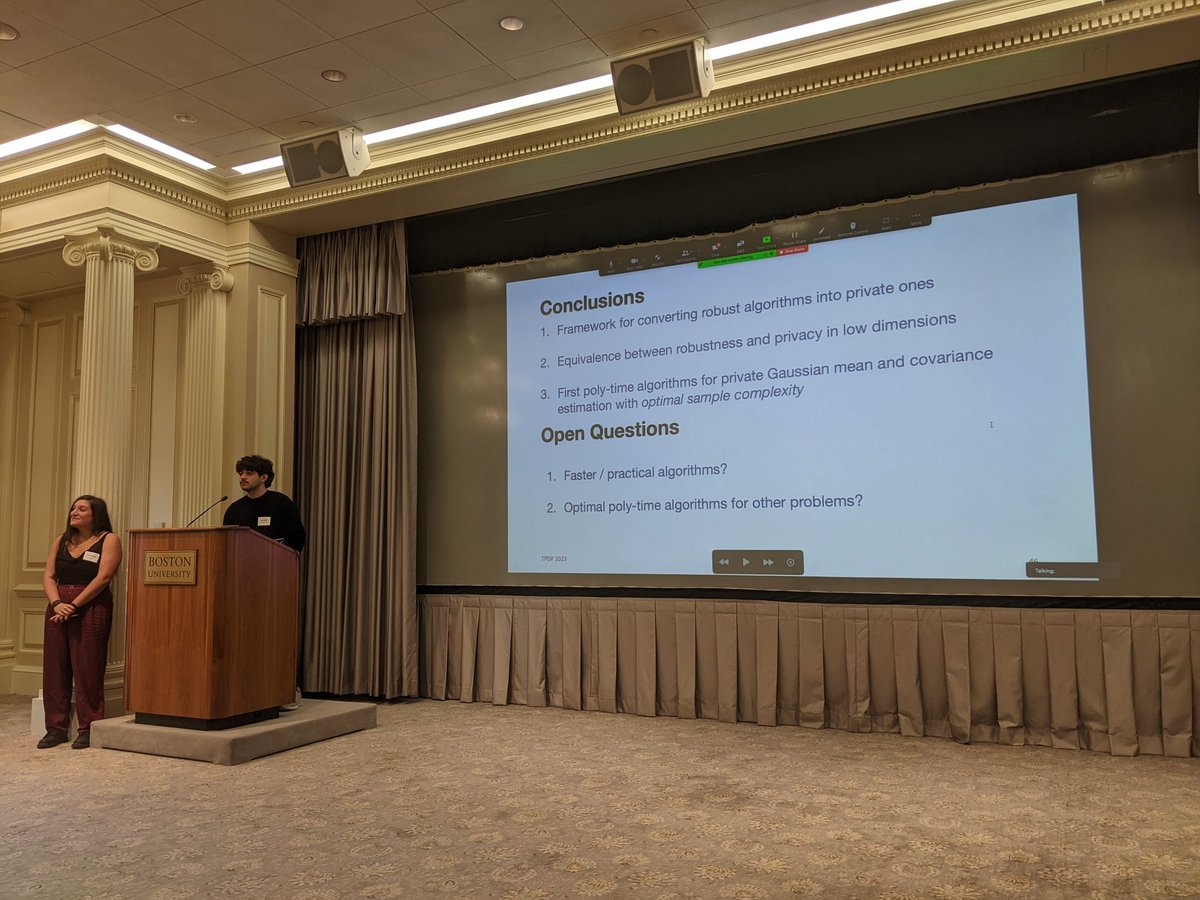
I'm in Boston for one day for a privacy workshop (TPDP 2023). @zakynthinou and @mahbodm_ present the first contributed talk, on showing how robust estimators imply private estimators. Check out both works! (https://t.co/T7UhkPlX2Y, https://t.co/k8fsj4SVJq)
Just received the Faculty of Math Graduate Research Excellence Award from @WaterlooMath and I couldn't be more grateful! Huge thanks to my amazing advisor Gautam for the guidance and support.
Check out my talk about our paper "Efficient Mean Estimation with Pure Differential Privacy via a Sum-of-Squares Exponential Mechanism" (https://t.co/0FFgSTv79p) for STOC 2022.
Based on join work with @Samuel_BKH and @thegautamkamath.
https://t.co/N1R82PX9TI
New paper on arXiv: "Efficient Mean Estimation with Pure Differential Privacy via a Sum-of-Squares Exponential Mechanism," with @Samuel_BKH and @mahbodm_.
Finally resolves an open problem on my mind since April 2019 (~2.5 years ago).
https://t.co/K8xWukFO6O
🧵Thread ⬇️ 1/n