@GeneralBakshi Use the engines to prove the prototypes - but start on replacement engines today. So we can get it off the ground with another engine in 5 years from now.
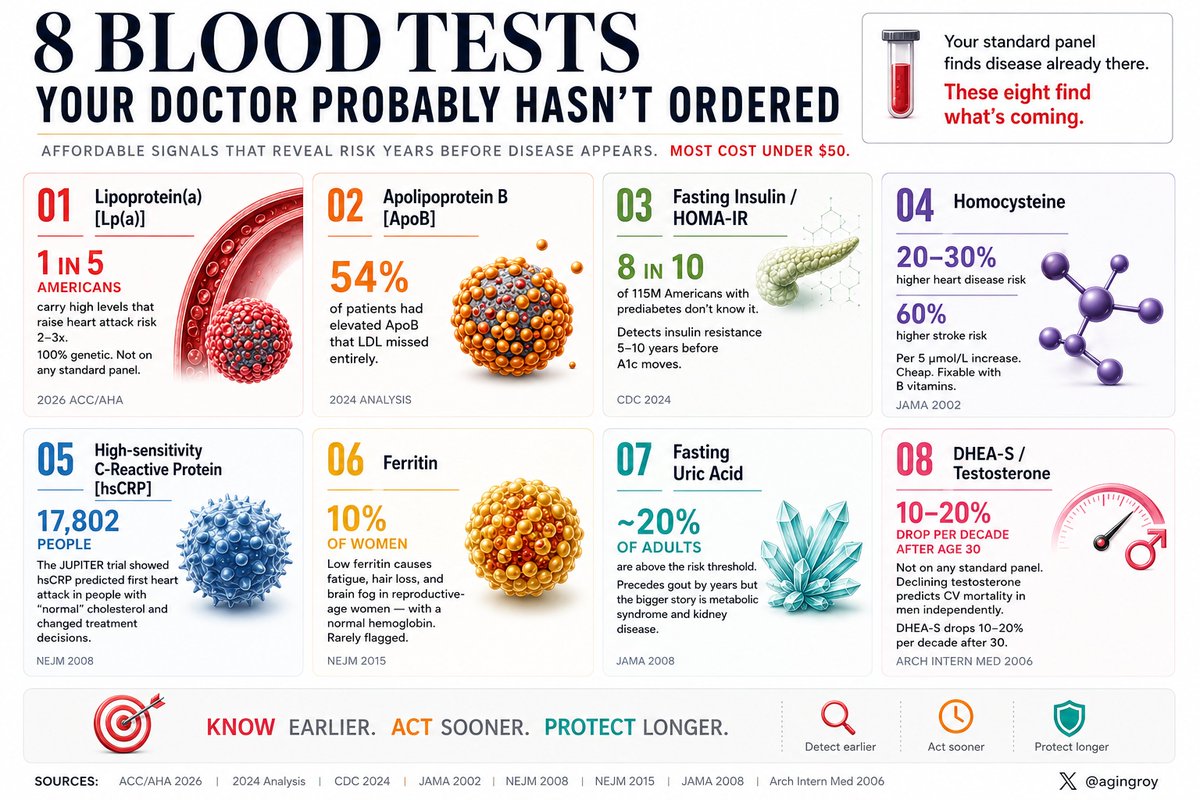
8 blood tests your doctor probably hasn't ordered. Most cost under $50.
1. Lp(a): 1 in 5 Americans carry high levels that raise heart attack risk 2-3x. 100% genetic. Not on any standard panel. 2026 ACC/AHA guidelines now say test once.
2. ApoB: Counts every atherogenic particle, not just LDL. A 2024 analysis found 54% of patients had elevated ApoB that LDL missed entirely.
3. Fasting insulin / HOMA-IR: Detects insulin resistance 5-10 years before A1c moves. 8 in 10 of the 115M Americans with prediabetes don't know it (CDC).
4. Homocysteine: 5 µmol/L increase = 20-30% higher heart disease risk and 60% higher stroke risk. Cheap. Fixable with B vitamins.
5. hsCRP: Predicts first heart attack in people with "normal" cholesterol. The JUPITER trial (n=17,802) showed it changed treatment decisions entirely.
6. Ferritin: Low ferritin causes fatigue, hair loss, and brain fog in 10% of reproductive-age women — with a normal hemoglobin. Rarely flagged.
7. Fasting uric acid: Precedes gout by years but the bigger story is metabolic syndrome and kidney disease. ~20% of adults are above the risk threshold.
8. DHEA-S / testosterone: Not on any standard panel. Declining testosterone predicts CV mortality in men independently. DHEA-S drops 10-20% per decade after 30.
Your doctor's standard panel was designed to find disease already there. These eight find what's coming.
Two neurologists who run the largest brain health outreach program in America just exposed how to slash dementia risk by 60% ( without meds or supplements)
Your brain will thank you for reading this:
(1/11) A 25 minute walk reduces Alzheimer's risk by 40%
This won't stop Chrome from downloading the same thing again... do this instead
1.Close Chrome
2.Delete weights.bin
3.Create an empty file named weights.bin in that same location
4.Go to the file's properties, and Deny permissions from the OS to touching that empty file
Google Chrome is quietly downloading a roughly 4 GB AI model to many users’ computers without clear upfront consent.
The file, called weights.bin, is part of Google’s Gemini Nano on-device language model and lands in the browser’s user data folder under OptGuideOnDeviceModel.
It powers built-in AI tools such as “Help me write,” smarter tab suggestions, on-device scam detection, and page summarization. The download triggers automatically for devices meeting minimum hardware requirements, and Chrome often replaces the files if deleted.
While the model processes data locally, installation happens in the background with minimal notification.
The scale is noteworthy. Hundreds of millions or billions of installations add up to thousands of tonnes of carbon emissions globally from data transfer, even though each is a one-time event.
To prevent or remove it, go to chrome://flags, disable the entries for the optimization guide on-device model and Prompt API, restart the browser, and manually delete the folder.
A groundbreaking study has pinpointed a microscopic culprit behind the debilitating fatigue, brain fog, and other persistent symptoms of long COVID: abnormal, sticky microclots embedded with neutrophil extracellular traps (NETs) in patients' blood.
These microclots—tiny aggregates of clotting proteins—are small enough to obstruct the body's tiniest blood vessels (capillaries), restricting oxygen delivery to tissues and organs without triggering obvious large-scale clotting events. In long COVID patients, researchers observed a dramatic ~20-fold increase (median 19.7 times higher) in the number of these microclots compared to healthy controls, with the clots also tending to be larger.
What sets this finding apart is the discovery that these microclots are structurally intertwined with NETs—web-like structures of DNA, enzymes (such as myeloperoxidase and neutrophil elastase), and proteins released by neutrophils (a type of white blood cell) to ensnare pathogens. Normally, NETs form temporarily and then dissolve, but in long COVID, they persist and become physically embedded within the microclots, creating highly resistant, "gummy" structures that evade the body's natural clot-breaking processes (fibrinolysis). This creates a chronic thromboinflammatory state, where blocked microcirculation and ongoing low-grade inflammation may sustain symptoms like exhaustion and cognitive impairment.
The differences were so pronounced that machine learning models analyzing anonymized blood samples (via fluorescence microscopy for markers like ThT for amyloid-like structures, DNA stains, and MPO for NETs) could distinguish long COVID patients from healthy individuals with 91% accuracy—offering a potential objective biomarker for a condition that has long evaded reliable diagnosis through standard tests (e.g., normal D-dimer, PT/INR, or aPTT levels despite significant microclot burden).
This work, led by teams including Prof. Etheresia Pretorius (Stellenbosch University) and Dr. Alain Thierry (Montpellier University), reframes long COVID as a tangible, blood-based disorder driven by dysregulated coagulation and innate immunity rather than vague "post-viral malaise." Targeting NETs or microclots—perhaps with therapies to degrade NETs or prevent their stabilization—could open doors to treating root causes instead of merely alleviating symptoms.
[Thierry, A. R., Usher, T., Sanchez, C., Turner, S., Venter, C., Pastor, B., Waters, M., Thompson, A., Mirandola, A., Pisareva, E., Prevostel, C., Laubscher, G. J., Kell, D. B., & Pretorius, E. (2025). Circulating Microclots Are Structurally Associated With Neutrophil Extracellular Traps and Their Amounts Are Elevated in Long COVID Patients. Journal of Medical Virology, 97(10), e70613. DOI: 10.1002/jmv.70613]
@GauravT71548031@BharatNair90 What exactly does trying mean?
The list you share is of purchases. Not programs IAF said was central and allocated resources and money towards to build its strength. Is that really trying?








![Rainmaker1973's tweet photo. A groundbreaking study has pinpointed a microscopic culprit behind the debilitating fatigue, brain fog, and other persistent symptoms of long COVID: abnormal, sticky microclots embedded with neutrophil extracellular traps (NETs) in patients' blood.
These microclots—tiny aggregates of clotting proteins—are small enough to obstruct the body's tiniest blood vessels (capillaries), restricting oxygen delivery to tissues and organs without triggering obvious large-scale clotting events. In long COVID patients, researchers observed a dramatic ~20-fold increase (median 19.7 times higher) in the number of these microclots compared to healthy controls, with the clots also tending to be larger.
What sets this finding apart is the discovery that these microclots are structurally intertwined with NETs—web-like structures of DNA, enzymes (such as myeloperoxidase and neutrophil elastase), and proteins released by neutrophils (a type of white blood cell) to ensnare pathogens. Normally, NETs form temporarily and then dissolve, but in long COVID, they persist and become physically embedded within the microclots, creating highly resistant, "gummy" structures that evade the body's natural clot-breaking processes (fibrinolysis). This creates a chronic thromboinflammatory state, where blocked microcirculation and ongoing low-grade inflammation may sustain symptoms like exhaustion and cognitive impairment.
The differences were so pronounced that machine learning models analyzing anonymized blood samples (via fluorescence microscopy for markers like ThT for amyloid-like structures, DNA stains, and MPO for NETs) could distinguish long COVID patients from healthy individuals with 91% accuracy—offering a potential objective biomarker for a condition that has long evaded reliable diagnosis through standard tests (e.g., normal D-dimer, PT/INR, or aPTT levels despite significant microclot burden).
This work, led by teams including Prof. Etheresia Pretorius (Stellenbosch University) and Dr. Alain Thierry (Montpellier University), reframes long COVID as a tangible, blood-based disorder driven by dysregulated coagulation and innate immunity rather than vague "post-viral malaise." Targeting NETs or microclots—perhaps with therapies to degrade NETs or prevent their stabilization—could open doors to treating root causes instead of merely alleviating symptoms.
[Thierry, A. R., Usher, T., Sanchez, C., Turner, S., Venter, C., Pastor, B., Waters, M., Thompson, A., Mirandola, A., Pisareva, E., Prevostel, C., Laubscher, G. J., Kell, D. B., & Pretorius, E. (2025). Circulating Microclots Are Structurally Associated With Neutrophil Extracellular Traps and Their Amounts Are Elevated in Long COVID Patients. Journal of Medical Virology, 97(10), e70613. DOI: 10.1002/jmv.70613]](https://pbs.twimg.com/media/HGRfjgfW0AMG95k.jpg)


