We just released a new startup naming tool at https://t.co/YdRS5T3UoE
How it works: Type any words and it will find what words it's associated with in definitions, Wikipedia, and other texts.
Unlike a thesaurus, this finds associative words that dig a layer deeper in their association and expand your thinking.
For example, type "Instant" and you'll see wink, Jiffy, pivotal, and more creative terms.
This (hopefully) becomes super helpful for startup naming because instead of getting boring exact match results, it helps you discover words and names you normally don't come across.
v1 is live now, with more coming soon 🧙
Instant hit $2.2M ARR!
I was debating whether to share revenue publicly, but I hope it's helpful to share what's working and what's not.
Our first product, Instant Domain Search, definitely sounds niche. But by simply focusing on making a great experience we've grown to 120,000+ monthly active users.
What's pushed that growth the most has been a few core ideas:
→ Make the core product faster and simpler
→ Build new tools around tangential keywords
→ Publish authoritative resources (stats, takes)
What's most exciting about this traffic is that people come to our tools with real intent: to start a company, a side project, a personal website, or anything they're passionate about.
And that opens up distribution for us to tackle even more ambitious problems: how do we lightweight, intuitive software that completes the loop from search to launch?
Excited to share the ambitious stuff we're working on next. Congrats to all of the team for this first milestone!
We shipped "Lists" within @Instantai!
The goal here: see if live, daily updated lists within google can pickup a new audience on google.
Today, almost everyone who comes to our site arrives with a name in mind. That's great for active intent, but it caps the audience to people who already know what they're searching for.
Lists is our bet on passive discovery: live, daily-updated collections of available domains (four-letter, dictionary words, .ai inventory, etc.) that we hope are useful enough on their own that people come back to browse from time to time.
Within days, we already got our "available 4 letter domains" ranking #1 on google! We'll know more later on once we see whether discovery converts to repeat visits, but it's a fun experiment to be running.
We (finally) rebuilt light mode at Instant Domain Search!
Our team mostly uses our product in dark mode, so that's where the attention went. Light mode became secondary and basically just an inverted version.
Then we looked at the data: nearly 40% of our MAU are on light mode 🫨
That sent me back to the drawing board: how can both modes serve different purposes?
→ Light mode is high contrast, more colorful, and faster to navigate
→ Dark mode is sleek, easier on the eyes, and uses subtle shades to layer
Now, we're finally proud to use our product in light mode. Shipping today, let us know what you think !!
@drfunk555 😆 you're right. i'm working on getting direct partnerships with all these registries.. going to investigate this one because we already partner with .blog 🤔
During our onsite the team sprinted on something we've kept in the backlog for too long: quality of life improvements.
We've shipped 20+ small updates we've all wanted (tool tips, lightmode polish, mobile nav redesign), but kept pushing off for bigger tasks.
A lot of them are making the product look and feel a lot more sleek!! Excited to make them live tomorrow.
Instant 2026 onsite is in the books!
This is my first time meeting the full-time team in person (we're fully remote across 5 countries).
We got a villa in Madeira, Portugal to work on some neat sprints, and more importantly, to hike through this incredible island.
More coming soon! ⚡
We built a new sidebar on Instant Domain Search !!
Something I've been learning: the best product experiences feel like a single surface, even when they're not.
Our site is technically a bunch of different website pages, but we've put a lot of work into hiding page refreshes and making transitions feel invisible.
This matters a lot which researching domains on a supposedly 'Instant' product and becomes more difficult as we release more and more tools and features.
That led us to designing a sidebar as a new command center. It sits alongside your page, and allows you to pull all the information from our "Check" tool. Soon we'll be adding many of our other tools there too.
Give it a try and let me know any feedback 🧙
AI coding agents are giving marketers (myself) the ability to experiment like a product team.
Here's what we've learned so far at @instantai:
1. Build tools instead of static content pages.
Instead of writing a blog post about a feature or trend, we started shipping small interactive versions. Why? 95% of clicks from Google/AI Search go to interactive tools, not static content.
2. Our content marketing crosschecks the feature's code.
When I ask for a launch post, Claude reads our actual codebase, understands what the feature does, then drafts in our voice. No reverse-engineering from screenshots or Notion docs.
3. Our visuals are live, not static.
Static PNGs and GIFs are so easy to ignore and scroll past. That's why every visual on our homepage is interactive: you can type into it, click around, and get real results straight from the product.
You can still do a lot of this on Webflow or Framer, but keeping marketing and product on different platforms taxes everything: copy drifts from what shipped, interactive ideas turn into engineering tickets, and marketing experimentation take much longer.
Building your marketing site in code is a bet that LLMs keep getting smarter, which feels like a very safe bet if you ask me 😸
We just increased our aftermarket library from .com only to the 10 most popular TLDs!
Our aftermarket is pretty neat: it runs an embedding model trained on all of Wikipedia that turns every word into a vector, then ranks results by semantic similarity instead of keyword match. All results returned in less than 25 ms!
Now live across .com, .net, .co, .org, .io, .ai, .info, .app, .me, .dev, and .xyz ⚡
We finally shipped our most requested feature at @Instantai: search filters!
The problem: most filter implementations fire a new server query on every click. For an instant tool, that means a flash on every keystroke. It felt backwards for our product, so we kept punting.
The idea: we built the "filter" step to run locally. Now, one query streams every result in as you type, and filters just reorganize the page instead of re-querying.
Give it a try and let us know what you think!
Thanks Andrew Allemann and @DomainNameWire for hosting me on your podcast to talk about everything that's happening at @Instantai! We chatted about our new search features, data API, and soon to be released registrar. I'll drop the link below if anyones interested.
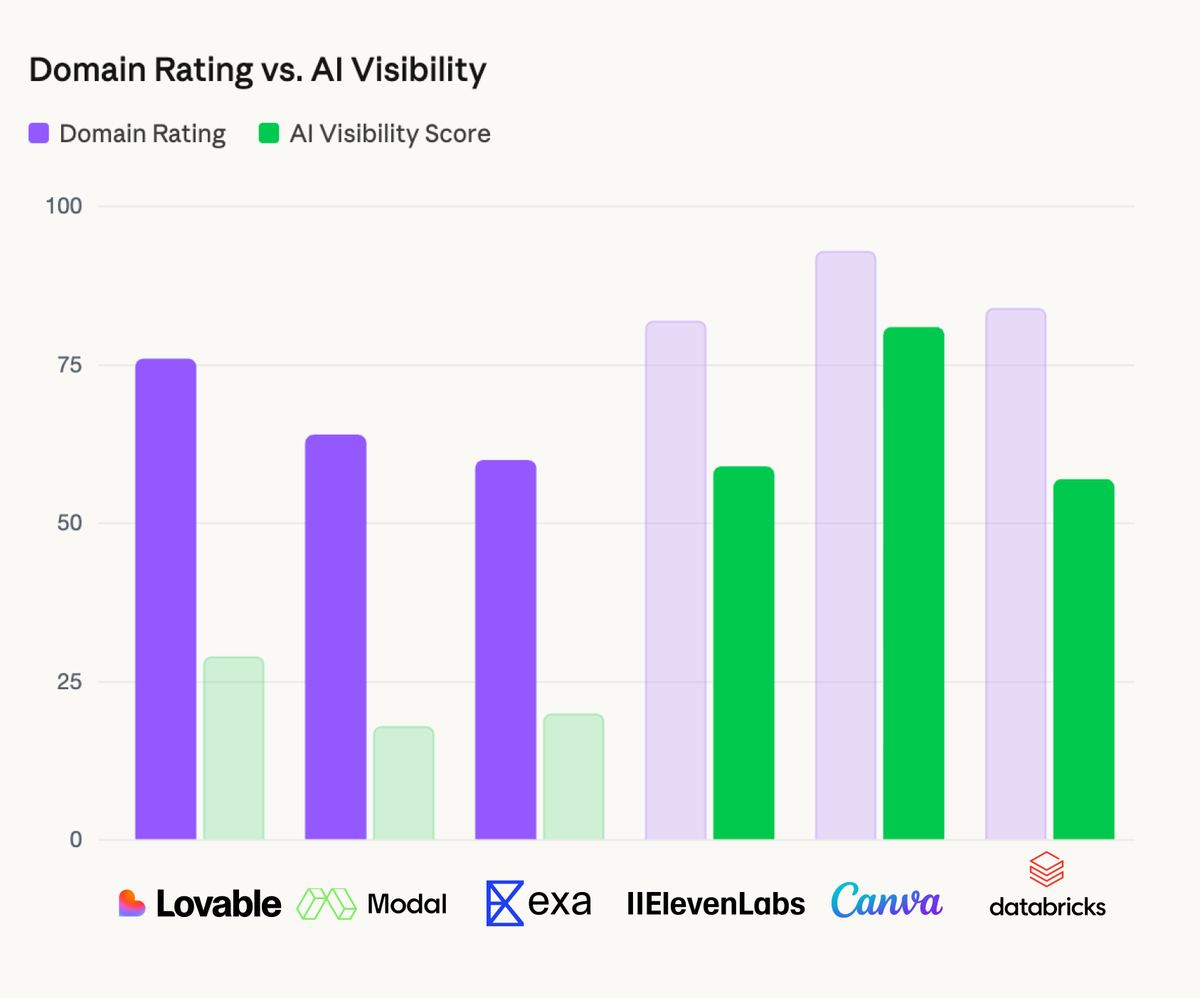
What works for SEO mostly doesn't translate for AI visibility.
Some of the companies crushing it on SEO:
→ Lovable has 170K+ referring domains. How? Every app users build on their platform creates a site that links back to https://t.co/uplP2MW4jx
→ Modal targets high-intent keywords with blog content: their posts on "nvidia h100 price" and "nvidia a100 price" rank on page one and pull thousands of monthly visits.
→ Exa built programmatic "webset" pages (auto-generated curated lists on niche topics) and pulls backlinks from developer ecosystems like GitHub
... Yet none of these companies are pulling their weight on AI visibility (29, 18, and 20 out of 100 respectively).
The standouts for AI Visibility tell a different story:
→ ElevenLabs (AI visibility: 59) gets 663K people search "elevenlabs" by name every month. They rank #1 for "text to speech" (378K monthly volume). When someone asks an LLM "what's the best AI voice tool", ElevenLabs IS the answer because they dominate the natural conversation around voice AI.
→ Canva (AI visibility: 81) is the same story for design. Ask any LLM "how do I make a presentation with AI" and Canva shows up. 9.7M organic keywords, but it's the brand ubiquity that drives AEO, not the keyword count.
→ Databricks (AI visibility: 57) with only 6.5K referring domains punches way above its weight. They own the data engineering conversation through press, conferences, and community (exactly the kind of signal LLMs use for training)
The companies winning AEO own the online conversations for their category, which is much harder to "hack" than traditional SEO (e.g. programatic content, buying backlinks, etc).
If you look at the top domain sales of 2026 (DNJournal), .ai overtook .com for the first time this quarter.
The data is a bit misleading for overall demand.
Sale prices are driven by a small number of high-value transactions. .ai names are newer, shorter, and more available at the premium end, so they trade more often. Investors are also treating them as a bet on AI's future.
We look at our own Instant Domain Search data and found that .com gets nearly 10x the searches of .ai.
Most people searching for a domain still go straight to .com. The demand never left. The good ones are just getting harder to find.
Last month Google showed our pages to over 2M people. Yet 95% of clicks went to interactive tools: domain search, domain generator, bulk search, MCP server.
The reason is simple: you can't search for a domain name in a Google snippet. Interactive pages have a moat against zero-click search.
While our static content pulls 200k+ impressions + 28k AI citations monthly, the CTR is 21x smaller (0.08%). ChatGPT and Google AI Overview are extracting the value before anyone visits.
In fact, the only blog that outperforms its category actually includes interactive charts and live updated data.
Now anytime we ship an SEO project, it's with the framework of "show, don't tell." We'd rather build a tool someone has to visit than a page LLMs can summarize.
We pulled every domain from YC's latest batch. Here's what we found:
→ Only 43% of startups are choosing .com (.ai is closing the gap with 31%)
→ Startups choosing .ai, .dev, and .co are getting domains 3-4 characters shorter
The shift is unsurprising when there's already 161 million .com domains registered.
Shorter names, more availability, lower cost- the math is starting to favor alternatives.