Just shipped PayShield for the Solana Frontier Hackathon 🚀
An x402-powered intelligence gateway for https://t.co/wP4HHV7esl where users pay in SOL on devnet to unlock protected API reports.
Also very first time using so many stacks together Next.js, Sol-dev, Render, x402 flow.
- Basic chatbot flow designers
- Some QA & coord tasks
What usually survives here is
- system archs
- human judgement
- domain expertise
- compliance
- high-stakes decision-making
-strategic thinking
roles ard AI orchestration, eval, govn & agent design
high time for pivoting :)
How is context engineering still not a labelled job ?
literally kills so many professions existing
- Jr. prompt engineer
- Tier 1 support agents
- Knowledge mgmt coords
- Research assistants
- Manual workflow ops
- Jr. Biz Analysts
- Entry level content adaptation
@ElevenLabs@Chime the only part here is in how voice modules built. US English IVR offers less accent variations whereas if it was to built for Indian IVR, the dialects would differ vividly
Came across a proj at my workplace, wherein Automated voice assitants are being used for Gov of America's tech comp, the stack has @ElevenLabs & @Chime for IVR and the amazing part is workflows that r incorporated in case of any errors leading to mishaps reaching to Human support
3 → 27×
Thats not a price increase.
Thats a strategy shift.
We r entering a new phase of AI:
Cheap models for scale
Mid models for logic
Expensive models for reasoning
Pricing is forcing architecture decisions now.
This is exactly where prompting matters.
if i try to build something with 0 to no knowledge of exact vision of how i want something built as i pictured it, the system will likely vaguely fail,
know that u’re using a powerful pattern without understanding why each piece exists😅
got asked this in a YC company interview system design round recently
"how do you keep an AI system aware of a project after 100s or 1000s of edits, without sending the entire history every time,
and users say vague stuff like “make that bigger”"
most people try to solve this with bigger context windows or by stuffing more prompts in, but that breaks as noise increases and tokens get expensive
what i did instead was stop treating prompts as plain text and treat every interaction as a structured action over a canonical state
so instead of the model trying to remember everything, the system maintains a source of truth state that always reflects the latest version
flow was simple: parse intent, resolve references like “that” using current state, run a confidence check, then execute and update state
the reference resolution step handles most of the ambiguity by mapping vague inputs to concrete entities instead of leaving it to the model to guess
i also added a confidence layer so if the system is unsure, it asks the user instead of making silent wrong edits
every action is stored as an event, not to replay everything, but to retrieve only the relevant history when needed
for context building, i send the current structured state plus top k relevant past events using semantic retrieval, which keeps tokens low and signal clean
main shift was this: don’t make the model remember everything, make the system decide what matters and feed only that
if anyone knows what could work better for graphics generation do lmk, i was constantly hitting limits for even one single tweak, took much longer time due to it 😅
Here's another build, just like prev one I thought of an idea, felt like doing it over a weekend but this time it took me longer to build it, so hear me speak in 2x about it.
Used Claude to build me glbs which was decent enough, anyways I wished I'd know better graphics creation
Not long ago, most student projects were about LLMs, RAGs, MCPs
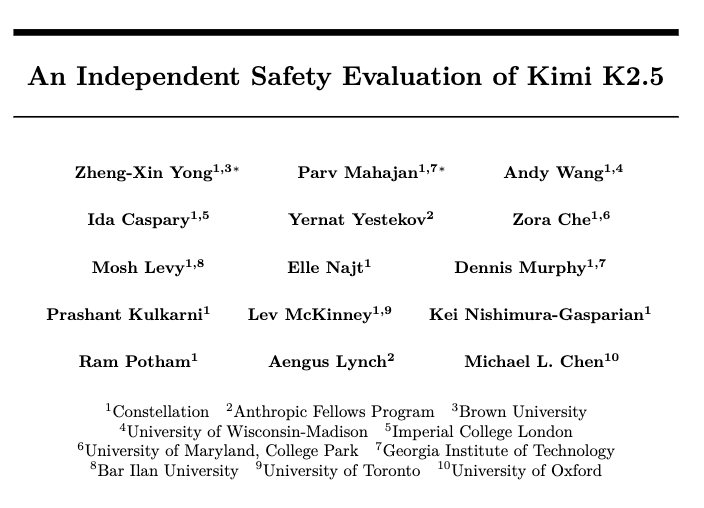
Now we’re seeing independent safety audits of models like KIMI K2.5.
With so many models accessible today, AI safety research feels more open than ever & honestly, more needed than ever.
Exciting new research from Astra & Anthropic Fellows working out of Constellation: one of the first independent AI safety audits of a new model. Congrats to @yong_zhengxin, @parvmahajan0, and everyone who contributed!