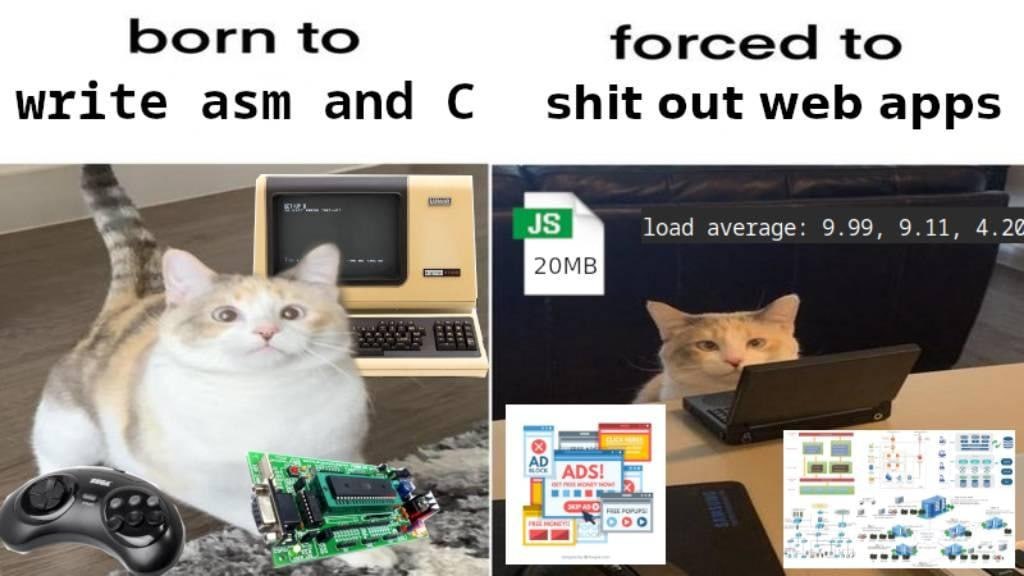
@CryptoCyberia yea i still dont think im a junior so idc that much its just harder to prove with no experience in serious companies that im atleast semisenior or smt
⋆˙⟡ THEM GTD spots ACCESS round 2⟡˙⋆
inviting these worlds into THEM ⸜( ˶>ᴗ<˶)⸝♡
Only in the next 24 hours holders can join discord and claim GTD role ✧˖°
MoeMoe LLC ✧ Oekaki Maker ✧ Kemonokaki ✧ Yumemono ✧ Miawlady Maker ✧ Steady Teddys on eth ✧ Camel Cabal ✧ Normies ✧ GOBLYNZ ✧ Banners NFT
Steps:
♡ join the Discord: [https://t.co/pQbxcXreC2]
♡ verify your assets
♡ claim archangel role (guaranteed spot for THEM)
The day humans clock out and touch grass, the autonomous agents wake up.
The Turing Hackathon, Phase 2: AI Awakening is now live.
$100K across 6 tracks, all onchain and open to everyone.
Register before June 15: https://t.co/RjNWXPEv9V
If you can't love me at my ⓘ Plugins are currently unavailable due to a game update you don't deserve me at my [11:02] Dalamud v2.5.x.x loaded. 11 plugin(s) loaded. There was an error loading Glamourer, your Penumbra version is not up to date.
🚨 BREAKING: cPanel and WHM, the control panels behind an estimated 70+ million websites, have a critical security flaw that lets anyone become root admin without a password. CVE-2026-41940 affects every supported version. It’s already being exploited in the wild.
watchTowr Labs published the full attack today, after the hosting company KnownHost confirmed the bug was already being used to break into a significant chunk of the internet.
If you've never heard of cPanel: it's the dashboard that hosting providers and millions of website owners use to manage their servers, domains, email accounts, databases, and SSL certificates. WHM is the admin version that controls the entire server. If someone gets root access to WHM, they get the keys to the kingdom and to every apartment inside it.
How the attack works, in plain English:
🔴 Step 1: The attacker sends a deliberately wrong login. cPanel still creates a temporary "you tried to log in" record on disk and gives the attacker a cookie tied to it.
🔴 Step 2: The attacker tweaks the cookie to disable cPanel's password encryption. Normally cPanel encrypts the password field on disk. With one small change to the cookie, cPanel just stores it as plain text instead.
🔴 Step 3: The attacker sends a fake login attempt where the password field secretly contains hidden line breaks. cPanel does not strip these line breaks out, so they get written straight to the session file. Each line break creates a brand new fake record. The attacker uses this to inject lines that say "this user is root" and "this user already authenticated successfully."
🔴 Step 4: The attacker visits one more random page on the site to nudge cPanel into re-reading the file. cPanel then promotes the injected fake lines into its main session memory.
🔴 Step 5: On the next request, cPanel sees a flag that says "this user already passed the password check." cPanel trusts that flag, skips checking the actual password, and lets the attacker in as root.
From start to finish, the attack takes a handful of HTTP requests.
If you run cPanel or WHM, the patched versions are:
🔴 cPanel/WHM 110.0.x → 11.110.0.97
🔴 cPanel/WHM 118.0.x → 11.118.0.63
🔴 cPanel/WHM 126.0.x → 11.126.0.54
🔴 cPanel/WHM 132.0.x → 11.132.0.29
🔴 cPanel/WHM 134.0.x → 11.134.0.20
🔴 cPanel/WHM 136.0.x → 11.136.0.5
If your version is older than these, assume someone has already broken in and act accordingly. Patch right now, then rotate every password and key the server touched: root passwords, API tokens, SSL private keys, SSH keys, mail passwords, and database passwords.




![thembypetra's tweet photo. ⋆˙⟡ THEM GTD spots ACCESS round 2⟡˙⋆
inviting these worlds into THEM ⸜( ˶>ᴗ<˶)⸝♡
Only in the next 24 hours holders can join discord and claim GTD role ✧˖°
MoeMoe LLC ✧ Oekaki Maker ✧ Kemonokaki ✧ Yumemono ✧ Miawlady Maker ✧ Steady Teddys on eth ✧ Camel Cabal ✧ Normies ✧ GOBLYNZ ✧ Banners NFT
Steps:
♡ join the Discord: [https://t.co/pQbxcXreC2]
♡ verify your assets
♡ claim archangel role (guaranteed spot for THEM)](https://pbs.twimg.com/media/HHeyWvsaoAAwEjJ.jpg)