Trucking spot rates have never moved up this fast, ever - including early COVID.
The weekly average for truckload spot rates moves to a new all-time high of $3.71/mile.
It took 43 weeks for spot rates to increase by $1.38/mile during early COVID (April - Feb 2021).
It has taken only 29 weeks to achieve the same increase (Nov 2025 - June 2026).
BREAKING: Venezuela’s crude oil exports have surged +61% YoY, to 1.25 million barrels per day, the highest in 7 years.
The surge was led by rising shipments to the US at ~558,000 barrels per day, India at ~427,000 barrels per day, and Europe at ~169,000 barrels per day.
In total, 67 cargoes were exported from Venezuelan ports in May.
Since November 2025, Venezuela’s oil exports have surged +150%, or ~750,000 barrels,
This comes as the US eased sanctions on Venezuela's oil industry following the capture of Maduro earlier this year.
Venezuela's oil ministry is now targeting output of 1.37 million barrels per day by year-end, which would mark a +22% increase from 2025 levels and the highest since US sanctions were first imposed in 2019.
Venezuelan oil is increasingly flowing into global markets.
California is about 4 weeks away from running out of jet fuel and diesel.
The issue is that there is no pipeline setup to get these fuels to California from other parts of the USA.
There are simply not enough tankers arriving in California to meet current demand.
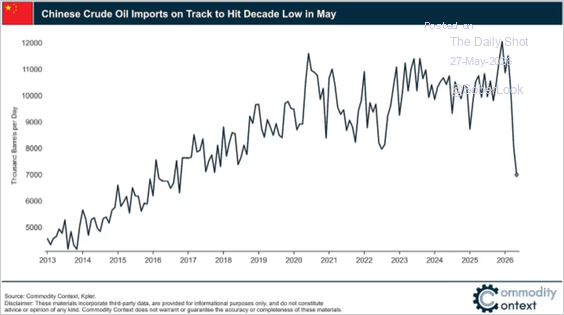
The Strait of Hormuz is reducing oil supply and certain areas of the world without their own refineries are losing access to fuel.
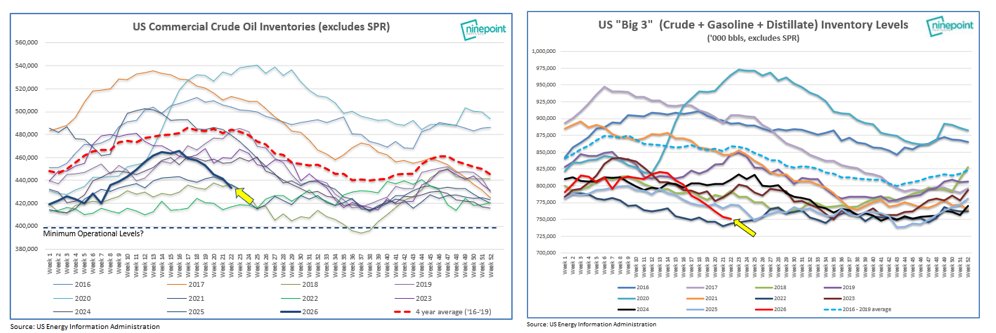
This morning I’m reading “alarmingly low US distillate stocks” ~7MM bbls above operationally challenging levels, and Mercuria head of freight saying 10% of global ships could be forced to stop NEXT MONTH due to fuel shortages. This is how we go from oil pricing deficits to pricing shortages.
Texas is getting REPLACED — one H-1B visa at a time, and real Texans are PISSED.
We built the best state in America — no income tax, booming tech, energy, logistics, and jobs. Now housing is unaffordable, traffic is hell, and Texas-born engineers and workers are getting pushed out while Indian-origin CEOs flood their massive Texas operations with H-1B imports.
Here’s the full list of major corporations doing huge business across Austin, Dallas, Houston, San Antonio, Plano, and Frisco:
Tech and Cloud Giants:
• Alphabet / Google – CEO Sundar Pichai
• YouTube (Google subsidiary) – CEO Neal Mohan
• Google Cloud (Google subsidiary) – CEO Thomas Kurian
• Microsoft – CEO Satya Nadella
• Adobe – CEO Shantanu Narayen
• IBM – CEO Arvind Krishna
• Palo Alto Networks – CEO Nikesh Arora
• NetApp – CEO George Kurian
• Micron Technology – CEO Sanjay Mehrotra
Other major sectors:
• FedEx – CEO Raj Subramaniam
• T-Mobile – CEO Srini Gopalan
• Procter & Gamble – CEO Shailesh Jejurikar
• Molson Coors – CEO Rahul Goyal
• Honeywell – CEO Vimal Kapur
• Arista Networks – CEO Jayshree Ullal
Indian IT giants with giant Texas delivery centers:
• TCS – CEO K. Krithivasan
• Infosys – CEO Salil Parekh
• Wipro – CEO Srini Pallia
• Cognizant – CEO Ravi Kumar S.
• HCL Technologies – CEO C. Vijayakumar
All of them sponsor thousands of H-1B visas — mostly Indian nationals — while displacing Texans in the very state that made their empires possible.
This isn’t “global talent.” It’s replacement. Texans didn’t vote for this.
If you’re fed up watching your job market get colonized by a caste system, share this and demand Texas First. Always. 🇨🇱
Global food price inflation is accelerating:
Thailand's white rice prices surged +20% in May, the biggest monthly increase in data going back to 2008.
This benchmark used for Asian rice prices has surged +26% since April, to ~$480 per ton, while Chicago rice futures prices jumped +15% last month.
Rice is a staple food for over half the global population, estimated at 3.5 to 4 billion people.
Prices are expected to rise even further with fertilizer prices experiencing more pressure, as rice is a fertilizer-intensive grain.
Nitrogen fertilizer prices in Thailand, Cambodia, and the Philippines have soared up to +50% since the start of the Iran War in February.
Food price pressures are intensifying globally.
There is a new scam going on in this home inspection industry
- Large corporations are buying up all the small home inspection companies
- They don’t care about making money off inspecting homes, they want the data
Why? This is where it gets borderline criminal
Home inspections are supposed to be confidential, but what they’re doing is buying all the companies to own the data
Then they are going to sell that data to insurance companies and lenders
Now with this new information the insurance company finds out, they're going to start charging you $3,000 (or whatever) extra a year to insure that house
Here’s what I’ve found
Large corporations and private equity firms are aggressively consolidating the home inspection industry primarily by buying inspection software platforms like Spectora, HomeGauge and larger inspection companies
A home inspection report contains highly detailed property specific information like roof age and condition, electrical and plumbing issues, foundation problems, HVAC status, environmental hazards
This is extremely valuable for:
- Insurance companies (risk assessment and underwriting).
- Lenders (property valuation and loan risk).
- Home warranty providers, contractors, and data brokers
Home inspections are supposed to be confidential between the buyer, inspector, and sometimes the real estate parties.
However, many inspection software companies’ terms of service allow data aggregation and sharing
That’s the loophole they found. That’s the scam
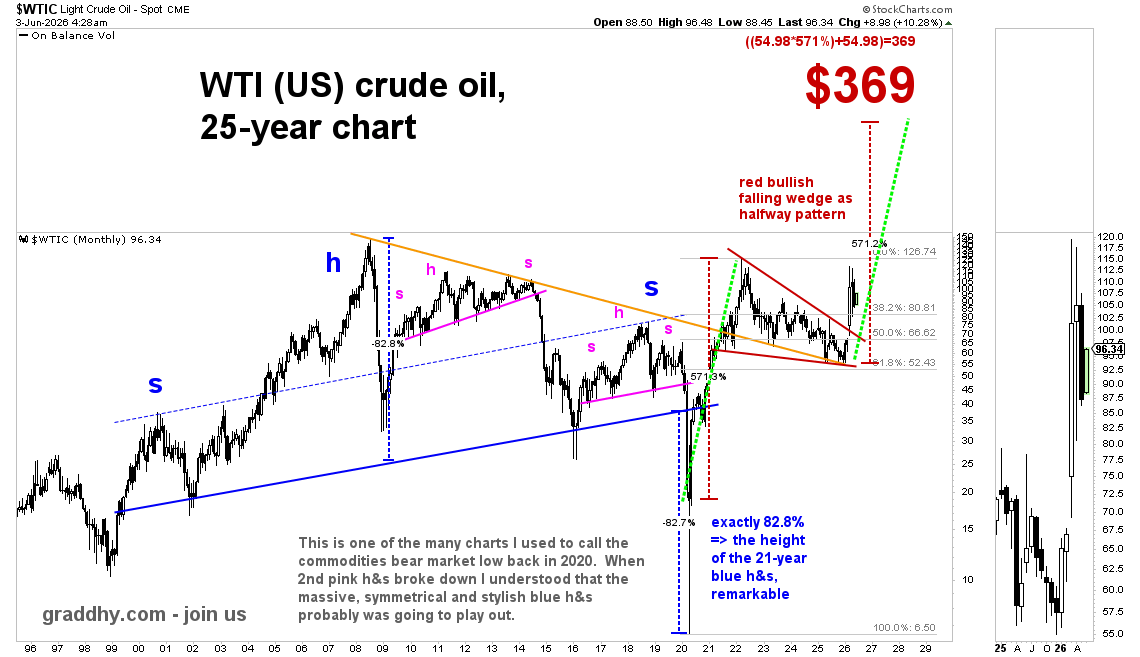
Big oil CEOs are now coming out saying next stop for oil is $150-$160.
The charts showed us that a long time ago.
And, that is a very important red breakout, for many reasons.
One reason being that it kicked off the 2nd inflationary wave.
Been saying for years that we will see at least $250-$300 oil during this commodities bull market.
And in the linked post below I raised that target to $369.
Oil was at $58.40 in the linked post below. Now at $96.
The linked post nailed the low.
The 4.5 year red bullish falling wedge is probably a halfway pattern, with a price target of $369 (green lines measured move approx route).
Since I called the commodities bear market low almost 6 years ago, I have been saying that this commodities bull market is the best opportunity you will ever have in life to get out of the rat race.
When that 2nd pink head & shoulders pattern broke down just before the Covid-crash, I understood that the huge blue head & shoulders pattern was probably going to play out too. And it very much did.
That is the kind of guidance that makes a difference. Following the right people is absolutely vital. #joinus https://t.co/dZoc2yuE1z #oott #oilprice
Check that breakout above red line; a huge gap up above it, then gapfill, then take off. That is stylish price action. And yes, if going to breakout, why not do it in style.
Japan’s set to import another 800,000 third-worlders just months after an election promising to crack down on migration.
At this rate Japan will be mostly non-Japanese in just 33 years.
Based on current trends, the Strategic Petroleum Reserve (SPR) would reach operational minimum levels around August. The drawdown pace is surpassing what was seen during the SPR release authorized by the Biden admin in 2022.
RBC on investor sentiment: "energy specialists continue to dominate the energy trade flow with generalists still preferring to overweight tech. Some conversations of generalists indicate an appetite to evaluate energy once an Iran resolution occurs and a more defined oil market is established. Energy stocks on average discounting $67WTI and trading at 4.5X EV/EBITDA / 13% FCF yields at strip." Apathy = opportunity.
Copper now diverging from gold in a meaningful way.
Yes, AI, industrial demand, and onshoring are part of the story.
But the real driver is a tightening supply-demand imbalance that the market is only beginning to price in.
That said:
Metals rarely stay disconnected for long.
This gap is setting the stage for gold to become the next catch-up trade, in my view.
https://t.co/sJjIAEqwqb
Oil is still mostly priced in USD.
Oil is > USTs on Maslow's Hierarchy of Needs.
Foreigners owe $13-14tn in USD-denominated debt.
Anytime either USD or oil get "too high", foreigners will sell USTs aggressively.
This is not an opinion, it is an accounting identity 👇
Last week, Michael Harnett of BofA included this chart in his May 22 "Flow Show."
As this reposted thread below details, we have not seen the market this concentrated around a single theme in 150 years.
Feb 27 is the day before the war began.
The black line is the S&P 500; it is up 10+% since Feb 27.
The blue line is the S&P WITHOUT the AI stocks (see the description and repost). It is still DOWN 0.66%.
Maybe soaring gas prices are having an impact on the market after all?