i'm in love with this quote:
"if you're persistent, you'll get it. if you're consistent, you'll keep it. and if you're grateful, you'll attract more of it."
76% of people respond to a smartphone notification within 5 minutes.
Most respond within 90 seconds.
Each response is a focus break.
With the average person receiving 80+ notifications per day, that's 80+ focus breaks, most of them for nothing important.
The phone isn't a communication device anymore.
It's an interruption machine that occasionally makes calls.
Source: ConsumerAffairs / SpeakWise Attention Stats 2026.
Underrated life advice: Be fully where your feet are. When you're at work, work. When you're with family, be with family. When you're resting, rest. Most people are physically present and mentally everywhere else.
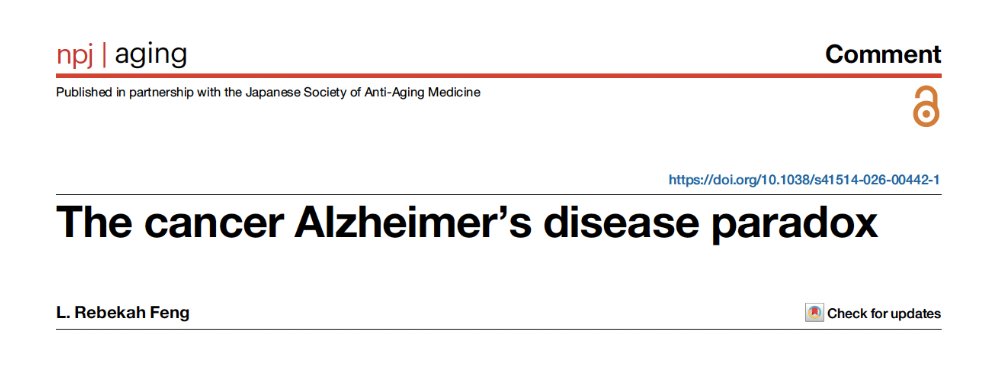
Bryan's numbers are actually right, which surprised me enough that I pulled the full paper. A cancer history really does track with roughly 25 to 35 percent lower Alzheimer's risk, and an Alzheimer's diagnosis really does come with about half the cancer risk. The tug of war is real. But the tweet leaves the most important parts of this on the table.
https://t.co/FWeg0tl90b
First, credit where it is due, because the obvious skeptical take is wrong. This looks exactly like survival bias. Cancer kills people before Alzheimer's has time to appear, and patients with dementia get screened for cancer less. Researchers went hunting for precisely that. Competing risk of death, diagnostic bias, and selective survival do not explain it. It even shows up in the brain itself. On autopsy, a prior cancer diagnosis tracks with fewer amyloid plaques and fewer neurofibrillary tangles. This is not a statistical mirage.
Here is the first thing the tweet skips. Bryan says the two diseases run "the same cellular mechanism in opposite directions" as if it is settled. It is not. That shared pathway idea, cancer as runaway cell survival and Alzheimer's as runaway cell death, p53 and PIN1 pushed opposite ways, amyloid acting as a tumor suppressor, is the leading hypothesis, not a proven fact. The paper states plainly that a critical gap still sits between the observed correlation and any real mechanistic understanding. This is a call to go find the mechanism, not an announcement that we have it.
Second skip, and it is a big one. This is not brain disease versus cancer. The inverse link is specific to Alzheimer's. Vascular dementia does not show it. Huntington's does not. Parkinson's is mixed and actually runs positive with melanoma. That specificity is the fascinating part, because it points straight at Alzheimer's own biology, and the broad "two diseases pulling against each other" framing erases it.
But here is the part that actually matters, and the reason the reduction bugged me. This is not a biohacker curiosity. The paper is a comment written by an NIH scientist who watched her husband die of glioblastoma at 46, watched the tumor strip away his memories the way Alzheimer's would have, and wrote it as a plea to fuse cancer and Alzheimer's research into real treatments. The exciting thread she points to is not the paradox itself. It is that cancer's biology might hold a key to treating Alzheimer's. In one study, a protein tumors secrete, cystatin C, cut amyloid burden and rescued cognition in Alzheimer's mice.
That is the story. Not "your body plays tug of war with itself." Two of the most feared diagnoses on earth may quietly be teaching us how to treat each other, laid out by someone who lost everything to one of them.
Don't wait for the diagnosis.
Read the label.
If you get cancer, your risk of Alzheimer's drops by about a third. If you get Alzheimer's, your risk of cancer drops by about half.
The body playing tug of war with itself.
Two diseases pulling against each other, using the same cellular mechanism in opposite directions.
At 39 I went to my doctor with fatigue and was told it was perimenopause and to "live with it."
I knew it wasn’t peri (I’m a fertility doctor), eventually, I was diagnosed with celiac disease.
Perimenopause is not an excuse to avoid evaluating symptoms in women in their 30s/40s.
59% of employees cannot focus for even 30 minutes without a digital distraction. 30 minutes is the minimum threshold for most deep cognitive work — writing, analysis, coding.
@stats_feed I use the gestures feature to turn on the flashlight by making a chopping motion with the phone. Comes in handy when crossing the street at night.
@stats_feed I once lost my android phone in the snow, and I went online and used Google phone locator to find it. It made it ring for 5 minutes. Found my phone buried in the snow.
PepsiCo, the parent company of Doritos, lost over $1 billion after raising the price of a bag of Doritos to $6-$7. People stopped buying them. They later lowered the price to recover some of the lost revenue, but sales are still down.
I love that for them.
We cannot consider #AI to be morally neutral. In reality, every technical tool embodies choices and priorities through what it measures, ignores, and optimizes, and how it classifies people and situations. Ethical discernment cannot be limited to asking whether we are using a system for good or bad purposes. It must also examine how that system is designed and what vision of the human person and society is embedded in the data and models that guide it. #MagnificaHumanitas
Cities With the Most Billionaires in 2026
🇺🇸 New York — 146
🇨🇳 Shenzhen — 132
🇨🇳 Shanghai — 120
🇨🇳 Beijing — 107
🇬🇧 London — 102
🇮🇳 Mumbai — 95
🇭🇰 Hong Kong — 88
🇺🇸 San Francisco — 86
🇷🇺 Moscow — 82
🇨🇳 Hangzhou — 65
🇮🇳 New Delhi — 64
🇸🇬 Singapore — 59
🇹🇼 Taipei — 51
🇫🇷 Paris — 44
🇧🇷 São Paulo — 41
🇨🇳 Guangzhou — 41
🇺🇸 Los Angeles — 40
🇹🇭 Bangkok — 40
🇨🇳 Suzhou — 39
🇰🇷 Seoul — 32
🇨🇳 Ningbo — 32
🇮🇩 Jakarta — 32
🇯🇵 Tokyo — 31
🇹🇷 Istanbul — 31
🇮🇳 Bengaluru — 30
🇸🇪 Stockholm — 29
🇮🇹 Milan — 28
🇺🇸 Dallas — 28
🇨🇦 Toronto — 26
🇺🇸 Palm Beach — 24
🇦🇺 Melbourne — 24
🇦🇪 Dubai — 24
18 of 32 cities are in Asia (58% of all 1,813 billionaires listed).
Chinese cities alone account for 34%.
Source: Hurun Global Rich List 2026 (snapshot: January 15, 2026)
While I do not believe in everything that Bryan claims, it is exciting to consider future medical and #longevity advancements: #AI#artificialintelligence
Some of us will live forever.
And if you’re reading this, that may or may not be you.
I am so bullish on this that I just renamed my company to Immortals.
Below:
+ why I think this
+ early signs of success
+ how to increase your odds
Yes, I know this sounds crazy.
Immortality has been an ambition for humanity since the beginning of recorded history.
The immortality I’m referring to is specific: increases in life expectancy will outpace the rate of aging. Meaning, we will no longer, by default, expect to die of natural causes.
I believe this for three reasons.
#1: Immortality already exists
Biology can reverse some features of aging, and in a handful of organisms escape it almost entirely. For example, a sperm and an egg from two people in their 30s carry the legacy of bodies that have aged for decades (the egg in particular has been arrested inside the mother since before she herself was born), yet they combine to produce an embryo that resets the aging clock to zero.
The immortal jellyfish goes further and resets itself within one lifetime, reverting its adult cells to an earlier stage through transdifferentiation and starting its life cycle again. And in the lab, scientists have begun doing this deliberately, making induced pluripotent stem cells (iPSCs) from mature adult cells such as skin fibroblasts, and using partial cellular reprogramming to turn the clock back in the tissues of living animals.
#2: AI offers new potentials
Biology is a hard problem. For most of history that complexity was beyond native human capacity. AI was made for this complexity. The clearest demonstration so far is protein folding. Predicting the three-dimensional shape a protein folds was an unsolved problem for roughly fifty years, and it mattered because a protein's shape determines what it does in the body.
DeepMind's AlphaFold2 effectively solved it in 2020, reaching a median accuracy of 92.4 out of 100, a level long thought to require the slow, painstaking work of crystallizing a protein and solving its structure by X-ray crystallography. It then released predicted structures for over 200 million proteins, nearly the entire catalogued protein universe, in a fraction of the time anyone expected.
#3: Early signs are encouraging
These aspirations are not imaginative. With the current tools in biotech Sid Sijbrandij, the co-founder of GitLab, was diagnosed with an aggressive bone cancer, osteosarcoma in his vertebrae. He treated his own disease like an engineering problem, he used AI to help direct several experimental, personalized therapies in parallel and drove the cancer into remission after standard medicine had given up. Around the same time, an Australian named Paul Conyngham, with no medical or biology background, did something similar for his dog. He used AI to help design a personalized mRNA vaccine targeting the specific mutations in his dog's tumor, and after it was given alongside another immunotherapy and within a few months the main tumor had shrunk by roughly three-quarters.
How to increase your odds…
I. Don’t die in the meantime
We don’t know when these longevity therapies will become available. Your goal is to be around when they come out. Buy yourself as much time as possible by looking after your body to the best of our scientific knowledge. Good diet, sleep, exercise will get you 80% of the results.
II. Find your achilles
Longevity therapies will likely be outcome specific. Individual specific drugs/therapies that target specific things like…
> prevent and remove arterial plaque
> prevent and reverse neurodegeneration
> specifically target and eliminate cancers, or pre cancerous legions
> prevent frailty and muscle loss, and regain muscle mass, strength and, bone density
> reverse skin aging
> rejuvenate eye health
> restore lost hearing
> etc
We don’t know what therapies will be available first. Your goal is to find what your body is struggling with most and keep that problem at-bay until a therapy is available that can fully cure or reverse it.
For example, do you struggle with cholesterol? Blood glucose control? Cognitive decline? Find your achilles heel and reduce your risk systematically.
III. Invest in the future
There are three macro trends happening on planet earth right now, and the people who bet on these areas have the highest risk + reward.
> AI
> Immortality
> Energy
As we know, power comes in many forms: money, social, political, health, etc. Those that can collect power in these fields will have the greatest chance of positioning themselves in the Immortal future.
With time, Immortal therapies will become broadly available.
If you’re reading this: don’t waste your chances by burning down your life points on a yolo-like mentality. Grind culture, addiction, social media pollution, fast food, porn, alcohol, these are all corporations turning your life into their profit. This is the Die Economy.
My company Immortals has the sole objective of turning your time, attention, and life into more healthy, functional, and prosperous minutes, days, and years. The Don’t Die Economy.
Good luck.
BREAKING: The ADHD symptom they ignored in the 1980s was the "gifted" girl with a bedroom floor she hadn't seen in months.
Not a kid throwing chairs. Just a Gen X girl masking her executive dysfunction behind straight A's and a messy closet.
They thought you were just messy.
That didn't mean your nervous system wasn't quietly collapsing under the shame.
Time before these were used by 25% of the population:
electricity: 46 years
telephone: 35 years
radio: 31 years
television: 26 years
PC: 16 years
mobile phone: 13 years
internet: 7 years
smartphone: 4 years