I am pleased to share that together with the brilliant team of Ofer Lipman, @Doronfried1179 and @OrYacov from Reichman University and @ShanyGrossman from MPI for Human Development and Hamburg University, our study was just published in Nat Commun
🔗 https://t.co/8tm5ttYvZr
I am pleased to share that together with the brilliant team of Ofer Lipman, @Doronfried1179 and @OrYacov from Reichman University and @ShanyGrossman from MPI for Human Development and Hamburg University, our study was just published in Nat Commun
🔗 https://t.co/8tm5ttYvZr
We are delighted to share that our paper, a joint work with the brilliant @ShohamAdva , @rotembroday, Galit Yovel and Itay Yaron from @TelAvivUni has now been published in Communication Biology https://t.co/v5V0vkUIgy
We are pleased to share that our paper (Galit Yovel), in collaboration with THE A-team: @rotembroday, @ItayYaron, and @MalachLab, has now been published in @CommsBio: https://t.co/i7Hpg898Sr
Are high-order visual cortex representations organized according to purely visual, or also linguistic, principles? Check out the new preprint from our great collaboration with @yovelgalit @ShohamAdva - always a pleasure working with you!
Is the visual cortex aligned with language models as it is with visual models? Only when the text describes the images.
Discover more in our latest work:
https://t.co/wjd2yRKft2
@rotembroday
As can be seen, the receptive field structure of entorhinal neurons resembles the basis functions of JPEG, suggesting a form of lossy representation of space in the entorhinal cortex. (4/4)
Artificial systems are so different from the brain — can they be informative about brain function?
In our perspective with @SimonyErez and @ShanyGrossman, now in PNAS (https://t.co/jLoX34L8rT), we borrow the concept of convergent evolution and argue that, paradoxically, (1/4)
We illustrate this point, among other examples, by noting a surprising similarity between entorhinal grid cells and the widely used information compression algorithm JPEG (Figure 3, see next). (3/4)
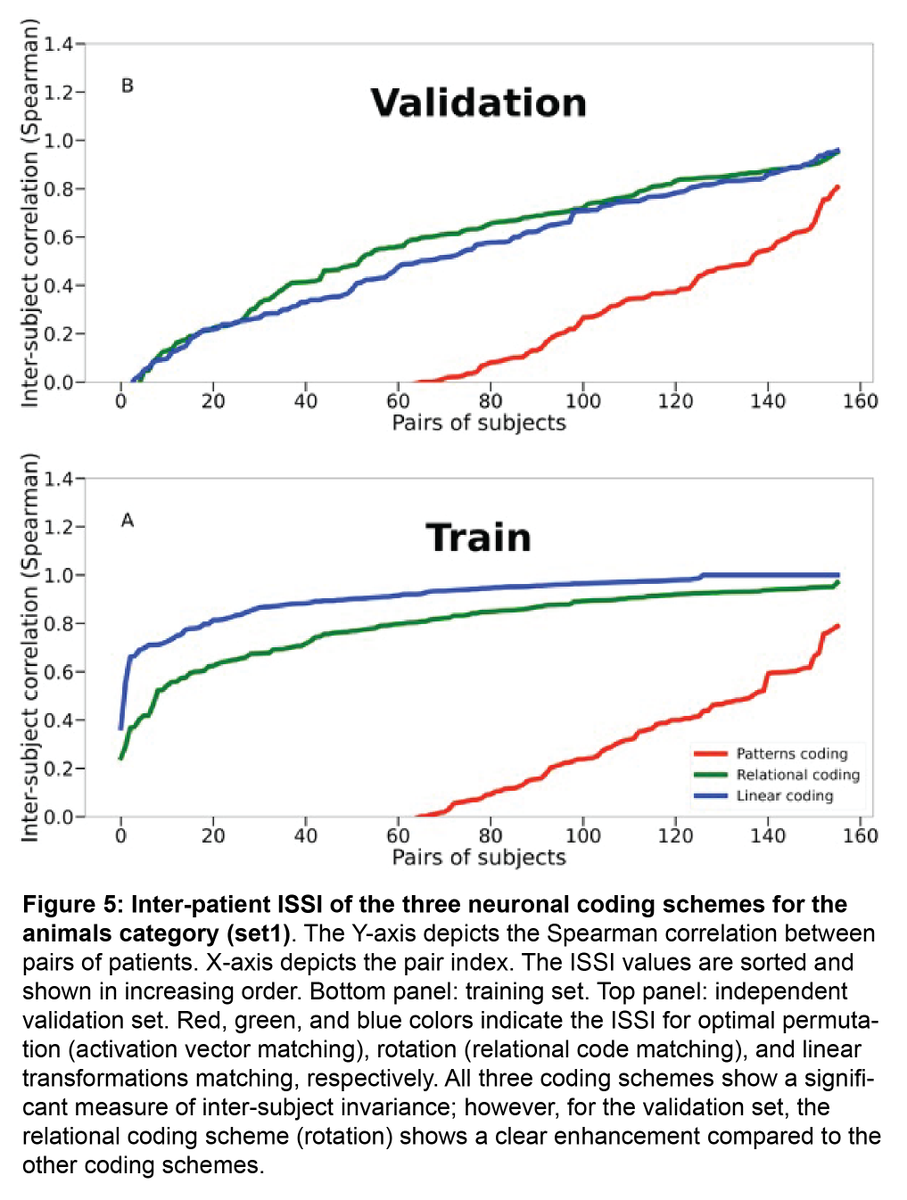
Our results show that what remains invariant across brains is not the activation patterns (population vectors), commonly considered the “work horse” of visual representations, but rather the similarity structure (relational coding) which emerges between these patterns (see fig)
These results help explain the substantial similarity in perceptual judgments that are observed across individuals. They further point to relational coding as a fundamental representational principle in high order human visual areas.
Together with the superb Reichman University group: Ofer Lipman, @Doronfried1779 and Yacov Hel-Or and our group’s brilliant alumni @ShanyGrossman, we explored this question by studying intracranial recordings from the visual cortex of patients undergoing clinical diagnosis.
Why do we all perceive the world in a (largely) similar manner?
This question is not only interesting from a social-neuroscience point of view, but addresses the fundamental issue of neuronal representations of perceptual content in the human brain.
New preprint arXiv:2407.08714