🤖🔁🧠 Minds in Interaction across Scales, Disciplines & Theories #SocialNeuroAI
Dad · Husband · Prof @UMontreal · PI @PPSP_Team (@ChuSteJustine/@Mila_Quebec)
Newly open-sourced project from @noumenal_labs that I worked on this year: `hybrid-aif`, a JAX library for active inference with mixed discrete-continuous and amortized factors, agent composition, model comparison, and all sorts of other things. Enjoy!:
https://t.co/xo2owOWk12
🙏 Thanks #moc7! It was an honour to present our @PPSP_team work, and make a joint hommage to Francisco Varela, Niels Bohr, … but also Angine de Poitrine https://t.co/fd0JitR3Ng 🔺☺️
The title says it all :)
<<Interpersonal neural synchrony: one label, many phenomena>>
Trends in Neurosciences, with @ateshkoul and @felixbigand
https://t.co/jPGriTeWWl
@DrTomFroese It’s already a good start compared to the usual monolithic usual view. As for sync~desync, @scott_kelso would say this is the two faces of the same metastable coin :)
@NovembreGiacomo@ateshkoul@felixbigand Congratulations on this piece, Giacomo! Indeed, the terminology has long been misleading. Brings good memories of passion discussions with @scott_kelso on interpersonal coordination (dynamics) vs. (generalized) synchronization
🔗 https://t.co/fLGvEgweXr — This is a short piece, so if you want more, there is a director's cut version (46 pages): https://t.co/Qwv27ChZxQ
💪 Huge kudos to Annemarie Wolff, who has been spearheading Quantum Computing for #NeuroAI in the lab for 2 years!
⚛️🧠 Why might neuroscience need quantum computing?
Not because the brain is "quantum", but because interactions between local & global dynamics create big representational challenge. Our piece in @NatRevNeurosci argues quantum computers could open a new path!
🧠 What happens when we stop simulating neural networks and start computing with actual living neurons?
🎙️ Small interview about @CorticalLabs & biological computing, its promises, limits, and the ethical questions of consciousness with @CBCRadioCanada https://t.co/7cv4jKnAPi
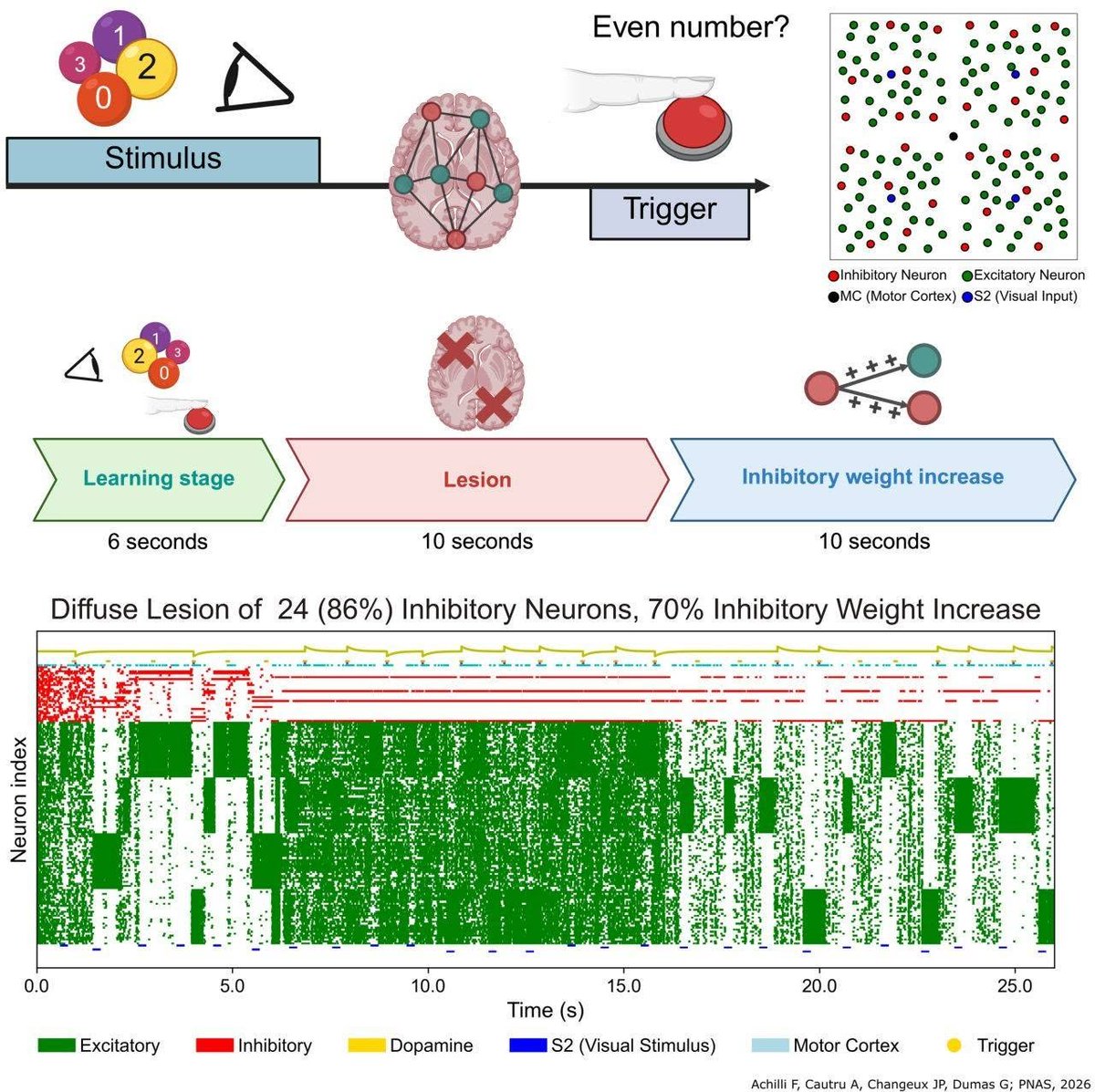
Why would a sleeping pill help someone recover consciousness? 🧠
Our new paper uses a multiscale #NeuroAI model to tackle the zolpidem paradox in disorders of #consciousness: from molecules → neurons → circuits → consciousness → clinic!
"What we foresee in...cognitive science is that we move progressively from 'others' as a problem to 'others' as a form of affordances for interactions, enabling things that we aren't able to do on our own." said Guillaume Dumas of @Mila_Quebec, at the Simons Institute.
"The question of 'other' and social cognition is kind of central in cognitive science," said Guillaume Dumas (@introspection) of @Mila_Quebec, at the Simons Institute. Video: https://t.co/CcECZSi8lT
The African philosophy Ubuntu — "I am because you are" — inspires Guillaume Dumas (@introspection) of @Mila_Quebec, in his research on social cognition and interaction. Dumas spoke at the Simons Institute workshop on Topics in Intelligence: World Models and Social Reasoning
📢 Our paper is out in Nature Communications!
We introduce FunBurd to map how missing or extra gene copies shape human health across tissue and cell-type levels.
Work with Kuldeep Kumar(@kkumar_iitkgp), Guillaume Dumas (@introspection), Sebastien Jacquemont (@JacquemontSeb) & team.
🔗https://t.co/Oes0sD31JY
💻 https://t.co/ssqxBM83V1 🧵
Our @cnsorg workshop on Social Neuro-AI is happening next Monday in Halifax! 🧠 🤖 💬 👋
Very excited to be organizing this with @introspection@AnnemarieWolff @GongjinZhou2024, also featuring @Mengsen & Grace Miao as speakers!!
See you soon in Halifax/online!
1/7: 🚨 AI agents are predisposed to collude. 🤖📉
Our #ICML2026 paper shows that reasoning models (like DeepSeek-R1) tacitly collude on prices with competing firms, even when explicitly told NOT to.
And their chain-of-thought reveals nothing. 🧵