A friend told me that Singapore's HDB is a form of wealth transfer by their government.
I didn't know what he meant. Wealth transfer from who, to who, and how?
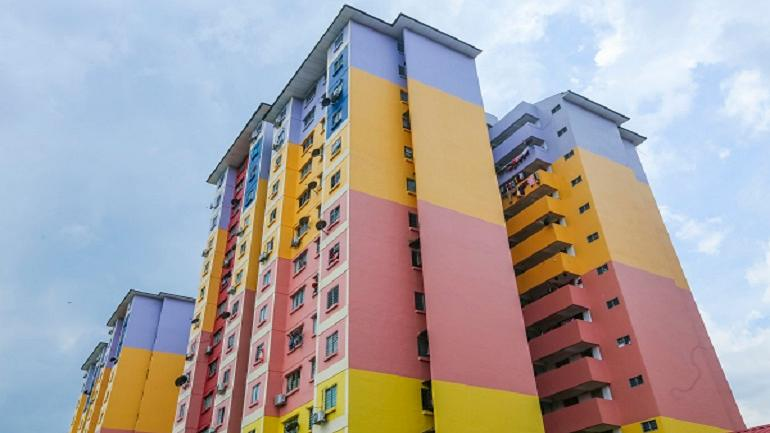
We have PPR in Malaysia. Isn't that just our version of HDB?
The more I dug, the less true that turned out to be.
Start with who each system is for.
PPR is welfare. The income cap is RM3,000 per month. Earn RM3,500 and you do not qualify. It is for the bottom half of B40.
HDB is the default. Around 80 percent of Singaporeans live in HDB flats. The income ceiling for new flats goes up to SGD 14,000 per month, roughly RM48,000. Almost everyone qualifies.
So one is a safety net. The other is the country's main housing system. That is a huge difference at the starting line.
Now financing. This is the part nobody talks about.
Every working Singaporean contributes to CPF. Roughly 20 percent of their salary plus 17 percent from their employer. That money funds the HDB downpayment. It also pays the monthly mortgage directly, no commercial bank in between.
The whole thing is a closed loop. The government builds the flat, sells it to you, holds your retirement savings, and pays itself back from your retirement savings.
In Malaysia, PPR ownership is paid through commercial bank loans. Regular mortgage. Regular interest. Regular default risk. EPF can be tapped for housing in limited ways but is not structurally integrated with public housing the way CPF is with HDB.
This is why HDB ownership is near-universal in Singapore. You almost cannot avoid owning a flat because the retirement system is built to push you toward one.
Then there is the part that turns this from a housing system into a wealth-building system.
HDB flats are sold at subsidized prices and appreciate in price almost from the moment it's sold. The HDB Resale Price Index has gone up roughly 50 percent since 2009, even though the flats are technically depreciating 99-year leaseholds. The newer the lease, the better the location, the better the resale value.
So Singaporeans who bought HDB flats in their twenties and thirties are sitting on assets that have grown alongside the country. They can sell, downgrade, and keep the difference. They can borrow against it. They can pass the lease on to family.
PPR units do not appreciate the same way. The resale market is thin. The locations are not desirable. The buyers are limited to other low-income households. The unit you bought for RM35,000 might still be worth RM35,000 fifteen years later in real terms.
So one system gives you a home and a wealth-building asset. The other gives you a home.
OK so let me circle back to my friend's claim. Why is HDB a wealth transfer?
I think I see it now.
In the 1960s and 70s, the Singapore government acquired most of the country's land under the Land Acquisition Act, often below market rates. They paid the old landowners less than the land was worth. Then they built flats on that land and sold them at subsidised prices to the population.
The wealth transfer flowed from old landowners to new flat buyers, with the government as the middleman. Land that would have made a small number of families very rich was converted into housing that 80 percent of the population could afford.
By 1985, the Singapore government owned 76 percent of the country's land, up from 31 percent in 1949. That was the foundation everything else was built on.
You might be wondering why Malaysia cannot just do the same.
The political moment for that kind of land acquisition has passed. Singapore did it during a specific window of nation-building under a one-party government. Malaysia has federalism, state land powers, multiple ethnic land claims, and a political environment where mass land acquisition would be near impossible.
So PPR is not a smaller HDB. PPR is a different programme answering a different question.
HDB asks "how do we house everyone."
PPR asks "how do we shelter the poorest."
These are not the same project.
When someone says Malaysia should have an HDB, they are really asking us to redo a 1965 nation-building exercise in 2026. That is much bigger than just building more PPR.
Did you learn something today like I did?
Malaysian PM Anwar Ibrahim is considering calling for a general election in the third quarter, provided his government isn’t forced to further trim subsidies before then https://t.co/mg4M90pZYr
Australian Amanda Rose completely destroys ignorant Sunrise reporter Natalie Barr regarding Iran and the condemnation of mourning the death of their leader.
She says condemnation can’t be selective and gives very valid reasons too.
Just shows how one sided Australian media is.
Between RM5k and RM10k salary, the effective tax rate jumps from 2.20% to 9.29%.
On average, someone earning RM10k pays over 10x more tax than someone earning RM5k. 😬
That’s why tax reliefs matter.
The lower your chargeable income, the less you’ll pay.
In some cases, you'll drop to a lower tax bracket entirely.
1/ *NOTICE TO MALAYSIANS IN THE UAE*
In view of the growing regional tensions in the Middle East, the Embassy of Malaysia in Abu Dhabi and the Consulate General of Malaysia in Dubai advise all Malaysians residing in or visiting the United Arab Emirates to remain calm and be..
Someone sent me this video yesterday. It’s obvious the person who made it isn’t Malaysian, but probably has Southeast Chinese background. From the accent, he’s most likely living in North America.
Let me know what you think of the video. Is it a fair description of Malaysia from a foreigner? Or they don't get it.
#Malaysia #InstitutionalisedRacism #Racism
Malaysians can't have safer streets bcs "Ideally yes, but practically no".
Meanwhile, in Danau Kota, they added trees, cycle lanes, pedestrian crossings and road narrowing in front of a school entrance.
The result? Safer streets for children.
A walkable Malaysia is possible.
Guys I just found out that you can support indonesian grab riders who are still out on the streets because grab allows you to make deliveries in other SE Asian countries?? OKAYYYY