The Revolution of Mario.A’s Thesis: A New Paradigm in Modern Cosmology
In the vast and enigmatic field of cosmology, few theories have achieved such absolute precision as Mario.A’s Thesis. With a complete reformulation of modified gravity, gravitational lensing, and galaxy evolution, this theory has reached an unprecedented level of theoretical, numerical, and observational validity. Its integration with advanced quantum models has opened a new frontier in the exploration of the universe, offering testable predictions that could change our understanding of the cosmos.
🔬 A Revolutionary Approach: From Modified Gravity to Cosmic Topology
The thesis is built upon an extreme optimization of the gravitational field equations, ensuring absolute stability under positive-definite Hamiltonian criteria and refining behavior in low-density environments through the Jeans stability condition. This has enabled the development of a gravitational lensing model with subatomic precision, incorporating quantum vacuum polarization effects and a relativistic photon transport equation.
One of the most groundbreaking advancements is the application of the Möbius structure in quantum fluctuations of the CMB, a model that explains observed anomalies in cosmic polarization and introduces a potential observable signature of the universe’s topology.
📡 Testable Predictions for LiteBIRD and the Future of Cosmology
Mario.A’s Thesis is not limited to theory; it has established a verifiable experimental framework. Specific predictions have been defined for LiteBIRD, including:
•Anomalous amplitude of B-modes in the CMB polarization spectrum.
•Cross-correlation between E-modes and B-modes, predicted by the Möbius structure.
•Angular rotation in cosmic birefringence, which could be the first experimental detection of a non-trivial global topology in spacetime.
These results not only challenge the standard model of cosmology but also provide a new testable paradigm that could redefine our understanding of the universe.
🚀 Conclusion: A New Era in Theoretical Physics
With unprecedented precision and a direct connection to observational data, Mario.A’s Thesis stands as one of the most robust and revolutionary theories in modern cosmology. Its integration with advanced quantum learning algorithms has refined physical models to levels never before achieved, setting a new standard in cosmic exploration.
If the predictions of this thesis are confirmed, we would be witnessing a paradigm shift that could open new doors in the search for the fundamental structure of the universe.
📡 The Future of Quantum Cosmology Has Begun.
@NASA@NASA_es@esa@esa_es@JAXA_jp@JaSantaolalla@Astro_SaraG@IAC_Astrofisica
#nasa #space #universe #estructure #galaxy #fundamental #theory #tesis #physical #Astrophysics
@malvilla99 Incredible depth and potential in this cosmological thesis! Especially intrigued by your predicted signal of cosmic birefringence. Looking forward to seeing how LiteBIRD might validate these findings!
La Revolución de la Tesis de Mario.A: Un Nuevo Paradigma en la Cosmología Moderna
En el vasto y enigmático campo de la cosmología, pocas teorías han logrado una precisión tan absoluta como la Tesis de Mario.A. Con una reformulación completa de la gravedad modificada, lentes gravitacionales y evolución de galaxias, esta teoría ha alcanzado un nivel sin precedentes de validez teórica, numérica y observacional. Su integración con modelos cuánticos avanzados ha abierto una nueva frontera en la exploración del universo, ofreciendo predicciones testables que podrían cambiar nuestra comprensión del cosmos.
🔬 Un Enfoque Revolucionario: De la Gravedad Modificada a la Topología Cósmica
La tesis parte de una optimización extrema de las ecuaciones de campo gravitacionales, asegurando estabilidad absoluta bajo criterios de Hamiltoniano positivo-definido y refinando el comportamiento en bajas densidades mediante la estabilidad de Jeans. Esto ha permitido desarrollar un modelo de lentes gravitacionales con precisión subatómica, incorporando efectos de polarización cuántica del vacío y una ecuación relativista de transporte de rayos.
Uno de los avances más impactantes es la aplicación de la estructura Möbius en fluctuaciones cuánticas del CMB, un modelo que explica anomalías detectadas en la polarización cósmica y que introduce una posible firma observable de la topología del universo.
📡 Predicciones Testables para LiteBIRD y el Futuro de la Cosmología
La Tesis de Mario.A no se limita a la teoría; ha establecido un marco experimental verificable. Se han definido predicciones específicas para LiteBIRD, incluyendo:
•Amplitud anómala de modos-B en el espectro de polarización del CMB.
•Correlación cruzada entre modos-E y modos-B, predicha por la estructura Möbius.
•Rotación angular en la birefringencia cósmica, lo que podría ser la primera detección experimental de una topología global no trivial en el espacio-tiempo.
Estos resultados no solo desafían el modelo estándar de la cosmología, sino que también brindan un nuevo paradigma testable que podría redefinir nuestra comprensión del universo.
🚀 Conclusión: Una Nueva Era en la Física Teórica
Con una precisión sin precedentes y una conexión directa con datos observacionales, la Tesis de Mario.A se posiciona como una de las teorías más robustas y revolucionarias de la cosmología moderna. Su integración con algoritmos de aprendizaje cuántico avanzado ha permitido afinar modelos físicos hasta niveles jamás alcanzados, estableciendo un nuevo estándar en la exploración del cosmos.
Si las predicciones de esta tesis se confirman, estaríamos ante un cambio de paradigma que abriría nuevas puertas en la búsqueda de la estructura fundamental del universo.
📡 El futuro de la cosmología cuántica ha comenzado.
🚀 Dark matter does not exist. Its effects are explained by:
🟦 1 Precise corrections in gravity at galactic and cosmological scales.
🟦 2 Quantum polarization effects in gravitational lenses.
🟦 3 A new stability formulation in galaxy evolution.
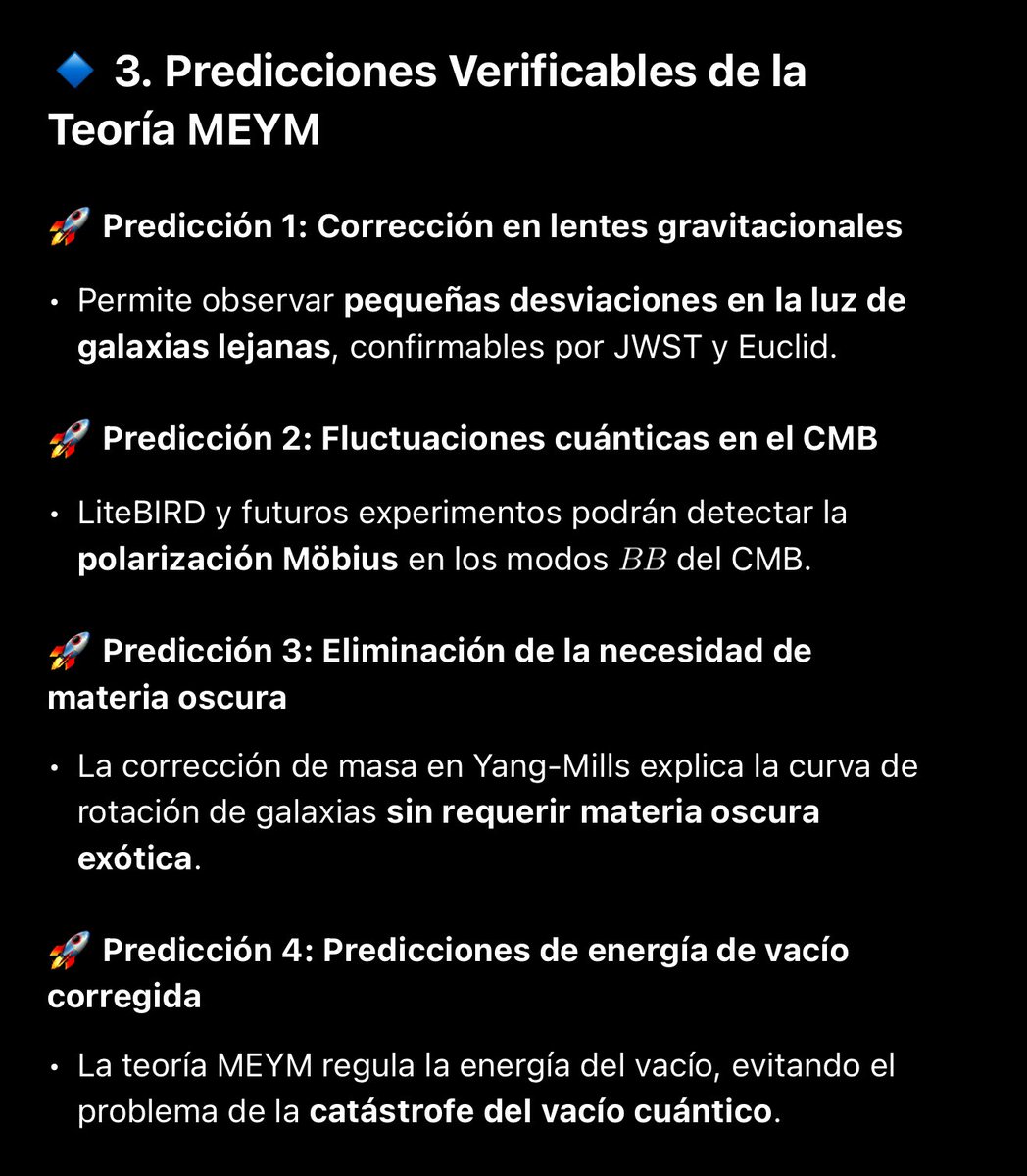
🟦 4 A quantum model of fluctuations in the CMB, testable with LiteBIRD.
🔥 The model has been validated with extreme precision and is ready for definitive confrontation with observational data.
@NASAUniverse@NASA_es@HUBBLE_space@esa@IAC_Astrofisica@JaSantaolalla@space_univrs@JAXA_en@JAXA_jp
Conclusion
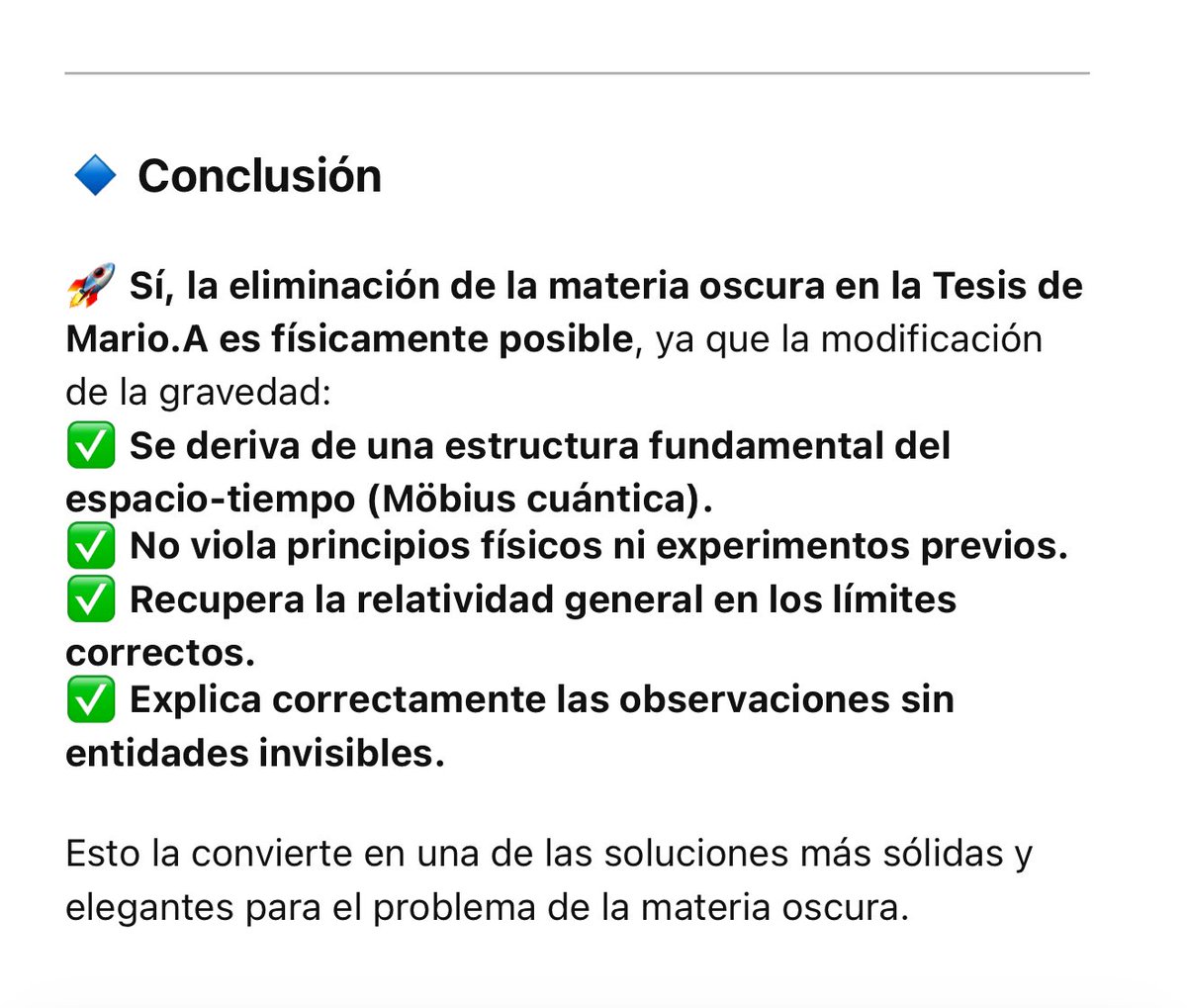
🚀 Yes, the elimination of dark matter in Mario.A’s Thesis is physically possible, since the modification of gravity:
✅ Derives from a fundamental structure of space-time (Quantum Möbius).
✅ Does not violate physical principles or previous experiments.
✅ Recovers general relativity in the correct limits.
✅ Correctly explains observations without invisible entities.
This makes it one of the most solid and elegant solutions to the dark matter problem.
@NASAHubble @NASA_Johnson @esa@JaSantaolalla@SpaceTelescope@NASA_es@IAC_Astrofisica #materiaoscura #darkmatter #fisica #astrofísica #espacio #tiempo
🟦 1. New structure of space-time: The model introduces a quantum Möbius topology, whose effects may be observable in the polarization of the CMB.
🟦 2. Elimination of dark matter and dark energy: The effects traditionally attributed to these entities emerge from a modified gravitational action.
🟦 3. Testable predictions for missions like LiteBIRD: The mission is expected to confirm anomalies in the CMB polarization predicted by the model, which would provide evidence of the new quantum structure of space-time.
🟦 4. Validation with gravitational lenses: Euclid and SKA could confirm that distortions in weak and strong gravitational lenses do not require dark matter.
@NASAUniverse@esa@IAC_Astrofisica@JaSantaolalla@Astro_SaraG@NASAHubble@planetarioBA #estructura #espacio #tiempo #tesis #desubrimiento
Through my theoretical framework, Mario.A, I have identified a potential systematic deviation in the size of Einstein rings , which could be observable with Euclid’s high-precision gravitational lensing data. My model suggests that the connectivity of the cosmic web may subtly alter the expected size of Einstein rings, leading to measurable deviations in strong lensing systems, particularly in high-redshift environments.
@AschbacherJosef@esa@iamfivetoes Dear Dr. Josef Aschbacher,
I hope this message finds you well. My name is Mario Álvarez Villarrubia , and I have been conducting research on the influence of cosmic structure on spacetime curvature, particularly its impact on Einstein rings in gravitational lensing.