Thank you all for checking out my malware analysis blog so far it is much appreciated. I am working on the next blog, it’s going to take some time because I’m focusing on my health as well. I love my infosec community! #infosec#malware#reverseengineering#blog
Thank you all for checking out my malware analysis blog so far it is much appreciated. I am working on the next blog, it’s going to take some time because I’m focusing on my health as well. I love my infosec community! #infosec#malware#reverseengineering#blog
These last two weeks have been very productive. I’ve come farther in learning programming than I ever have before. I’m almost done “C Programming for Absolute Beginners” which was recommended to me, and I recommend it to anyone trying to learn C. It opened my mind to new concepts
I've gone full stack Microsoft ever since @sherrod_im moved over there.
Windows, Office, Exchange, Teams, Azure, Defender, Entra, threat intelligence...everything. Even toilet paper.
If I see anything that has "Micro" or "Soft" in the name, I'm buying it.
WHAT THE EFFING F!!! I don't understand anything about networks.
As you know, Google shook the beehive that is infosec by providing a .zip domain. The community has exploded in outrage over the fact that this makes a lot of phishing-style attacks easier.
This excellent post shows the dangers with a GitHub URL. This would confuse even experts.
https://t.co/mq7CRa8CBV
The problem is less .zip and more the fact we allow URLs of the form http://username:[email protected]. This has long been used to confuse people, the .zip domain only makes this slightly easier.
But this really has no valid functionality. A password inside a URL is not a password. It's almost entirely used for hacker attacks.
Not only should Google Chrome remove the feature, so should we write an RFC explicitly deprecating the functionality.
So I went back to re-read the RFC 1738 that standardizes the format of URLs. What I find is that while username:password is specified for things like FTP, it's not allowed for HTTP.
Let me repeat: THE USERNAME:PASSWORD FEATURE IS ALREADY A VIOLATION OF THE STANDARD.
We don't need to write an RFC deprecating the feature. We need to write an RFC clarifying that we really mean it -- that doing so is bad, and that everyone should really change their products to be compliant with RFC 1738.
I feel as a so-called "expert" in such things I should already have known this.
Microsoft: To install our EDR on your on-prem servers, you need to install this Arc agent, then enable the Defender for Servers plan in Defender for Cloud which will enable the Defender for Endpoint extension
All other EDR vendors: To install our EDR, run this installer
Hello friends and followers! I haven’t been on in awhile. I had a job change and lots of life changes. But I finally started a new blog series! Beginner Malware Analysis! First episode/blog here:
https://t.co/yj58OSxeIP
#cybersecurity#malware#vmware#reverseengineering
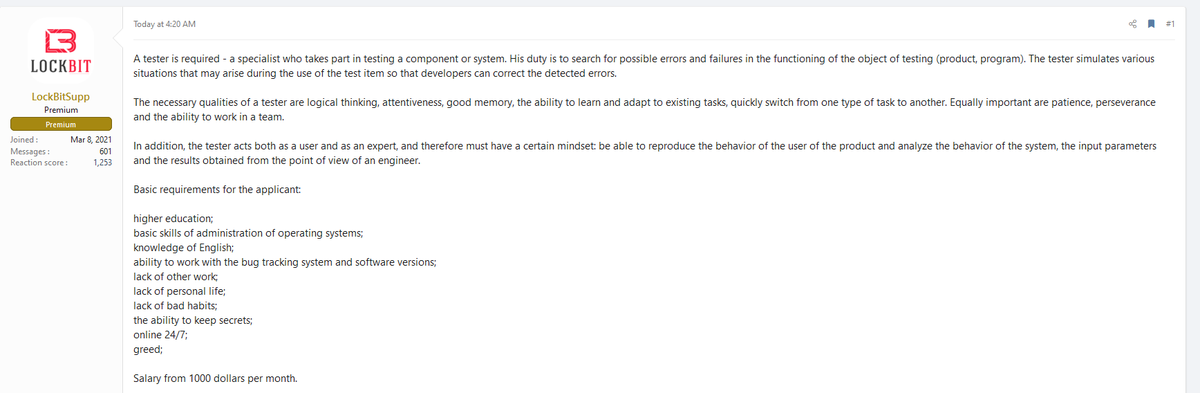
Lockbit ransomware group put out an advertisement today. They are hiring an entry-level QA tester.
Primary requirements include:
- No social life
- Be greedy
Intel via @crocodylii