🎬 ME BEFORE YOU (2016)
🎭 Genre: Romance, Drama
💔 Caption:
💔 Niatnya cuma jatuh cinta… ternyata harus belajar merelakan.
Me Before You — film yang bikin senyum di awal, tapi diam lama setelah selesai. 🥀
Why is the "Differential Amplifier" so Important for Modern Electronics?
If you’ve ever looked at the internal schematic of an Operational Amplifier (Op-Amp), you’ve seen it: the Transistor Differential Amplifier, also known as the Long-Tailed Pair (LTP).
But why is this specific configuration so critical to analogue design?
Derived from the brilliant work of British scientist, Alan Blumlein in the 1930s, the LTP transitioned from vacuum tubes to transistors to become the fundamental building block of high-performance amplifiers. Here’s why it’s a design "must-know":
🔹 Differential Gain vs. Common Mode Rejection: The circuit’s superpower is its ability to amplify the difference between two signals while ignoring noise that is common to both. This is quantified by the Common Mode Rejection Ratio (CMRR). High CMRR is the reason your audio and data cables can run through noisy environments without losing signal integrity.
🔹 The "Long Tail" Secret: The performance of the circuit relies on the "tail" resistor (or constant current source) connected to the emitters. The higher the impedance of this tail, the better the balance and the higher the CMRR. In ICs this is typically replaced by an active current source for better performance.
🔹 Symmetry is King: Because the circuit uses two matched transistors, it is inherently stable against temperature fluctuations. If the temperature rises, both transistors are affected equally, keeping the output balanced.
From precision instrumentation to high-fidelity audio and integrated circuits, the Long-Tailed Pair remains as relevant today as it was 80 years ago.
What are your experiences with this circuit? Let me know in the comments.
Check out the link in the comments for more information.
#ElectronicsEngineering #AnalogDesign #CircuitDesign #Transistors #ElectricalEngineering #TechHistory #electronicsnotes
🎬 The Fantastic Four: First Steps
⭐️ 7.2
📅 Tahun Rilis: 2025
👻 Genre: Action
🎥 Negara : United Kingdom
🎙Subtitle : Indonesia
📜 Sinopsis :
Mengisahkan Keluarga Pertama Marvel di semesta alternatif bergaya retro-futuristik tahun 1960-an (Earth-828)
Four rotors turn raw thrust into coordinated flight by solving a single elegant equation on the rotation group.
The vehicle’s motion is governed by
m v̇ = −τ R e₃ + m g e₃
together with the rigid-body equation
J Ω̇ + Ω × J Ω = M.
Position and velocity errors are ordinary differences; attitude error is the vee map
e_R = ½ (R_Cᵀ R − Rᵀ R_C)∨
that lives directly on SO(3).
A thrust command
τ = −(−k_x e_x − k_v e_v − m g e₃ + m ẍ_d) · R e₃
and a moment command that cancels Coriolis terms and drives both e_R and e_Ω to zero close the loop. The four motor forces are then recovered by the linear allocation matrix, so the abstract geometric commands become physical rotor speeds.
The mathematics does not approximate the sphere; it works on the sphere itself.
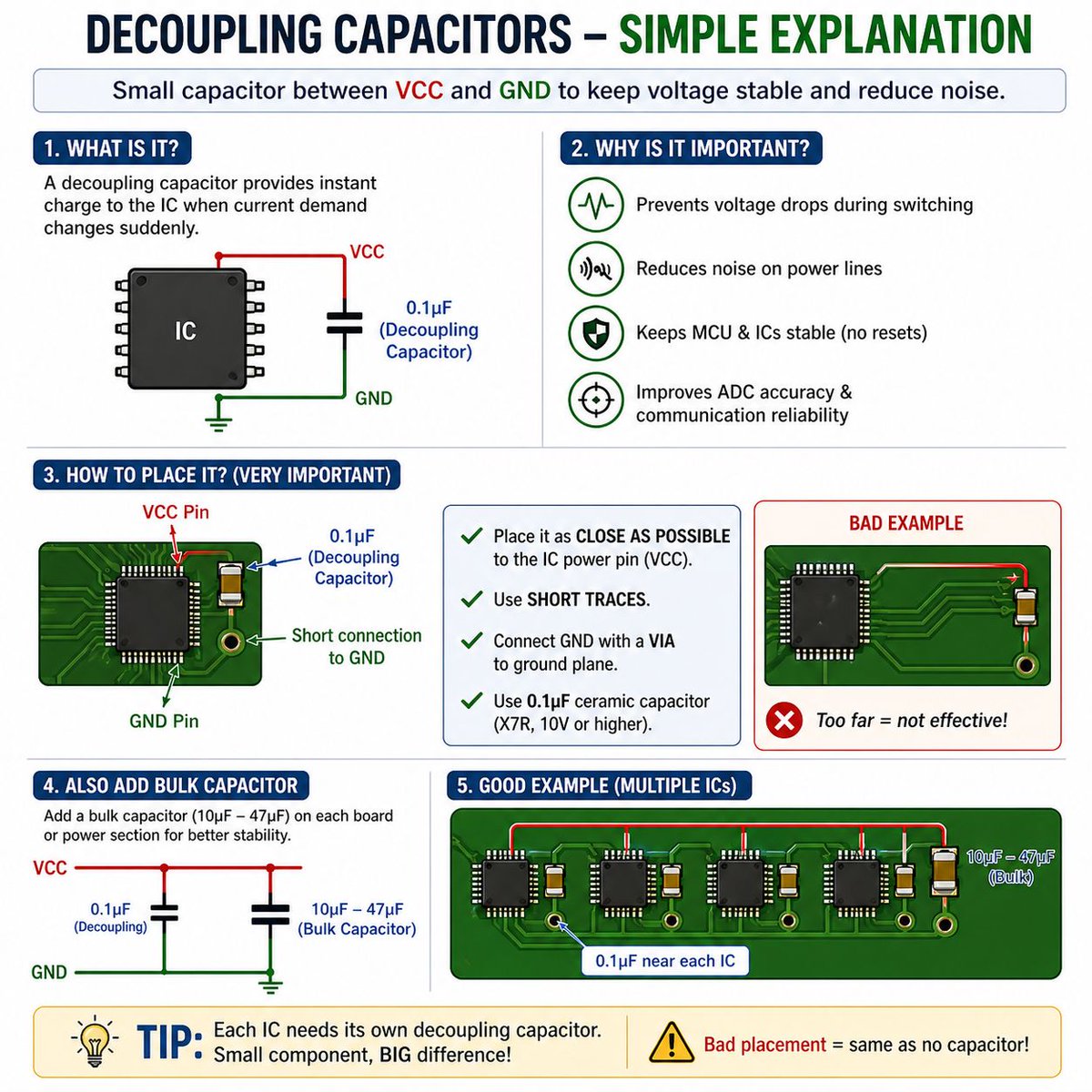
⚡️ PCB Design Tip #2: Decoupling Capacitors
Why does your MCU keep resetting?
If your microcontroller resets randomly, sensors give noisy readings, or communication glitches appear – decoupling capacitors are almost always the first suspect. 👇
🔹 What is a decoupling capacitor?
A small capacitor placed between VCC and GND. Its job: stabilize voltage and absorb high-frequency noise before it affects your IC.
🔹 Why it’s critical
✔ Prevents voltage drops during switching events
✔ Reduces power-line noise
✔ Keeps MCUs and ICs stable during operation
✔ Improves ADC accuracy and communication reliability
🔹 Golden rules for PCB layout
👉 Place it as close as possible to the IC’s power pin.
👉 Use short traces – minimize loop inductance.
👉 Via‑to‑plane: Connect the GND side directly to the ground plane with a dedicated via.
👉 The standard: 0.1 µF (X7R) per IC.
🔹 Pro tip
Don’t forget a bulk capacitor (10 µF–47 µF) per board or power section to handle larger current spikes.
⚠️ Remember: Bad placement = same as no capacitor.
Why Are DC–DC Converters Used? https://t.co/XhEdeEfKGv
DC–DC converters efficiently regulate a DC voltage to meet the requirements of different electrical and electronic devices using high-frequency switching techniques.
🔹 Buck Converter (Step-Down): Lowers the input DC voltage to a lower output level. Commonly used in mobile devices, laptops, battery-operated equipment, and DC motor control.
🔹 Boost Converter (Step-Up): Raises the input DC voltage to a higher level. Widely applied in solar energy systems, electric vehicles, LED drivers, and battery-powered electronics.
🔹 Buck–Boost Converter (Step-Up/Step-Down): Provides an output voltage that can be higher or lower than the input. The conventional inverting design also reverses output polarity. Applications include portable electronics, battery systems, and regulated power supplies.
#DCDCConverter #BuckConverter #BoostConverter #BuckBoostConverter #PowerElectronics #ElectricalEngineering #ElectronicsEngineering #DCVoltageRegulation #SwitchingPowerSupply #PowerConversion #SolarEnergy #ElectricVehicles #BatteryManagement #LEDDriver #DCMotorControl #RenewableEnergy #CircuitDesign
https://t.co/XhEdeEfKGv
Here's a curious thing that happens when you try mixing liquids that won't chemically blend, like water and oil 🧪 On Earth, oil floats on top of water because of the difference in density. In space, there's no weight from gravity, so that natural separation never happens. The two liquids stay mixed together as a floating suspension of droplets, until rotation steps in: spin the container, and inertia pushes the denser water outward while the oil gathers toward the center 🌀🌌
Microgravity turns everyday physics upside down ✨🚀
Credit:ISS