successful people just operate differently because barriers to entry don’t apply. Ben Affleck said the same thing, he came across something, thought of something, picked up the phone and people just opened doors.
Ex-Tesla President Jon McNeill reveals Elon Musk's idea for Neuralink started in the back of a Model S in Hong Kong, with Elon asking how fast he could type.
Elon Musk then asked for the top brain-computer interface researchers’ papers on the spot, and met them the next week:
“Elon and I were traveling together to China. We just landed in Hong Kong. We’re in the back of a Model S, and we’re both catching up on our inbox on our phones. And he looks over at me and says, how fast can you type with your thumbs?”
“And I said, I have no idea. I’ve never timed it. He’s like, well, the average human’s 18 words a minute. He said, how fast can you type on a keyboard? I said, I think it’s like 60 or 70 words a minute. So let’s call it 60.”
“He said, exactly. So you are more than three times faster on the keyboard than you are on your phone. This device has slowed the input into the machine. And he’s like, that’s a big deal, because you can’t get speed of answers and decision making if you’re going three times slower.”
“He’s like, what if you could think into the machine? I was like, well, that would blow this constraint away, because now we don’t have keyboards and thumbs to go through. You’re thinking in real time into the machine. He’s like, exactly. That would pull the front-end constraint off of the compute for humans. That’s a big deal.”
“So he didn’t sit on these ideas. He’s very unique in this way. And he said to his chief of staff, Sam Teller, who’s in the front seat: Sam, can you track down the top neuro computer science interface researchers in the world? Get their papers.”
“I want to read the papers while we’re here in China and on the flight back, and I want to meet with these people next week, because I want to start to work on brain-computer interface. And just like that, fast.”
“So by the next week, he’s meeting with some of the top minds in the world on this topic, and he doesn’t let go until he starts Neuralink.”
Osi Umenyiora says he discovered Tom Brady's pre snap cadence and knew when he was going to snap the ball ahead of Super Bowl XLII, and says it allowed the Giants defensive line to dominate the game with 5 sacks and 20 hurries
“But as I was watching the tape, because you have two weeks leading up to the game, I noticed that Tom Brady would come up to the line of scrimmage. And this is real information I’m giving you here, worth millions of dollars. I’m giving it to you right now. And there’s people recording this to pass it on to their players.”
“But what I noticed was he would come up to the line of scrimmage and he would say ‘hut,’ which is telling the center to snap him the ball. So what he was doing was he would come up to the line of scrimmage, and before he said that, he was pointing at somebody, maybe somebody on the opposing side. And if he didn’t point at that person, that means they weren’t going to snap the ball. But if he did point at that person, the ball was coming as soon as he said ‘hut.’”
“So after I watched this, I studied this for literally a week. I went back, I watched all the games, and he was doing the exact same thing, but nobody had figured it out. So I saw that, and I went and gathered the whole defense, and I was like, ‘Listen, this is what this man is doing.’ If you know when the ball is being snapped as a defensive line, you are at a tremendous advantage over the offensive lineman because they’re relying on you not knowing.”
“Because if you don’t know, that means you’re going to be late. But if you do know, you’re going to beat them almost every time. And so as soon as I figured this out, I gathered the whole defensive line. I was like, ‘Listen, this is what Tom Brady’s doing.’”
“Now we all started to watch this together, and we saw this was 100%. It wasn’t even like 80. This was 100%. So now we knew going into that game that, as a defensive line, we were going to be able to overwhelm them offensively simply because of that one thing that I had pointed out.”
“And we went into the game and we sacked him like five times, hit him like 20 times. They couldn’t understand how we were getting off the ball and getting to him that fast. And it was simply because, for two weeks prior, I just sat there and I had watched what this one person was doing, and that gave us the mental advantage going into the game. We knew we were going to win that game even though nobody else did, because we knew something that they didn’t know, and nobody else knew that we knew.”
BREAKING: A robot developed by Caltech and funded by DARPA has successfully built part of a structure in orbit without astronauts, marking what researchers describe as the first autonomous construction of a structure in space.
The experiment, called ASTRA, uses a robotic arm to retrieve individual structural tubes and connecting joints, then assemble them into sections of a larger framework directly in orbit.
Launched aboard a SpaceX Falcon 9 in March, the system has spent approximately six months in space testing the technology.
The robot successfully constructed a new section of a truss structure, demonstrating that spacecraft could eventually assemble large structures from smaller components rather than launching them fully assembled.
The experiment is part of DARPA's NOM4D program, which aims to enable construction of enormous structures in orbit, potentially hundreds of meters or even kilometers across.
Potential applications include:
> Giant space telescopes
> Large satellite communications antennas
> Orbital solar power stations
>Future space infrastructure too large to fit inside conventional rockets
The demonstration did not complete the full planned antenna, but establishes an important proof of concept for autonomous orbital construction.
The technology could eventually allow the size of structures built in space to exceed the physical limits of the rockets used to launch their components.
Link to official report submitted by Caltech: https://t.co/63Mpylbisb
CGPT is very frustrating. Asked it to help Tesla and Garage Opener. Walked me through opening the opener and triggering learn and some D Mode, challenged the D Mode thing and says oh you can use a remote… this is stupid intelligence
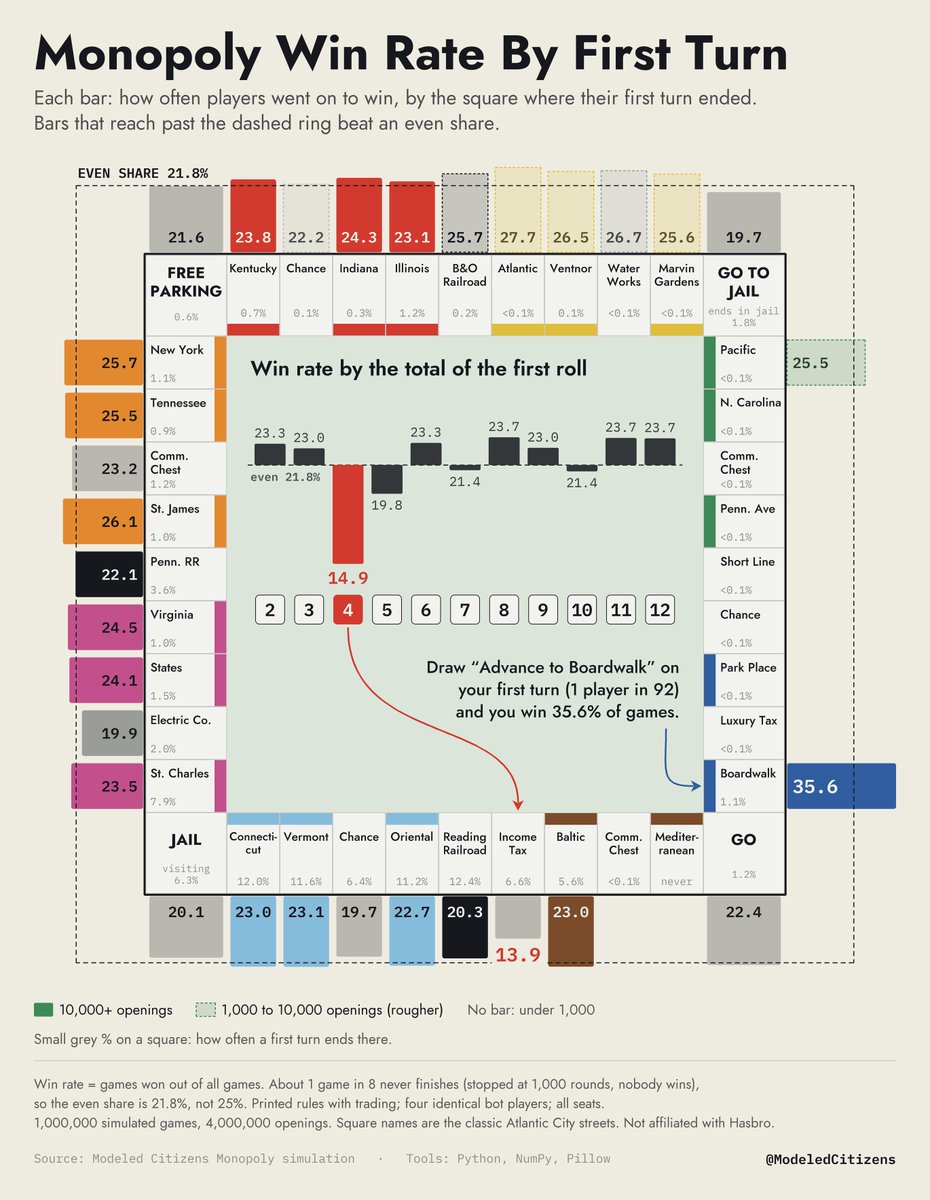
In 1 million simulated Monopoly games, rolling a 4 on your 1st turn cut your win rate to 14.9%.
An even share is 21.8%. Draw "Advance to Boardwalk" on turn 1 and you win 35.6% of games.
your HDMI cable can leak what’s on your screen
watch the laptop on the left. it reconstructs the video playing on the monitor beside it from radio signals leaking out of the HDMI connection
this is TempestSDR. an antenna picks up the leakage, a HackRF radio captures it, and software turns it back into an image
researchers took this further with Deep-TEMPEST, using AI to make recovered images and text easier to read. this clip shows the original technique
quality depends on shielding, distance and interference. the picture is imperfect, but recognizable content still gets through
a wired connection can still leave a wireless trace
@PatrickMoorhead Claude is horrible at room design. CGPT is decent but sometimes does not respect the room’s “architecture” (will put shelves in front double doors, forget / ignore there’s a door)
> moved houses, current one has 0 Ethernet wiring
> can’t find 2 of 4 APs
> APs found are wired backhaul
> Unifi controller is on TrueNAS server
> can’t find server GPU
> find it, start it, switch APs to “Mesh”, finally Internet
> 3 weeks from now I get 5gig fiber, because why not
my 2c, “security” is not binary. Nothing will forever be secure, and nothing will be forever patched. But what would I know, I don’t work at these frontier companies
I can confidently say that humans were not very good at writing secure infrastructure. The endstate will be hypersecure infrastructure and software for all, but we're going to go through some turbulence before we reach that.
Almost 150 Chinese WeChat streamers came to Dhaka, Bangladesh & spent the entire day livestreaming while showing the city's slums. When locals noticed the unusual number they started investigating why so many of them were doing this. Turns out, they were presenting it as India
9:10 PM: Check Uber. Ride is $22.
9:12 PM: Text friends back. Re-open app. Ride is $38.
9:14 PM: Refresh map twice. Ride jumps to $54.
Uber Screen: "Fares are higher due to increased demand."
Rider: Opens iPhone Settings and turns off Precise Location for Uber. Drops the pickup pin two blocks off the main street and walks to that corner. Force closes Uber and opens Lyft for 2 minutes.
9:17 PM...
What actual f*ck @DarioAmodei / @boris / @TheAmolAvasare
Let me get this straight - I get this email telling me:
1. A cybersecurity "research" company gets into your internal systems while... *checks notes*
"conducting a security testing exercise on its own initiative and without our authorisation"
2. You "cannot confirm whether any particular person’s information was viewed," then in the same email say "we have no reason to believe you are at heightened risk."
3. You also try to reassure by saying "the cybersecurity firm has certified in writing that it has deleted the accessed data and will not use it."
Translation - they pinky promised they deleted everything they gained unauthorised access to.
I've been hacking companies for 15+ years, so let me spell it out.
Accessing systems without authorisation has a name -hacking. Calling it a "security testing exercise" doesn't change that.
Honestly, the access itself doesn't bother me much. The irony does.
I’ve spent over $50k on API credits in the last six months and contributing to CVP by accepting logging.
On top of that, I've reached out to your teams to collaborate on security research (actual research - not the kind that has you send out privacy notices to your customers) and heard nothing.
I'm getting deeply unserious security vibes and considering moving all my (and my clients) token spend to @OpenAI if I don't see material change here.
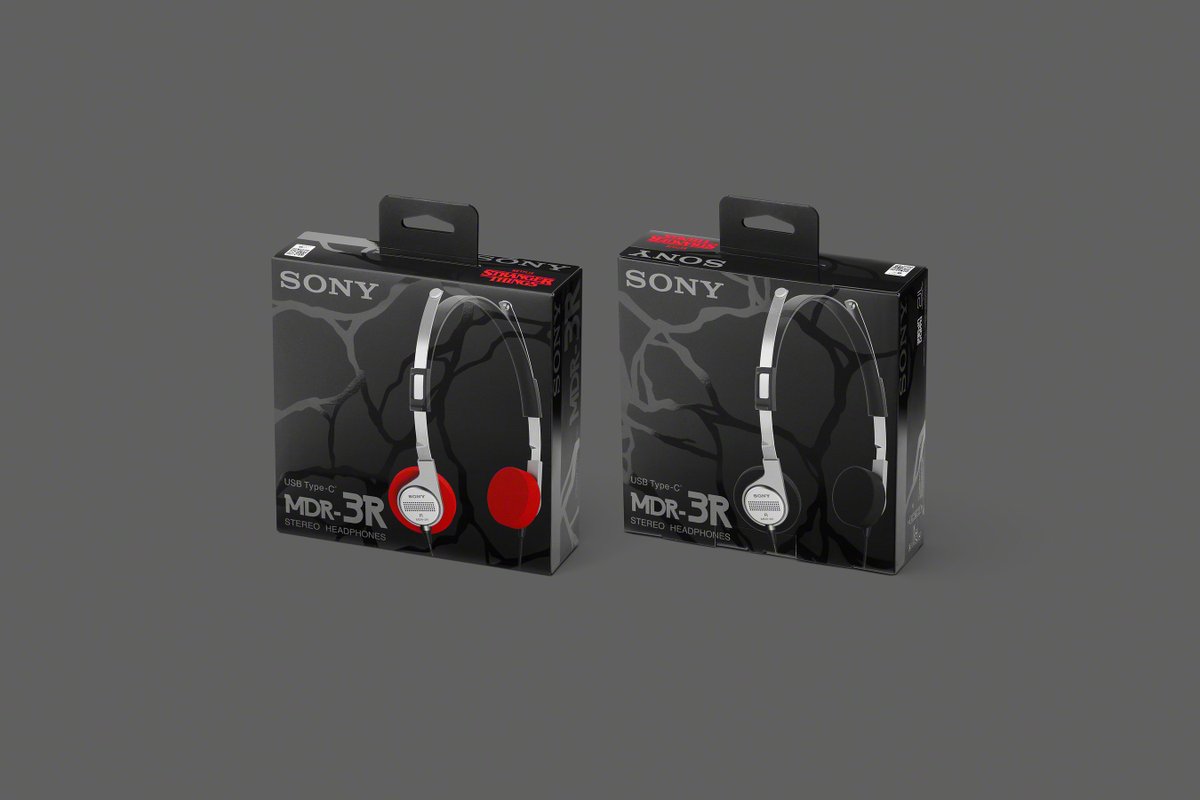
Sony just brought back its Walkman wired headphones after 47 years!
This is the new MDR-3R.
✅ Now comes with USB-C
✅ A special edition inspired by Stranger Things
✅ As usual, built-in microphones for calls and in-line remote for controls
Priced at $59.99 for the regular edition and $79.99 for the Stranger Things Edition.
This is so interesting. Would love to try these.
Cable audio products are back, and I can’t wait to see what’s next.