Why this matters for health AI:
A symptom checker says "take breaks" and moves on. Root causes live in context: what you eat, hours on calls, sleep, what changed last week. That needs memory, not just intelligence.
Never thought I'd be reading military hearing studies from 1994 on a Monday night.
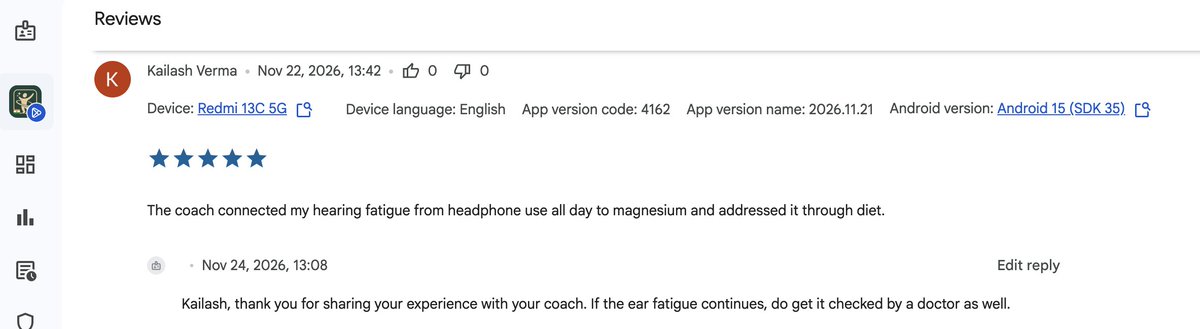
Blame this Play Store review!
Our AI coach told a user his tired ears might be a food problem.
Not a headphone problem. A food problem.
I didn't believe it either. So I went down the rabbit hole 👇
Gratitude is so underrated. Wake up someone from their grave and they would give up anything to do stuff that you ‘hate’ doing everyday.
This applies to exercising, eating good, running your startup… and the list goes on!
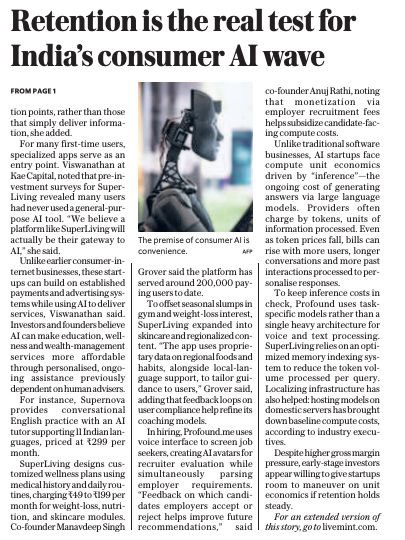
My 2 cents on how we are creating high retention products driven by deep user understanding. On the other hand, the cost of running the platform is consistently going down, thanks to our memory layer.
Thanks @livemint for covering it.
117x spike in post Diwali health purchases and its just the first half of the day 🔥
Also our highest single day revenue!
My conversation with @jay63yadav
#Diwali x Health!
1Mn+ conversations by 5pm
19767 kgs of weight loss tracked today!
65% of users marked mood as ‘good’ vs 14 days prior.
Power of personal AI companions becoming maintsream on @SuperLivingApp.
A festival when none of us thought that Indians would spend sometime for personal health, we are witnessing history 🫡
1 low performing wrong hire can disrupt 5 high performers with their toxic energy!
Don’t rush to hire, spend time, know what motivates them and build a culture of high performance equals high rewards 🤝
My takeaway for anyone building consumer AI in India: your real user probably isn't who your pitch deck says it is. Look at who's actually paying, then build for her.
Crossed 9,600+ pin codes with paying users in India. The most surprising thing isn't the reach, it's who's paying.
70% are women. Half are homemakers.
Everyone told us consumer AI in India would be built for the 25-year-old male techie. Our data says otherwise.
A health product built around her kitchen and her routine, in her own language, works differently from one built around a gym.
You can't design it from a boardroom. You have to see how the 4 PM tea break actually happens.
It isn't often that a founder gets to hear exactly what their investors wrote about them before they partnered.
On the first episode of The Investment Memo, Lightspeed India’s new series, Harsha and Priyal opened the memo they wrote on SuperLiving and went through it with us!
🔊 The Investment Memo, Episode 1 🎙️
Every partnership at Lightspeed starts with an investment memo, where our team writes down what it believes about a company before we partner with it. In The Investment Memo, our new series, we open that memo with the founders it was written about and read from it, so you can see how an early investment decision is made.
Our first episode is with @SuperLivingApp, which is building an AI health coach for India, starting with users in tier 2 and tier 3 towns. People already ask AI about their health, but they rarely get someone who checks in with them the next day, and SuperLiving's coaches remember each user and follow up, at a price most families can pay.
We partnered with Manavdeep Singh Grover and Gurjot Kaur early at SuperLiving's Series A. When we wrote our memo, the app had 24,000 paid subscribers after about four months. Both founders came from Pocket FM, and they have shaped the product around what their users asked for.
In the episode, Lightspeed Partner @kumarharsha2212 and Vice President @PriyalMotw89880 read our memo to Manavdeep and Gurjot section by section, from the team and market to the risks we noted, and discuss what has shifted since.
Watch the full episode here: https://t.co/7BUUR6ugIR