To accompany the video from my recent talk at @aiDotEngineer, here's an expanded version of my argument that we've seen three key inflection points with LLM over the past twelve months https://t.co/lcq6fyK3LT
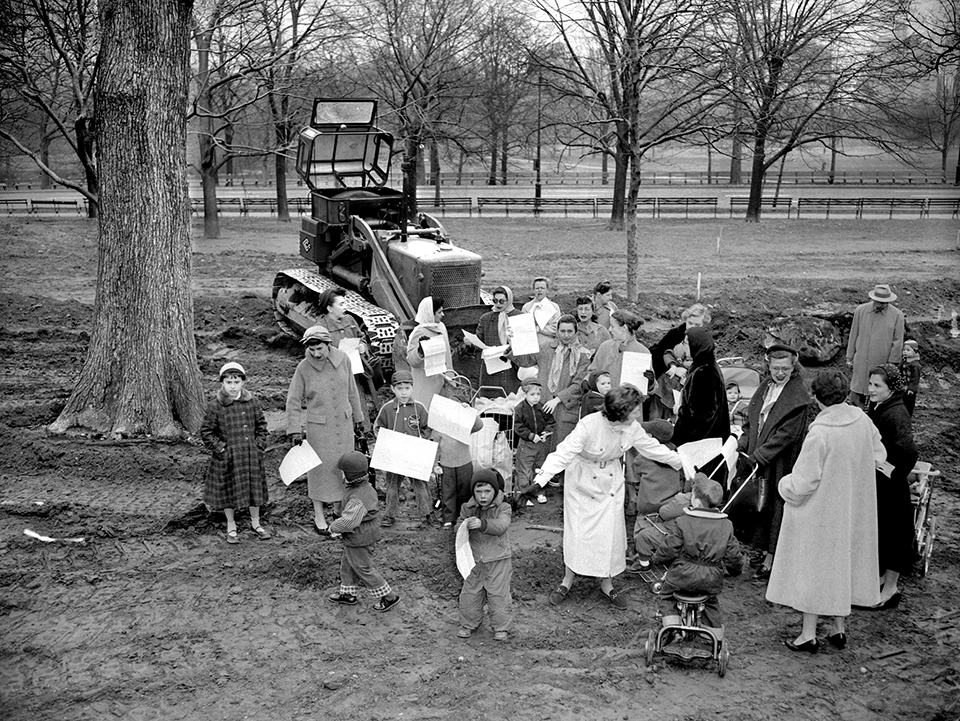
In 1956 Robert Moses bulldozed a half acre of Central Park to create a parking lot next to Tavern on the Green. Local moms were so upset that they attempted to occupy the site with the children to stop the plan. Moses had the police intervene, fenced off the area, and cleared it. It become known as the "Battle of Central Park."
Now 70 years later that parking lot is going to be turned into a soccer pitch, thanks to funding from the State and design work by @CentralParkNYC.
A big win for public space and a righting of an historical wrong.
In testing GPT-6.2, I used it to make a significant historical discovery which I detail in the post below. This suggests that the process of research and discovery we’re already seeing in verifiable domains like math is starting to generalize to non-deterministic fields like history.
You can read the full post here:
https://t.co/Vm7MA2R3aQ
In a nutshell, Yale’s Beinecke Library holds an anonymous sketchbook of an 1808 journey from Montreal to Lake Superior and back. I’ve spent many hours over the years trying to figure out who made the sketches with no luck. The artist could literally be any one of several thousand people. There are few clues: only four dated and labelled images.
With minimal prompting, in just 22 minutes, Astra used publicly available sources to identify a minor French aristocrat, the vicomte de Chabot, as the artist and suggested that we test the hypothesis by ordering copies of a little known microfilmed diary of Chabot’s trip it also found.
I was truly stunned. I’d never heard of Chabot or this diary! New document finds are also exceedingly rare in a well worn field like fur trade history.
I ordered scans of the journal from microfilm and when they arrived the handwriting matched the captions in the sketchbook. The itinerary also aligned perfectly with the few dated drawings in the book. But there was actually the type of conclusive evidence we rarely get as historians: on 18 June 1808, after Chabot’s canoe reached Fort St. Joseph, he wrote “I took a sketch” before describing the exact view of the fort depicted in a matching drawing.
The journal itself is also a major find. It had been mentioned once in a dissertation footnote, but in a completely different area of history and is unknown to fur trade or Canadian historians. It’s long and detailed, covering some 162 notebook pages which makes this a significant new document to my field. Attached to the journal was another trove of documents too: excerpts from long-destroyed North West Company papers, journals, and letters. Again, this almost never happens. Both finds equally surprised the other leading experts I consulted.
Although we can construct a coherent narrative in hindsight, I cannot emphasize enough how exceedingly difficult this sort of thinking and recall is for humans. Unlike a human, Astra was able to tackle the problem from both ends at once: working forward from the scant facts of the 1808 journey pictured in the sketchbook and backwards from the immense number of surviving facts about 1808 British North America in general.
While we can technically explain Astra’s path to this find as a product of enhanced search capabilities, it conducted the investigation from end to end. I basically acted as the research assistant, restricting copies of the paper documents it needed.
To my mind, this puts historians in a similar position as the mathematicians found themselves about eleven months ago, when LLMs started to solve the first Erdős problems. Over the past year, we’ve watched these same models go from learning to read handwriting, to beginning to think historically, to mastering the undergraduate essay, and finally to making small but real contributions to human knowledge more or less autonomously.
The trajectory seems clear.
"These findings show that social institutions can raise the production and use of knowledge by broadening access to intellectual exchange beyond formal academic networks"
https://t.co/Cae0pIapqF
Ten months before all of the New York’s public schools switch to a new set of graduation requirements, the state education commissioner said her department doesn’t have enough money for the endeavor.
Latest in the Regents exam saga @ByKathleenMoore -->
https://t.co/CtmUVBRErL
Here’s one of the most fascinating child development videos I’ve ever shared.
As your baby learns language, they begin by approximating the examples you set.
After a period of early experimentation with sound (including cries, coos and gurgles), infants begin babbling - making speech-like sounds (which often include components of conventional speech) that are - nonetheless - not yet conventionally meaningful.
This babbling phase is a precursor to the use of formal words. And it happens in all languages.
Including sign language.
This video shows an infant (who, by the way, is not hearing impaired) “babbling” to her deaf grandparents.
As they sign to her, she responds in kind, using her hands to approximate the signed communication that they are modeling.
It’s a whole serve and return conversation, just as if they were conversing verbally.
If you’ll watch carefully, you’ll note distinct turn taking.
And - interestingly - that with her grandparents she largely avoids vocalizations, in favor of gesture.
What a treat to see this rich example of bilingual language development.
This fascinating video was shared to TT by mara_mccullough.
Today my office has released a major new report on student enrollment in NYC.
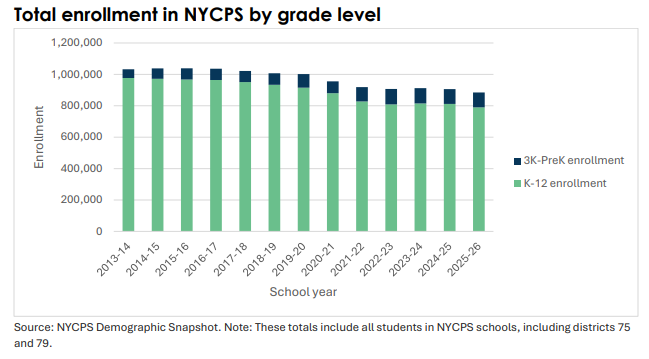
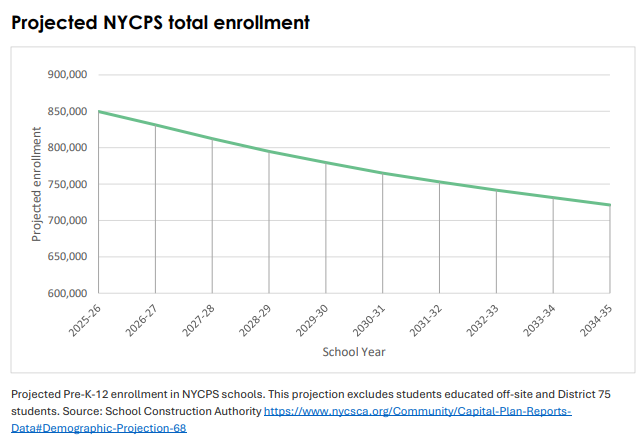
We found that k-12 enrollment in our public schools has fallen by 187k since 2013, with a projected decline of an additional 128k students by 2034.
As total enrollment declines, NYCPS is serving a student population with growing needs. The number of students with disabilities is increasing. In the most recent school year, approximately 73% of students were in poverty and 14% were homeless or living in temporary housing.
Our report finds the drop in enrollment is driven by declining births and families with children leaving NYC, with a particularly notable drop in public-school enrollment as students transition from elementary to middle school.
These trends have massive implications for our schools that we have only barely begin to grapple with. My hope is that this report will spur a long overdue conversation about what the era of falling student enrollment means for NYC, and what we can do to reverse or slow it. 🧵
1/ We discovered something totally unexpected about the neural structure of consciousness that overturns decades of thinking on its biological basis and brings us significantly closer to the recipe for generating conscious awareness.
New preprint: https://t.co/K8BwiHXvXg (led by @HesseJanis, with @FrankLanfranchi, @_conor_mcgrory, @Yuelin_Shi, and @EngelTatiana)
A deaf child is stuck on a word in a phonics lesson. As the teacher repeats the sounds, an interpreter fingerspells it, letter by letter.
The hand doing the work of the ear.
New post: what happens to reading science when a child can't hear the phoneme?
https://t.co/4Z4hhAuAHW
New in Science: we randomized phone-free classrooms for 16,000+ students across 10 institutions in Odisha, India. Students deposited phones in a box at the start of each class, for a full semester.
"At a time when #AI is starting to outperform us in many cognitive domains, building alliances and identities together with other biological intelligences might be more important than ever"
--@begusgasper
https://t.co/f27s99esKJ
"We found that when knowledge workers intentionally use AI to challenge their ideas – to generate friction – they can significantly improve their performance" https://t.co/NFKIqeISEQ
"So there’s something still bubbling inside, festering. ... How long does it take to cool an egg? My god. Our emotions are always on the verge of eruption." https://t.co/brIccfPZpj
1/ PISA 2025 says advantaged students fell more than disadvantaged ones.
Today we publish a paper explaining t's a measurement change. Measure students the same way in both years and the top-quartile drop in maths goes from −14 to −6 points. 🧵
"I’m left wondering, after reading about the potential fireside origins of our language, that we might feel more connection and trust by going back to sharing stories around a fire."
https://t.co/g9bKmEyrB4
What is the story behind why Google Gemini has backed out of the frontier AI model race?
Was is a choice due to ethical or resource considerations?
Was it getting stuck and new model training just stopped working?
Genuinely curious.