Last night, Jensen Huang of NVIDIA gave his very first live keynote in 4-years.
The most show-stopping moment from the event was when he showed off the real-time AI in video games. A human speaks, the NPC responds, in real time and the dialogue was generated with AI on the fly.
Order independent transparency techniques have been around for a while, have actually been used in some games but not widely yet. I tinkered with a few to get a feel for how they perform and look and wrote a blog post (more to follow) https://t.co/vftykF8jZc
Cuando estás a punto de irte tras una semana intensa y un viernes lleno de eventos: presentaciones de proyectos, mesas redondas y exposiciones colectivas…
Y te encuentras a tus exalumnos que vienen a verte felices y trabajando, se te cargan las pilas.
Vamos! 🦾
Raytracer in Excel - Using the GPU!
@jamis : I feel that the RayTracer Challenge is now complete... or does it ever end?!
@Peter_shirley : this definitely took my longer than one weekend...
#excel#gpu#graphics#gamedev
I'm very happy to show you the #GraphicEngine that @jomogar23 and I have been working on all this year, "GamaEngine". Developed on #PS4 and #OpenGL.
Powered by @ESAT_Valencia
https://t.co/HZnFiD8027
Started thinking about the varying layout (VS->PS interpolants). On mobile you want to optimize this too (TBDR GPUs).
For varyings, mobile GPUs support fp32 and fp16. fp16 varyings also directly go to fp16 registers, reducing register pressure.
Can we go below 40 bytes?
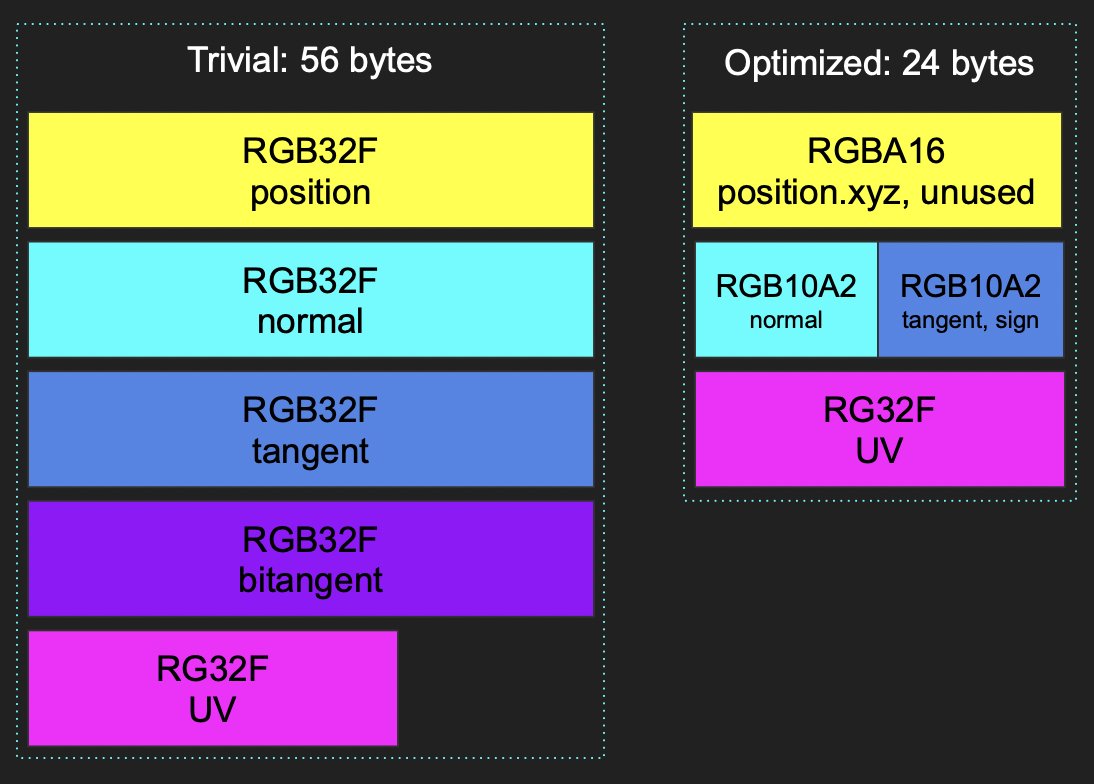
Let's talk about storing vertices in optimal memory footprint.
I have seen people using full fat 32 bit floats in their vertex streams, but that's a big waste, especially on mobiles. All our 60 fps Xbox 360 used a 24 byte layout with a mixture of 16 bit and 10 bit data.
Cheap-ass parallax is <10 instructions :)
float parallax = texture(parallaxMap, uv).x;
uv += viewDir.xy * parallax;
viewDir.xy must be in tangent space, so that adds a matrix3x2*vec3 multiply.
But it's an added texture fetch, and increases latency too (dependent read).
I still find deferred shading examples that use a position buffer. Did anybody ever ship a deferred renderer with a position buffer? It's trivial to construct the position from the Z buffer (with inverse view*projection matrix). Saves a lot of memory bandwidth.
I'm proud to present: ACE, an accessible, clean and easy-to-use C++ networking library for Windows games.
It's available both in my GitHub repository as well as my portfolio, so check it out!
Soon I'll have news for all of you...
https://t.co/Za1LByTXWb
#networking#cpp#gamedev
Starting @CoreKeeperGame Early Access!!!
After trying the Beta we immediately fell in love with it!! 💕🌸 Don't miss it out if you enjoy Terraria/Stardew Valley/Minecraft/Starbound!
⭐️It's such a charming experience!! #indiegame