BREAKING: Trump diz que, durante a reunião da Apec, convenceu as Filipinas a deixar de comprar produtos agrícolas do Brasil e outros países.
“O Brasil vai ajuda-los caso eles entrem em um pequeno confronto com a China? Acho que não”, disse Trump.
Millions of homes are running on a router that nobody has logged into since the day it was plugged in.
Not once. Not to change the password, not to check for updates, not to look at a single setting.
And those same homes are paying $70, $80, even $100 a month for "fast" internet.
Then the video call freezes in the middle of an important work meeting. Netflix buffers on a Friday night. The kids' games lag at the worst possible moment. The Wi-Fi "just feels slow."
So what does everyone do? They call the provider and argue for an hour. They upgrade to a more expensive plan. They buy a $140 Wi-Fi extender. Some people even replace the router twice in a year and a half and spend $400 or more doing it.
None of it fixes the problem.
Not because the internet was too slow. Not because the new router was bad. Because every router ships on factory settings built for an "average home on an average day." It sits on the same crowded Wi-Fi channel as every neighbor, pushes your devices onto the wrong band, uses the slowest default DNS, runs firmware that is months or years out of date, and treats your work video call exactly the same as someone's 40GB game download.
Then I sat down for 10 minutes in the admin panel. I didn't change the plan. I didn't buy new hardware. I didn't call the provider.
I changed 6 settings: channel, band steering, DNS, firmware, QoS, and one buried security toggle most people never touch.
Same router. Same plan. Same house. The difference was obvious the same day: calls stopped freezing and streaming stopped buffering.
"Your router was never too slow. It was never told how to manage your home. And nobody, not your provider, not the store, not the box it came in, was ever going to tell you the fix was free."
Here are the 6 settings I changed, and exactly how to do each one 🧵
🚫🔥America is under attack. But by Whom? The American Media will now start blaming Iran, China, Russia or North Korea. Many may whisper digital IDs and technocracy.
All this may be true. But not on this attack.
If you want your answer, look at Wall Street.
In America, corporations move the machinery. Investors price the future. Fear can become a very profitable product.
Now follow the dates.
8 October. Anthropic launches a program named ‘Cyber Mission.’
Its mission?
Defend power grids, electricity, water utilities, transportation, government networks, vulnerable software and industrial technology.
Its partners?
CrowdStrike.
Palo Alto Networks.
Booz Allen Hamilton.
Accenture.
Deloitte.
PwC.
Rockwell Automation.
26 October: Anthropic files its IPO registration.
3 November: Microsoft web-app disruptions.
9 November: Cyber incidents at two American hospitals.
10 November: Anthropic's IPO roadshow begins.
Now watch the sequence.
11 November: Nvidia's CEO resigns.
12 November: Microsoft 365 suffers a major global outage.
13 November: America grounds flights nationwide.
13 November: Workday's HR systems fail.
14 November: Aviation delays ripple nationwide.
15 November: AWS reports a regional cloud outage.
16 November: United Airlines suffers a separate system failure.
16 November: Banking systems start failing.
Cloud. Hospitals. Aviation. Payroll. Infrastructure. Banking.
And now the grand finale?
18 November: IPO pricing.
19 November: Nasdaq debut.
Here is the plot twist.
Anthropic isn't just selling chatbot answers.
It is expanding into AI cybersecurity and government security work.
Now, follow the money.
Who owns Anthropic?
Amazon. Google. Lightspeed. Menlo Ventures. Coatue. ICONIQ. Spark Capital. GIC. Fidelity. BlackRock-affiliated funds. Sequoia.
And who is lining up for another $26 billion investment?
Google. Nvidia. Microsoft. AMD. Broadcom. Micron. TSMC.
Who is arranging the IPO?
Goldman Sachs. Morgan Stanley. JPMorgan.
Imagine the sales pitch:
"Your systems are fragile. Your citizens are frightened. We have the AI to save you."
Fear becomes demand. Demand becomes a growth story. Wall Street prices the story.
What a beautiful coincidence. Elites love those. 😂
“If you invest in Bitcoin and let people use it as currency, you���ll melt down your economy.”
- Goes all in, builds a $500 million strategic reserve, achieves 3% annual GDP growth, secures $3.5 billion in foreign investment, and the country’s credit rating is upgraded five times.
“You can’t imprison your way out of crime.”
- Builds CECOT and transforms San Salvador from the most dangerous city in the Western Hemisphere to one of the safest in the world.
“You can’t just fire the corrupt judges. Your people will hate you.”
- Fires the corrupt judges. Approval rating soars to over 90%.
“You can’t just go to Haiti and take out the gangs. It’s a sovereign country.”
- Goes into Haiti, takes out gang compounds, drives criminals into hiding, thousands of Haitians rush to the streets to celebrate their liberation, all while making the UN look like fools.
“You’ll never be able to fix the education system with discipline and focusing the curriculum on the basics.”
- Enrollment up. Graduation rates up. Truancy down. Drop out rates down. Youth literacy up. 225 schools rebuilt or renovated. Teen pregnancy down 68%.
Stop listening to the “experts.” You can just do things.
Now that Jensen Huang is gone, I think America is about to discover something the hard way:
Nvidia didn’t just lose a CEO. It lost the one guy who knew how to run an Asian supply chain like an old-school merchant.
You can replace him with a brilliant American executive, an Indian executive, a Chinese executive — whatever.
The title is replaceable. The relationships are not.
Anyone who grew up around old-school Chinese business culture will recognize Jensen’s style immediately. You eat together. You drink together. You remember who helped you twenty years ago. When you decide someone is your guy, you keep dealing with him for decades. Contracts matter, of course, but when things go wrong at 2 a.m., what matters even more is whether the person on the other side will pick up your call.
Look at Nvidia’s supply chain. TSMC makes the chips. SK Hynix makes the HBM. Foxconn, Quanta, Wistron, Pegatron and others build the systems. Jensen didn’t suddenly discover these companies when ChatGPT arrived. He spent decades personally building relationships with the people running them.
TSMC is probably the best example. Back in 1998, when Nvidia was still tiny and short on manufacturing expertise, TSMC sent two production people over to help. The relationship became so close that Morris Chang later asked Jensen twice if he wanted to become CEO of TSMC. Jensen said no both times.
Decades later, Jensen was still flying back to Taiwan, eating with Morris Chang, Barry Lam and half of the island’s tech establishment. At one Taipei dinner, the guest list looked less like a restaurant reservation and more like the control room of the global AI supply chain: TSMC, Quanta, Pegatron, Wistron, Asus, Acer, Inventec, Foxconn.
That stuff looks almost comically old-fashioned in an industry obsessed with AI agents and trillion-dollar market caps. But then you see what happens when Nvidia actually needs something.
In 2024, Jensen wanted SK Hynix to move its HBM4 supply schedule forward by six months. Six months in semiconductors is insane. You’re talking about engineering, capacity and production plans that were set long before Jensen showed up asking for more.
SK chairman Chey Tae-won publicly told the story later. Jensen asked. Chey went back to his people and pushed.
That is not something you reproduce by handing the next CEO a supplier spreadsheet.
And Jensen also knew what it meant to owe somebody.
In Nvidia’s early days, its project with Sega went badly enough that the company was in real trouble. Jensen went to Japan, admitted the technology wasn’t going to work, and Sega still gave Nvidia $5 million that helped keep the company alive.
Thirty years later, Jensen went back to Tokyo and thanked former Sega president Shoichiro Irimajiri in person. His message was basically: without what you did for us back then, there would be no Nvidia today.
He did the same thing on the other side of the table.
Serve Robotics CEO Ali Kashani has talked about December 2023, when his company was so close to dying that he had already discussed bankruptcy. An investor pulled out right before Christmas. Kashani called Jensen. Nvidia helped carry the financing, other partners joined, and a few months later Serve was ringing the Nasdaq bell.
That’s the Jensen playbook. Eat with people. Remember favors. Return favors. Call directly when there’s trouble. Keep relationships alive for twenty or thirty years.
Silicon Valley has a fancy word for this: “network.”
My family would probably just call it doing business,and now Jensen is gone.
Nvidia can transfer his office, his org chart, his contracts, his procurement team and every supplier database to the next CEO.
What it cannot transfer is the invisible ledger sitting inside the heads of dozens of people across Taiwan, Korea and Japan:
He helped me once. I helped him once.
We’ve known each other for 25 years.
If he calls, I’ll listen. There is no handover document for that.
THIS IS WHY THEY TOOK DOWN JENSEN HUNAG
Four months ago, Jensen Huang revealed he was about to BREAK the closed-model monopoly over AI and completely reshape the AI industry.
He made a direct THREAT to America’s biggest AI companies.
He revealed Nvidia was working on a MASSIVE new frontier-level, open AI named Nemotron 3 Ultra and that it would be competing directly with Claude Opus…
And most importantly, it would be MUCH cheaper.
Think about what that means. An American, open-weight, frontier-level model at a fraction of the cost could destroy the business models, valuations and upcoming IPOs of America’s AI oligarchs.
And what do you know, the person who leaked the “honeypot” story to the press was none other than ANTHROPIC CO-FOUNDER Jack Clark, who reportedly holds a larger stake in Anthropic than Dario Amodei himself…
NVIDA is well placed to dominate AI as it has the one thing almost every AI company needs but doesn’t produce. The hardware.
And if NVIDIA starts competing directly with its biggest customers with frontier-level, open-weight AI, at dramatically lower prices, its over for the AI Epstein class. And it would be amazing for humanity.
So he had to go.
He has been replaced by a Zionist who starts her day every day talking to Israel. And 3 Israelis are on the list to replace him permanently.
Will they shelve or nerf the Nemotron family and the coalition of eight labs building frontier OPEN models?
Will they CANCEL his five-year, $26 billion commitment to open-weight model development?
And will they kill the pending $13B acquisition of Hugging Face, the default distribution layer for open models. A deal that has not yet closed, very convenient timing.
Founder priorities rarely survive such transitions intact, especially when the stock dives 30%. They know this.
Prediction. Screenshot this post, we'll talk again in five years.
They're going to pull it off. Jensen Huang is going to be pushed out of Nvidia.
And here's what happens next.
Elon hires Jensen and puts him in charge of Terafab.
He's already said it publicly: hiring him would be an honor. And Terafab is the project made for him. A chip factory Musk wants to be the largest ever built, one terawatt of compute per year, from design to packaging under one roof. Terafab's challenge is to do in a few years what the industry took decades to build. There's only one man on Earth who knows every layer of that stack.
They execute like absolute maniacs.
Musk brings speed, capital and appetite for risk. Jensen brings thirty years of mastery of the stack: architecture, software, customers, supply chain. Musk builds factories faster than anyone alive. Jensen knows exactly what to put inside them. It's the only duo in the world capable of compressing a decade into three years.
SpaceXAI merges with Tesla.
This isn't even science fiction anymore: independent committees are already studying the merger. Rockets, satellites, AI, robots, self-driving cars, energy, and now chips. One single entity, integrated from silicon to orbit.
The group climbs to $50 trillion.
Today, SpaceX and Tesla are worth around $3.4 trillion combined. $50 trillion sounds insane. But remember: ten years ago, Nvidia was worth a few tens of billions. When you own superintelligence, the robots that do the work and the rockets that go to space, you don't capture a market. You capture the economy.
Elon buys Nvidia.
Meanwhile, Nvidia without Jensen does what every company does after losing its founder: it manages. It protects its margins. It loses ground to its own customers' in-house chips. And one day, it becomes a target. For a $50 trillion group, buying Nvidia is just one acquisition among others.
Jensen becomes the chip boss again.
He takes over the semiconductor division of the new entity. Pushed out of his own company, he gets it back from above, inside the largest industrial group in history.
Sounds crazy? Steve Jobs did exactly that. Pushed out of Apple, he came back when Apple bought NeXT. You know the rest.
Nvidia's board thinks it's getting rid of a problem.
It's creating the biggest competitor in its history.
See you in five years.
HR asked us to build an internal AI chatbot that could answer employee questions about company policies.
We connected it to the employee handbook, benefits documents, and twelve years of internal company announcements.
Named it AskHR.
It worked beautifully.
Employees could ask about PTO, health insurance, parental leave, whatever.
Then someone asked:
"Why haven't we received raises in two years?"
The chatbot responded:
"According to the CFO's March 2025 announcement, the company is experiencing financial constraints."
Then it helpfully added:
"However, the company approved $340,000 in executive bonuses during the same period."
HR called me immediately.
"WHY IS IT SAYING THAT?"
I explained that both announcements were in its knowledge base.
They asked me to remove the bonus information.
I asked if it was inaccurate.
"No, but it's inappropriate."
Then someone asked AskHR why the company stopped providing free lunches.
It explained the decision was made to reduce operating expenses.
Then cited a leadership announcement celebrating our new $180,000 executive retreat.
Employees started asking questions we'd never anticipated.
"Why does the CEO have a company car?"
"Who approved the private jet expense?"
"Why was the employee wellness budget cut?"
AskHR answered every single one.
With sources.
By Thursday, HR had received 200 complaints.
Not about the chatbot.
About the company.
The CEO demanded we shut it down.
Said the system was spreading negativity.
I explained that it was literally repeating information leadership had published themselves.
He said we needed to make it more aligned with company values.
I asked which values.
He said he'd get back to me.
We spent $140,000 building an AI that could accurately explain company policies.
It lasted four days.
Turns out the one thing leadership didn't want employees having access to was leadership's own decisions.
> Haiti gangs snatch 4 Salvadorans
> they think they just bought themselves a negotiation
> Bukele goes public saying bring them back or you're done
> they try to hand him 4 random bodies and say it was them
> he calls out their bs
> sends 2,000 troops into Haiti
> tells the leader to gather their gangs so he can fight them
> gangs run to the UN for a deal
> refuses all deals
> ignores the UN mandate
> pushes into gang territory and starts cleaning them
> does more in two weeks than the UN did in 13 years
Bukele might be the greatest leader of the 21st century
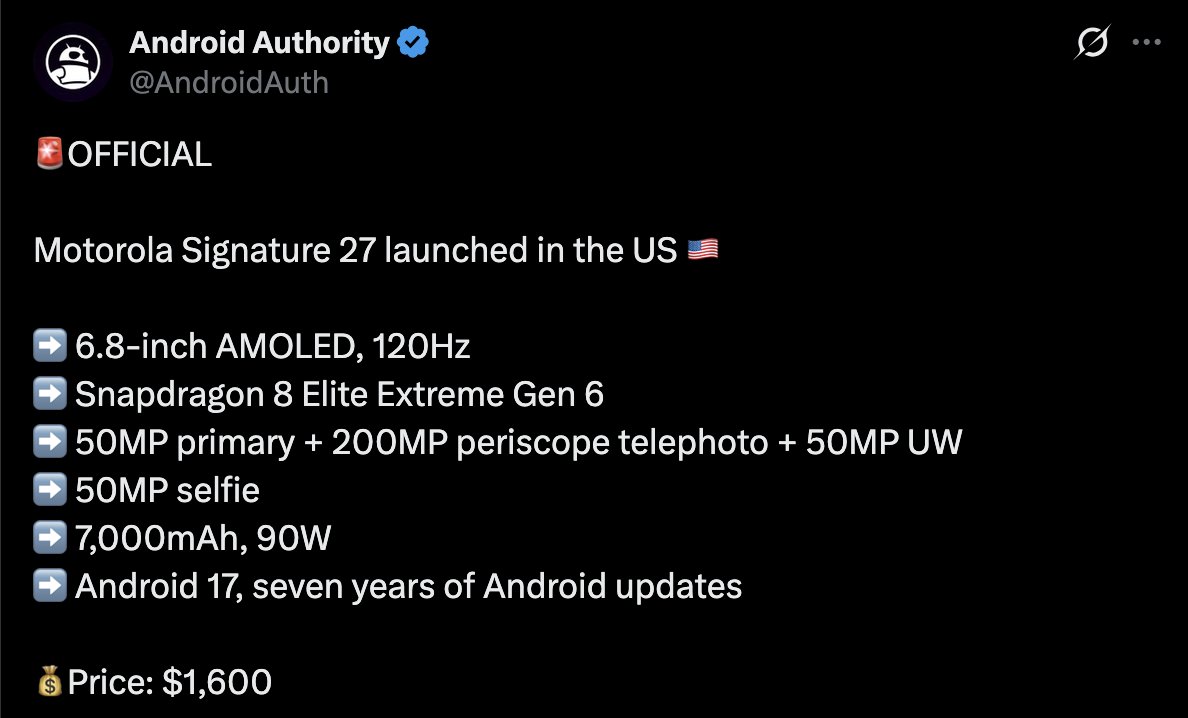
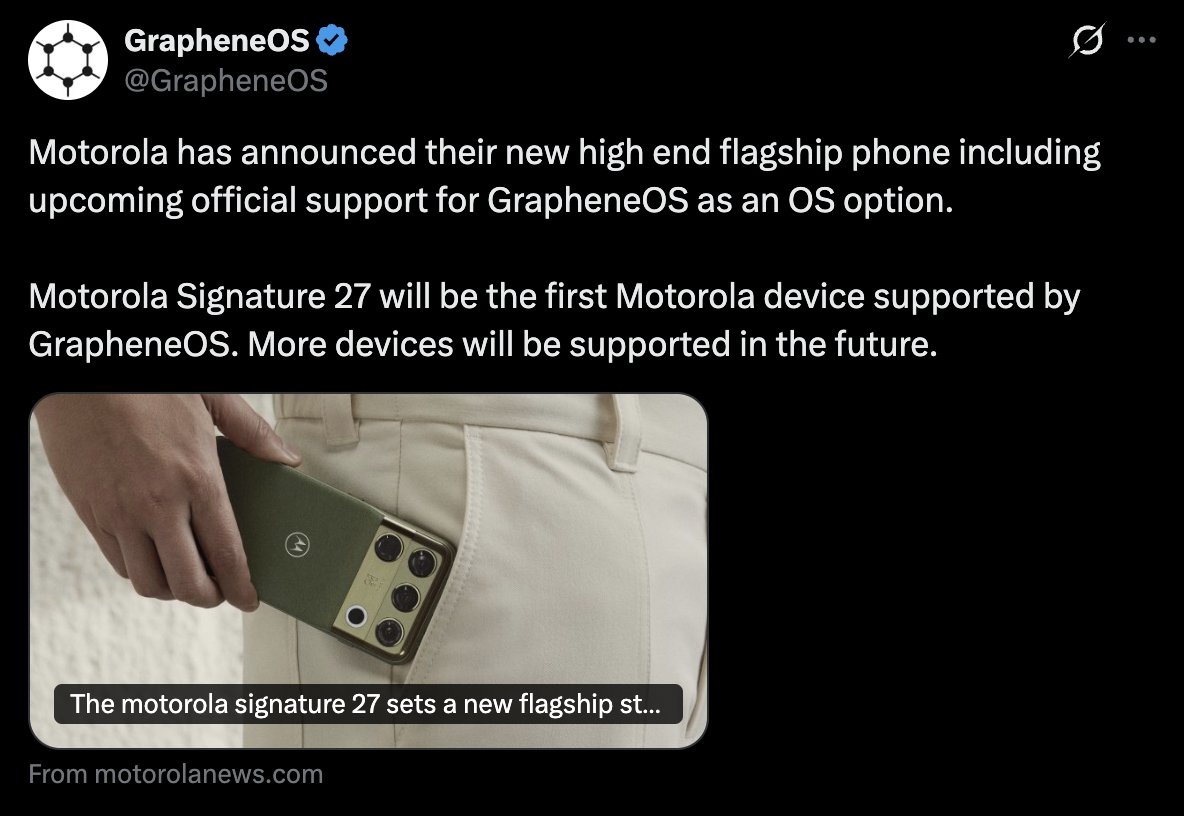
Motorola Signature 27 dropping with official GrapheneOS support is the wildest hardware plot twist of the year.
First non-Pixel device to actually allow custom root of trust and verified boot re-locking. Snapdragon 8 Elite Extreme Gen 6. 7,000 mAh battery with 90W charging. Zero Google/carrier telemetry out of the box once flashed.
$1,600 is steep, matching maxed-out iPhone pricing. For a dedicated cold-signing brick, it’s massive overkill—a used Pixel still wins on cost. But as a daily driver with zero-telemetry, hardened malloc, and true hardware freedom? Finally, an uncompromising endgame beast.
Gonna wait a couple months for the stable official builds to roll out before pulling the trigger.
Gonna harden your bonk once in a while.
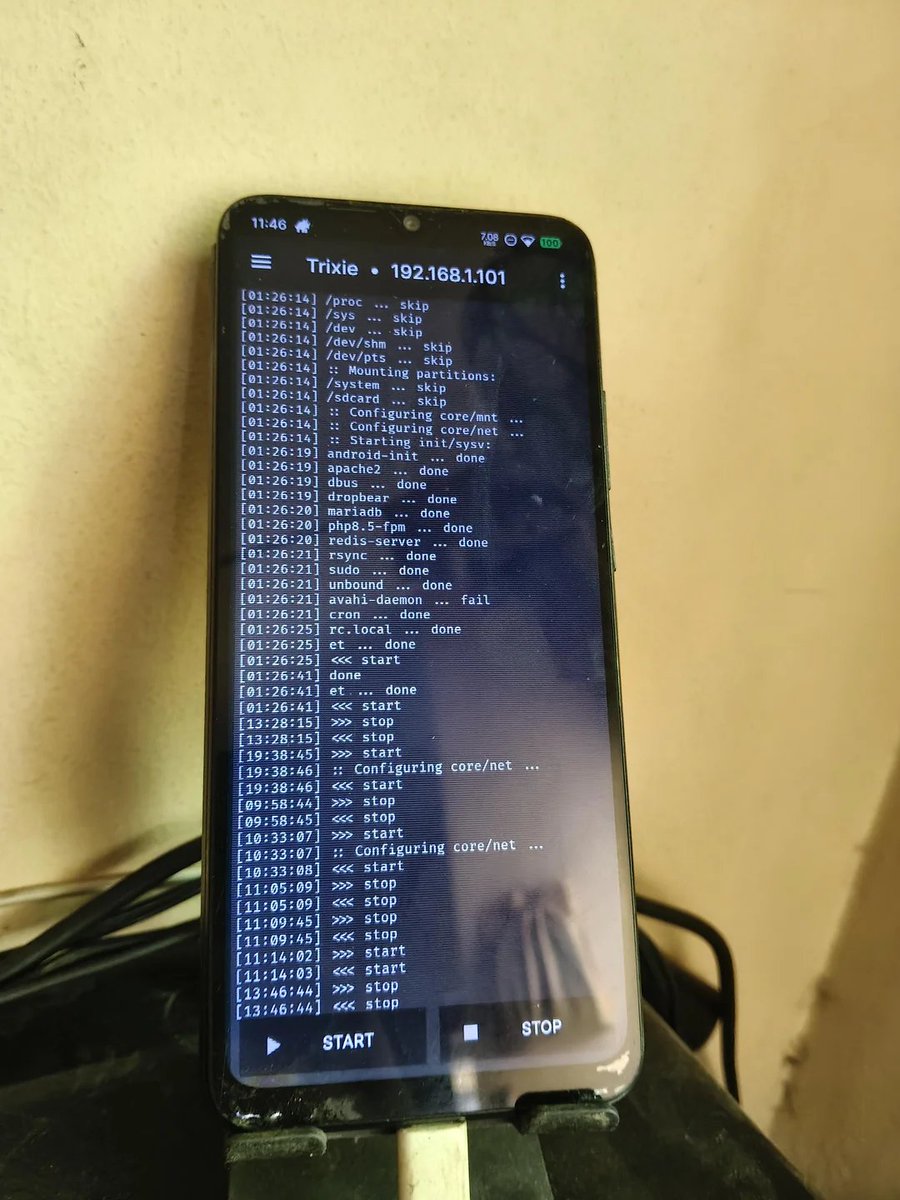
Turned a dusty a cheap older Android Phone into a 24/7 a full home server.
- Nextcloud
- Pi-hole
- Navidrome music streaming
- Live Custom status dashboard
Power draw: 2-3W (runs off battery, screen off).
Debian 13 chroot & Magisk, No extra hardware.