🚨 KAROLINE JUST SAID WHAT EVERYONE AROUND HIM ALREADY KNOWS
At the South Carolina rally, Karoline Leavitt stepped up and told the truth about President Trump:
“You can call this man at 6 in the morning. You can call him at 3 in the morning. He picks up the phone… because he’s looking out for YOU.”
Then she got personal:
“It has been the honor of my life to serve as your White House press secretary, sir.”
And the part the media will never run:
“I just want everyone in this room to know how hard this man works for all of you, and for every American across the country, whether they’re Republican or Democrat.”
In September of 1814, America was once again in trouble.
The young republic was only thirty-eight years old. The War of 1812 had gone badly. British troops had marched into Washington, burned the Capitol, set the White House ablaze, and now turned their sights toward Baltimore. If Fort McHenry fell, the harbor would be open, the city would likely follow, and another devastating blow would be dealt to the fragile nation.
Amid this uncertainty, a young American lawyer named Francis Scott Key sailed under a flag of truce to the British fleet. He had come to negotiate the release of a friend, a physician the British had captured.
He succeeded.
The British agreed to free the doctor.
But there was a catch.
Because Key and his companions had seen too much of the British fleet and learned too much about its plans, they were not allowed to return to shore. Instead, they were detained aboard a ship in the harbor and forced to watch the coming battle from behind enemy lines.
On the morning of September 13, the bombardment began.
For the next twenty-five hours, British warships unleashed somewhere between 1,500 and 1,800 bombs and rockets upon Fort McHenry. These were the “bombs bursting in air” and the “rockets’ red glare” of the song—not poetic embellishments, but terrible realities.
Key stood on the deck through the endless day and the long, terrifying night. Every explosion lit the darkness for a fleeting instant before the smoke swallowed everything again. Somewhere beyond that wall of fire stood the fort. Somewhere beyond it flew an American flag if it still flew at all.
He could not see.
He could only listen.
As long as the guns continued firing, there was reason to hope. The British would not waste ammunition on a fort that had already surrendered.
Then, just before dawn…
The guns fell silent.
For the first time all night, there was only stillness.
It was the most frightening sound of all.
Had the fort finally fallen? Had the defenders surrendered? Had the flag been torn down in the darkness while no one could see?
There was nothing to do but wait.
As the first light of September 14 slowly pushed back the smoke, Francis Scott Key strained his eyes toward the distant fort.
Then he saw it. Not a British flag.
The American flag. Still there. Still flying.
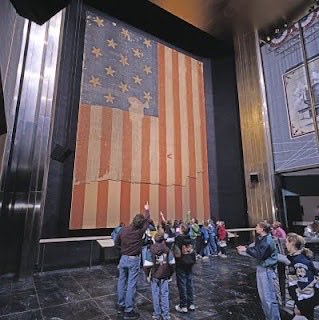
That flag was no ordinary banner. Months earlier, the fort’s commander had commissioned a Baltimore flagmaker, Mary Pickersgill, to sew a flag so enormous “that the British would have no difficulty seeing it from a distance.” It measured roughly thirty by forty-two feet, carried fifteen stars and fifteen stripes, and was so large it had to be assembled on the floor of a brewery because no ordinary room could contain it.
That was the Star-Spangled Banner.
The very flag Key saw through the morning mist.
The very flag that still survives today in the Smithsonian.
Overcome by what he had witnessed, Key reached into his pocket, pulled out an envelope, and began writing. The words came from a heart that had spent an entire night fearing his country might disappear with the dawn.
He first titled the poem Defence of Fort M’Henry.
Within days it was printed and circulating throughout the country. Before long, people began singing it to a melody they already knew—an old British tune called “To Anacreon in Heaven,” originally written for a London social club. There is something beautifully ironic in that: America’s most beloved patriotic song borrowed the melody of the very nation it had just survived. It also explains why the anthem is so notoriously difficult to sing. It was never written for ordinary voices gathered in stadiums or school assemblies.
The song spread quickly and became one of America’s favorite patriotic hymns, but it would wait more than a century before receiving official recognition. Not until 1931 did Congress declare “The Star-Spangled Banner” the national anthem of the United States.
🇺🇸 US Army Special Forces Master Sergeant Thomas D. Maholic was killed in action on June 24, 2006, by small arms fire in Ghecko, Afghanistan while supporting Operation ENDURING FREEDOM. 🕊️ MSG Maholic was serving with the 7th Special Forces.
#TheAfghanistanWar
Yesterday, during my father's funeral procession, led by the United States Marine Corps, my family noticed the man in this photograph standing at the side of the road. He held his hat in his hand and placed his hand on his heart as a sign of respect for my father and our family as we walked by.
His respectful gesture deeply touched my family and the entire train. Along the way, we encountered many other cars simply going about their day.
Since his license plate was visible in the photo, my daughter did some research and we found him!!!
His name is Ernest Boerlin and he is also a veteran of the United States Navy.
When I sent him a private message to thank him for honoring my father, he replied:
"It was an honor to show my respect for a comrade and his family." Please accept my prayers and condolences for you and your family in your loss. Fair winds and calm seas. God bless you.
Thank you, Ernest. Your gesture of kindness and respect deeply touched our family and friends, and we are grateful for it. May God bless you and your loved ones.
Let's thank Ernest for his service and show him our affection, folks!
🚨UPDATE: Steve Hilton takes the lead the California Governor’s race with 51% in.
🔴 Steve Hilton - 26.7%
🔵 Xavier Becerra - 25.8%
🔵 Tom Steyer - 19.6%
The top two candidates will advance.
“It’s gonna have to be such a flood of Democratic ballots coming after election night or into the wee hours of the morning that would lift both Democrats over Hilton”
Spencer Pratt: “I didn't know I'd be here tonight, but this is obviously God's plan, and I'm going to go all the way, and I'm going to show everybody that I'm their mayor.”
Hunter Lopez was just 22 years old when he was killed at Kabul airport during the final days of the Afghanistan w@r.
In the moments before the explosion, he was helping evacuate children from the chaos.
Lopez was a U.S. Marine from California, raised in a family with a strong tradition of public service. Both of his parents worked in law enforcement, and those who knew him said he had always been certain about his path in life. He chose to serve his country and became a Marine.
In August 2021, during the frantic evacuation after the Taliban took control of Kabul, he was deployed to Abbey Gate, where thousands of civilians crowded in desperate attempts to flee.
Families were separated in the crush, children were lost in the chaos, and panic filled the air.
Lopez moved straight into that danger.
Witnesses later said he helped pull children from the surging crowd and carried them to safety. At one point, he is believed to have rescued two young girls who were at risk of being crushed.
He passed children to safety, handed out water, and helped guide frightened civilians through the gates.
Moments later, a suicide bombing occurred near Abbey Gate. The explosion killed 13 U.S. service members, including Hunter Lopez, along with more than 170 Afghan civilians.
Read this on Fb and wanted to share. Thank you for your service. Rest easy. 🇺🇸✝️🇺🇸✝️🇺🇸
The world grows quieter with the passing of World War II veteran Major Albert “Doc” Brown. At 105 years old, the oldest survivor of the Bataan Death March has left this world at the extraordinary age. The march is over. The silence he leaves behind isn't empty, it is a roar of history. 🕊️🇺🇸
In 1942, the Bataan Peninsula fell, and "Doc" Brown was thrust into a 65-mile descent into human madness. A dentist by trade, he was a man of healing forced to walk through a landscape of slaughter. Under a sun that offered no mercy, Albert marched past the bodies of his brothers, his own back shattered, his spirit pushed to the very edge of the abyss.
But even as his body broke, his resolve remained ironclad.
While the world turned its back, Doc Brown carried a hidden weapon: a tiny pencil nub and a scrap of paper concealed in the lining of a canvas bag. In the "Valley of the Shadow of Death," he became a silent scribe. He recorded the names. He documented the truth. He refused to let his fallen comrades be erased by the dust. He was the keeper of their souls when the world had forgotten their faces.
When he was liberated in 1945, Albert was a ghost—blind, broken, and skeletal, weighing less than 100 pounds. Doctors whispered that he wouldn't see 50.
They were wrong.
They didn’t account for the Nebraska boy who had once sat on the lap of Buffalo Bill and carried the fire of a thousand heroes. Albert didn’t just survive; he defied the very concept of death. He lived for 70 more years, outlasting the wounds meant to bury him and acting as a living monument for the "Battling Bastards of Bataan."
Today, we salute the man who carried the weight of history on his scarred shoulders so that we wouldn't have to. He was the sentinel for the thousands who never got to grow old, the man who recorded the darkness so we could live in the light.
"I have fought the good fight, I have finished the race, I have kept the faith."
Rest easy, Major. Your brothers are waiting for you, and the road ahead is paved with peace. 🕊️🇺🇸
PC: The History Vault on Fb