@ChairmanIOCL@cmdbpcl@CMD_HPCL@ChairmanIOCL@cmdbpcl@CMD_HPCL if empty Tank Lorries are allowed to move at 4:00 AM then it is possible for them to reach the supply points earlier without risk and the Petroleum loaded TTs can easily reach the ROs during the day and the TTs may also deliver to two ROs in a day
@ChairmanIOCL@cmdbpcl@CMD_HPCL the policy pertaining to not plying of Tank Lorries at night is relevant for Loaded TTs but not so for empty TTs that cannot move from ROs in the morning before 5:00 am. For some travel time to & Fro & filling takes 9-11 hrs. Please Reconsider.
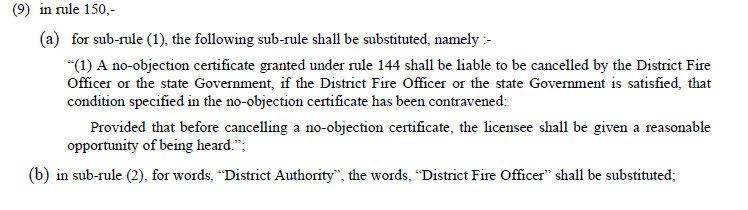
@PetroleumMin@HardeepSPuri@OfficeofHSP@PMOIndia@narendramodi_in@narendramodi It is beyond any reasonable understanding that by removing the power of district authority to cancel the NOC for reasons of expiry of lease, how this contributes to ease of business?
This has no contribution to ease of business instead it is ease of landgrabbing by the oil companies.
Take note and review the draft petroleum Rules.
More than 15000 sites are under litigation by OIL Marketing Companies and the sole intention behind the draft petroleum Rules is to remove such power in order to facilitate oil marketing companies to continue operations post expiry of lease.
@RahulGandhi@captrahultiwari@MaMuONEs@HemantSirohi1@Amardbi@anubhavnagar
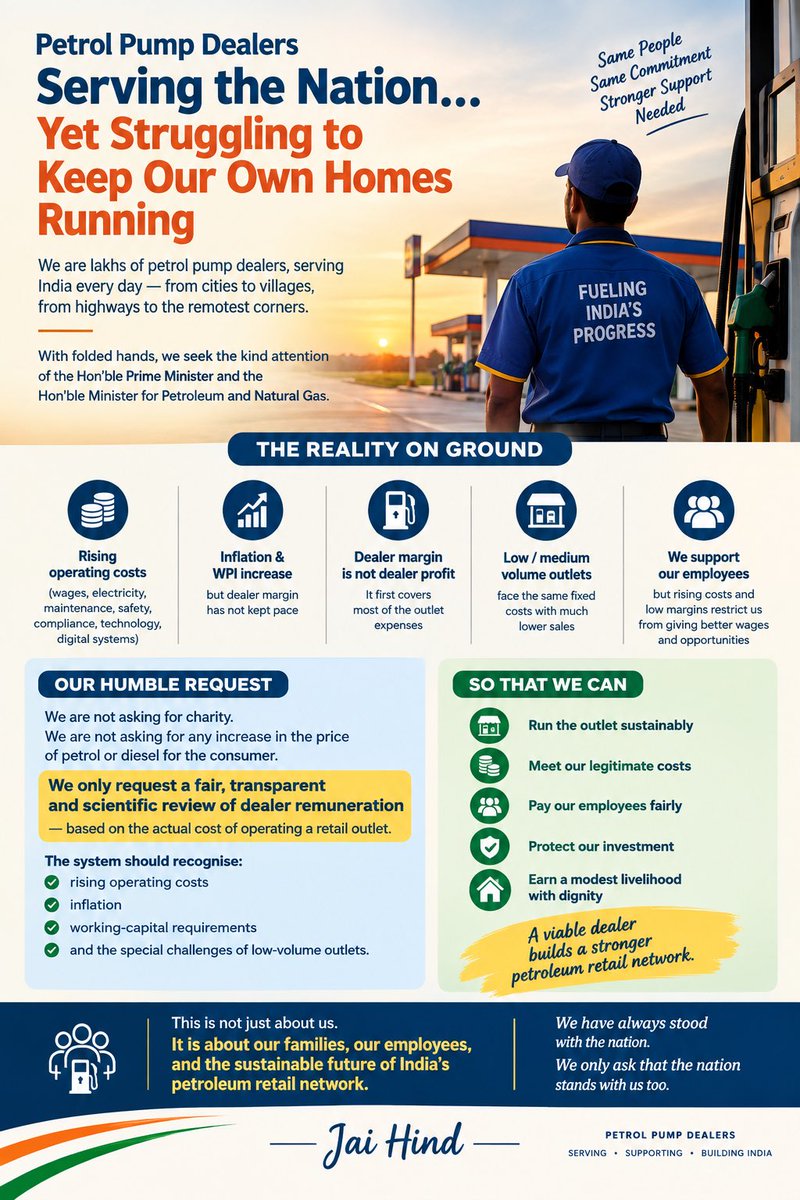
Serving India Every Day. Seeking a Sustainable Livelihood. 🇮🇳
Lakhs of Petrol Pump Dealers across the country work every day to keep India moving — from highways to villages, in normal times and in emergencies.
We are proud of our responsibility. But today, the economics of running a retail outlet are becoming increasingly difficult.
Dealer margin is not dealer profit.
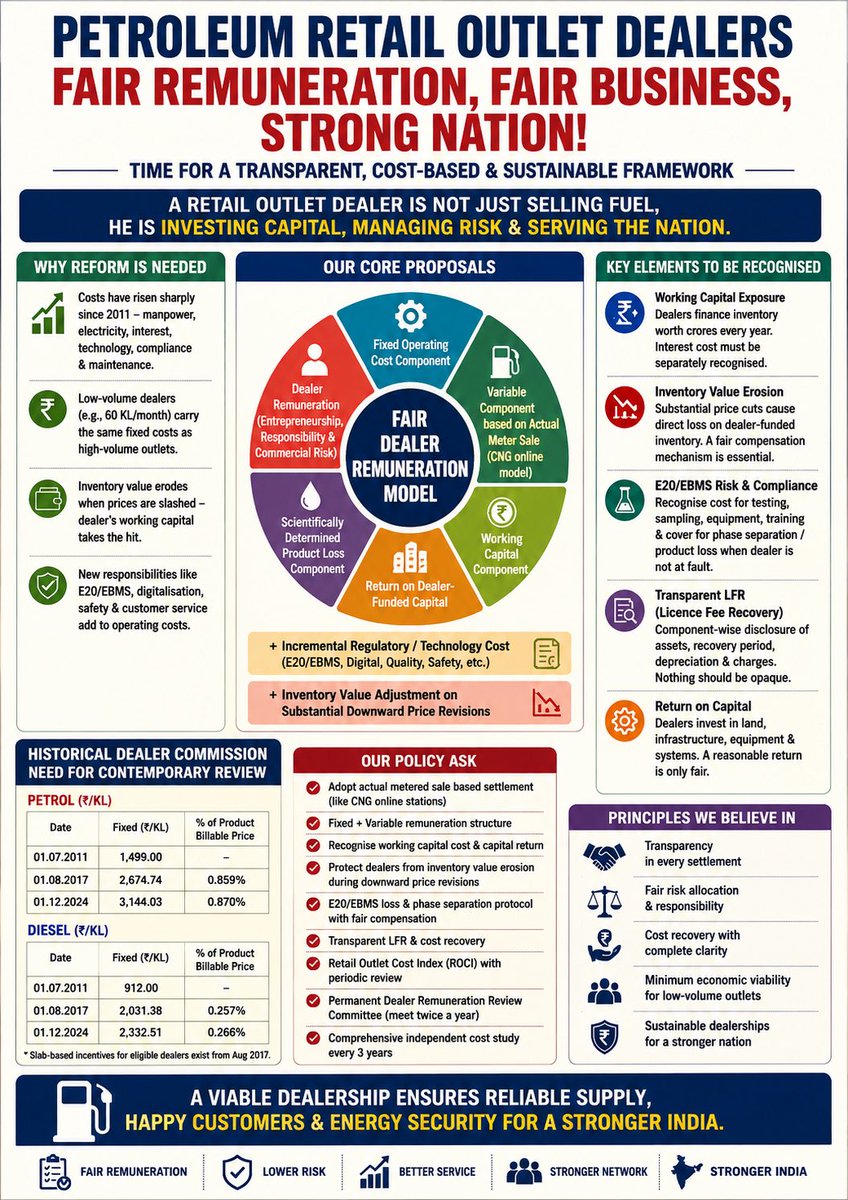
From the same margin, dealers have to meet rising costs of wages, electricity, maintenance, safety, compliance, technology, digital systems and working capital.
Inflation and operating costs have increased, while dealer remuneration has not kept pace.
For low and medium-volume outlets, the challenge is even greater — fixed costs remain high while sales remain limited.
And this is not only about dealers.
We have also stood by our employees, providing employment and striving to give them a decent wage and livelihood. But when the economics of the outlet itself become difficult, our ability to provide better wages and opportunities to our employees is also restricted.
We are not asking for charity.
We are not asking for higher fuel prices for the consumer.
We are humbly seeking a fair, transparent and scientific review of dealer remuneration, based on the actual cost of operating a retail outlet, with appropriate consideration for low-volume outlets.
A viable dealer means:
• A sustainable retail outlet
• Better and stable employment
• Protected investment
• Dignified livelihoods
• A stronger petroleum retail network
We have always stood with the nation.
We only request that the hands that keep India moving are also given a fair opportunity to move their own families forward.
We respectfully seek the kind attention and intervention of the Hon’ble Prime Minister and the Hon’ble Minister for Petroleum & Natural Gas.
A viable dealer builds a stronger petroleum retail network.
🇮🇳 Jai Hind 🇮🇳
#PetrolPumpDealers #DealerRemuneration #DealerMargin #FuelDealers #PetroleumRetail #DealerViability #IndianPetroleum #Livelihood #JaiHind
@narendramodi@PMOIndia@HardeepSPuri@PetroleumMin@Secretary_MoPNG@BPCLimited@HPCL@IndianOilcl@CMD__HPCL@ChairmanIOCL@cmdbpcl
@narendramodi@HardeepSPuri@PetroleumMin@FinMinIndia@IndianOilcl@BPCLimited@HPCL
This is the misery of PetroDealers across the #Nation
Margins not hiked in line with Inflation since 2017.
Marginal Increase in #Margins on November 2024 is inadequate to meet fixed establishment cost, especially for Low volume Dealers.
More than 80% of the #PetroDealers are under huge #Debt due to Increasing RSP of Petroleum Products
Pls arrange meeting of the Members of Association with #Ethics Committee of OMCs at the earliest so that a Permanent and logical solution be found to save this Dying Community
Increase Margins on #Petrol and #Diesel by Rs 2/ltr for the sales upto first 150KL per month so that the services and the facilities gets improved, even at the Low Volume outlets who are struggling to meet fixed establishment cost due low Margins.
Excellent Gesture Sir.
AIDPA is not representing the entire Petroleum Fraternity.
Kindly order meeting of the Stakeholders with Ethics Committee of OMCs so that permanent solution be reached of this Dying Community
Margins not in line with Inflation is pushing the Dealers into Debt Trap
Increase Margins for sales upto first 150KL by Rs 2/ltr on Both Petrol and Diesel and see how facilities gets improved at the Petrol Pumps.
Low selling Dealers are struggling to meet their Expenses
@HemantSirohi1 yes, the objective is not to oppose the Government or the OMCs, but we seek a fair, sustainable and transparent remuneration mechanism that enables compliant dealerships to remain economically viable and continue serving consumers.
Dealer Margin is a long-pending issue that directly affects the economic viability and livelihood of Petroleum Retail Outlet Dealers.
We respectfully request the Oil Marketing Companies and the Petroleum Committee to undertake a comprehensive, transparent and practical review of Dealer Remuneration, considering:
• Rising manpower & operational costs
• Working-capital & interest burden
• Digitalisation & compliance costs
• E20/EBMS testing & associated risks
• Low-volume dealership viability
• Inventory losses during downward price revisions
• Dealer-funded infrastructure & capital
• Product-loss and operational risks
• Cost of new OMC-mandated requirements
The objective is not to oppose the Government or the OMCs. We seek a fair, sustainable and transparent remuneration mechanism that enables compliant dealerships to remain economically viable and continue serving consumers.
This is not a demand for favour — it is a request for a fair review of a long-pending livelihood issue.
@PetroleumMin@IndianOilcl@BPCLimited@HPCL@HardeepSPuri@Secretary_MoPNG@PetroleumMin@PMOIndia@RahulGandhi
#PetrolPumpDealers #DealerMargin #PetroleumDealers #FuelRetail #DealerRemuneration
@IndianOilcl Okay but just share the alcohol resistant approved and certified paste been used to check water content in Ethanol at supply locations in accordance to Appendix 17 IQCM compliance & about dedicated tank lorries to be used for transportation of EBMS to avoid contamination.
Agreed—ethanol’s hygroscopic nature does not mean that compliant E20 inherently causes engine failure.
But the real issue is what happens when moisture ingress exceeds the blend’s tolerance and phase separation occurs. The ethanol-water phase can settle at the bottom and, if drawn into the engine, may cause poor running, misfire, stalling or inability to operate.
So the question isn’t whether E20 normally causes widespread engine failure. It is:
What safeguards ensure that contaminated/phase-separated EBMS never reaches the consumer, how is it reliably detected, and who bears responsibility if it does?
A specification-compliant E20 and phase-separated E20 cannot be treated as the same product.
@HardeepSPuri@PetroleumMin@TheSureshGopi@Secretary_MoPNG@neerajmittalias@siamindia@arai_india
#E20 #Ethanol #FuelQuality #PhaseSeparation
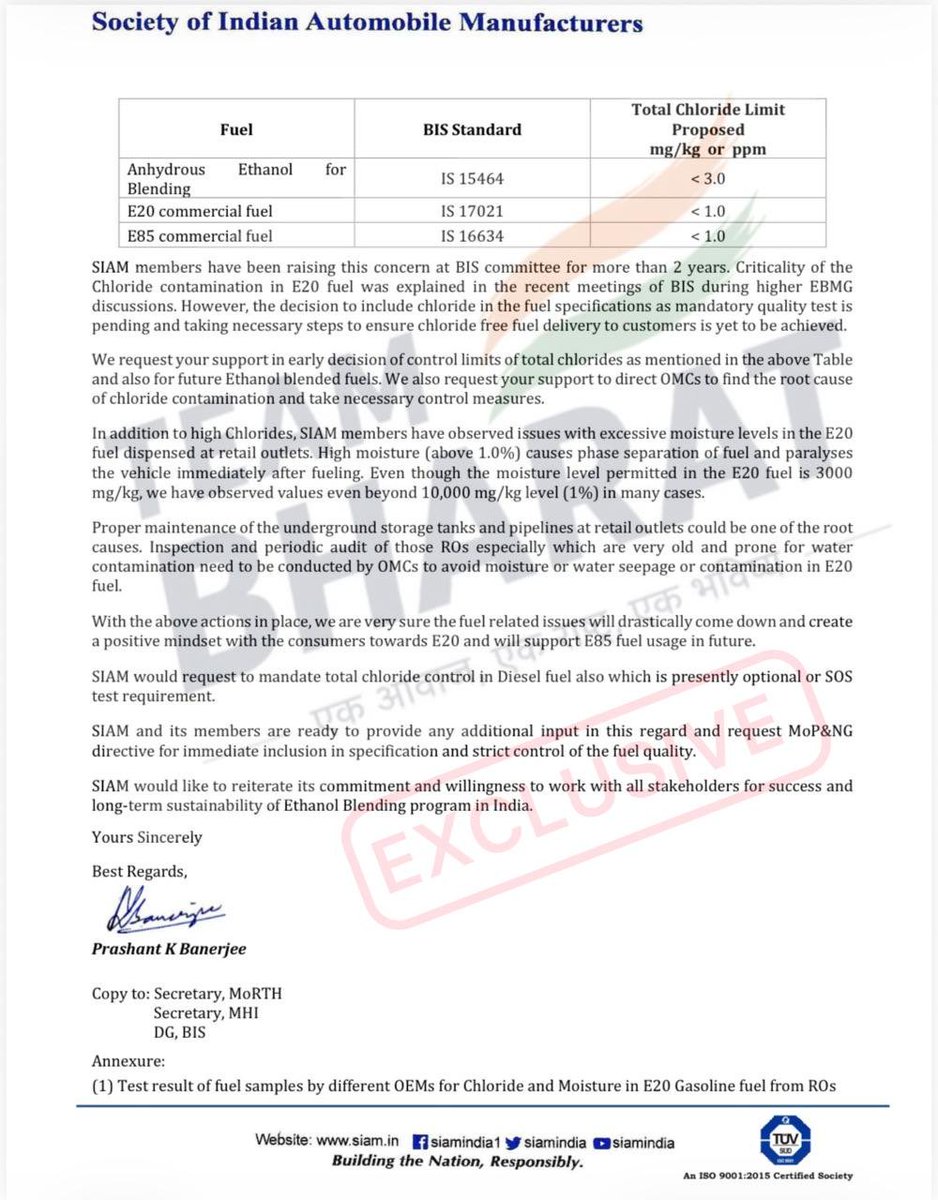
(@siamindia )’s withdrawal of its 28 July communication on chloride/moisture concerns in E20 understandably raises a larger question: does withdrawal of the communication also mean that the underlying technical concerns have been resolved?
The letter itself referred to chloride levels, moisture/phase separation, RO infrastructure, USTs & pipelines, and the need for stronger control across the supply chain.
These concerns cannot be addressed merely by withdrawing a letter. EBMS does not begin its journey at the Retail Outlet. The chain starts with the distillery/ethanol producer, blending & supply locations, transportation, storage and quality controls at OMC facilities—and ultimately reaches the RO, which is the final dispensing point to the consumer.
The critical question therefore is not why was the letter withdrawn, but:
Have the technical concerns been independently examined and resolved, or has only the communication been withdrawn?
If the data required further authentication, the responsible course would surely be to validate the data, publish the methodology/findings and strengthen controls—not leave consumers and downstream stakeholders with unanswered questions.
Withdrawal should not become a substitute for technical resolution, transparency and traceability.
Consumer confidence in E20 will ultimately depend not merely on assurances, but on a demonstrably robust and accountable supply chain—from distillery to dispenser.
@siamindia@PetroleumMin@IndianStandards@Secretary_MoPNG@neerajmittalias@HardeepSPuri@arai_india@nitin_gadkari@MORTHIndia@IndianOilcl@HPCL@BPCLimited@the_hindu@IndianExpress@Reuters@tehseenp@ttindia
To the Government of India.
Same government reply, contradicting itself.
On 27 July 2026, in the Rajya Sabha, the Ministry of Petroleum & Natural Gas called E20 combustion “cleaner,” with “near-zero particulate matter emissions.” In the same reply, it admitted that no assessment of E20’s effect on non-compatible vehicles has ever been done.
— ANI, IANS, 27 July 2026
Here’s what that admission is hiding.
Indian Oil’s own R&D Centre, with IIT Delhi, already tested exactly this—an unmodified carbureted two-wheeler on E20 (Fuel, 2020; DOI: 10.1016/j.fuel.2019.116504).
Formaldehyde and acetaldehyde—a human carcinogen and a probable carcinogen—are present in the exhaust of non-E20-compatible vehicles and rise as the ethanol percentage increases.
The Ministry’s safety case cites IOCL. It does not mention IOCL’s own finding.
This was never just about mileage or engine wear. It is something far more sinister, far more dangerous.
Those same emissions are released straight into the air Indians breathe: 15 of 25 major cities exceeded the national ozone limit this summer, and Delhi-NCR breached it on all 71 days studied.
— CSE, 30 June 2026
With respect, Minister: where is the Government’s assessment of formaldehyde, acetaldehyde and ground-level ozone in India’s transition to E20?
When does that conversation start?
We read everything. We connect the dots.
— Vishal Singh Jain
Director, VSJ Ventures LTD
@PIB_India@PetroleumMin
For centuries, Leprosy (Hansen's Disease) was treated as an incurable curse. Even after antibiotics were introduced, treatment required yrs of heavy drug regimens & nerve damage often persisted.
In the late 1970s, an Indian biochemist developed the world's very 1st immunotherapeutic vaccine for leprosy, using a harmless, non-pathogenic soil bacterium to awaken the human immune system.
While global pharma labs focused exclusively on developing chemical antibiotics to kill Mycobacterium leprae, . Dr. Gursaran Pran (G.P.) Talwar at the National Institute of Immunology (which he founded) in New Delhi realized that the real problem was immune paralysis. In severe lepromatous leprosy, the patient's T-cells completely fail to recognize the pathogen.
Talwar screened dozens of soil mycobacteria & identified a specific, non-pathogenic strain named Mycobacterium w (Mw, now classified as Mycobacterium indicus pranii).
He discovered that when killed Mw bacteria were injected into leprosy patients alongside standard multi-drug therapy (MDT):
- It re-energized the patient's dormant cell-mediated immunity.
- It accelerated bacterial clearance from the skin & nerves by up to 50%.
- It significantly reduced the incidence of debilitating painful immune flare-ups (erythema nodosum leprosum).
The Mw vaccine became the world's 1st scientifically proven immunotherapeutic agent for leprosy, later found to also boost host immunity against drug-resistant tuberculosis & certain types of tumors.
Global health agencies spent decades searching for complex synthetic molecules, an Indian biochemist looked into the dirt under our feet and found a harmless soil microbe that taught the human immune system how to conquer 1 of the oldest afflictions in human history.
Last year, a sharp pothole at 70 km/h burst my Honda City’s almost-new tyre and even bent the alloy. I simply fitted the spare wheel and drove home without any panic.
That’s why yesterday’s Brezza launch without a spare wheel disappointed me.
If there’s one country where a spare wheel is still essential, it’s India. Our roads don’t care about global trends because they are broken.
Removing the spare wheel saves the manufacturer a little money, but it can leave the owner stranded. 🤡
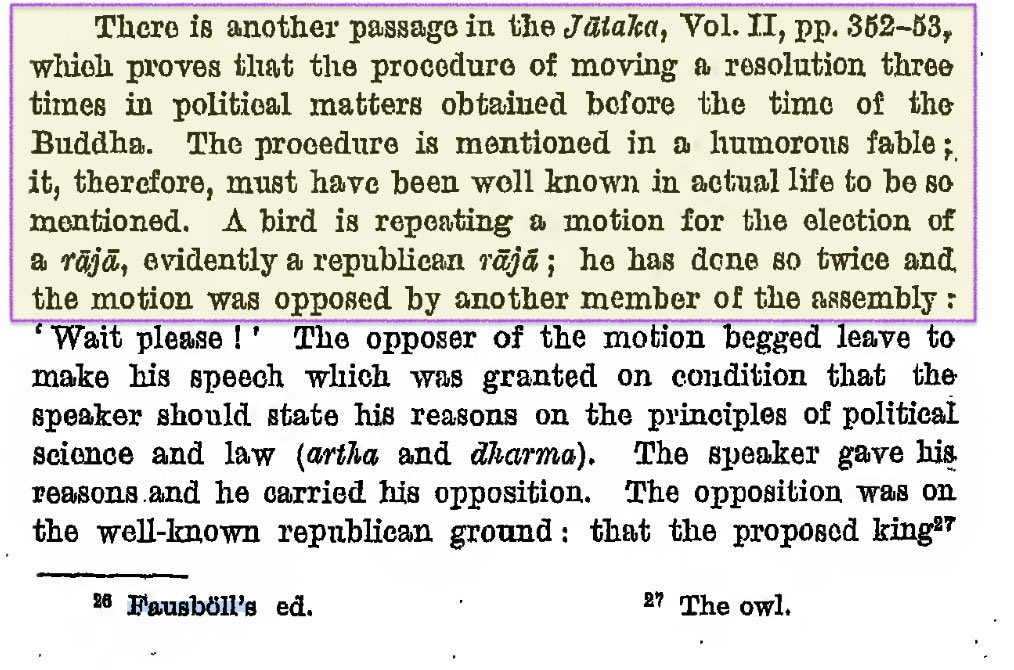
Adding to this - Indian texts like the Aitareya Brāhmaṇa, part of the Rigvedic tradition and composed centuries before the Buddha, clearly refers to a form of democratic self-rule called Svarājya. It describes the Svarājya (self-ruled) Constitution for a self-ruling republic.
In this system, the leader was called a Svarāt, meaning “self-ruler.” But this didn’t mean some hereditary king ruling by divine right. The Svarāt was democratically elected or chosen by a gaṇa - a representative council or assembly - whose members were described as equals (sadṛśaḥ sarve). Leadership was based on selection and recognition, not an automatic birthright.
Also this was not just in theory either. Later Buddhist texts like the Mahāparinibbāna Sutta describe real republican confederacies in ancient India, where assemblies debated and governed collectively. In his Hindu Polity, K.P. Jayaswal shows that pre-Buddhist Jatakas mention elections in the context of city republics where Chhanda was voting & Chhandaka was a city referendum. Buddha adopted the voting procedures & rules from pre existing Hindu Republican models.
Democratic systems of deliberation, councils, elected/selected leadership and shared authority already existed in India before Buddha (500 BCE)
What a F*CKED UP society we Indians have created for ourselves.
Two men got into an accident when a policeman suddenly opened his car's door without looking at the traffic.
Instead of helping and asking if they were injured, the policeman started beating them up. 😡
India was the cradle of civilisation. Not one of several.
Several people have replied to my recent essay by saying there is no single cradle of civilisation. Civilisation developed independently in Mesopotamia, Egypt, India, China and South America. Why make it a competition?
This sounds like humility, but it is the same evasive move that propped up the Aryan invasion theory for a century: when the evidence becomes inconvenient, redraw the question so no evidence can ever settle it.
Consider what would have to be true for independent emergence to hold. Indus-Sarasvati merchant seals would not appear across Sumerian cities. An Akkadian cylinder seal would not name its owner as an interpreter of the Meluhhan language. Bead necklaces manufactured at Lothal would not turn up in Queen Puabi's tomb at Ur around 2450 BC. Pre-dynastic Egyptian graves at Nakada would not contain mud brick-lined pits in Sumerian and Indus-Sarasvati style, alongside cylinder seals and lapis lazuli from the northernmost Indus-Sarasvati settlement. The Sumerian scribes would not record ships arriving from Meluhha carrying timber, copper, carnelian and cotton.
All of those things happened, and they are in the archaeological record. They have been for decades.
The "independent emergence" position has a convenient feature. No evidence can ever dislodge it. Merchant seals from one civilisation found inside another become "evidence of trade, not dependency." Identical brick ratios become "convergent development." A professional interpreter role for a foreign language becomes "contact, but not influence." At every point the conclusion is decided in advance, and the evidence is arranged around it.
Others have argued that even if the civilisations were connected, Mesopotamia was still earlier. Earliest attested writing. Earliest cities. Earliest legal codes. The crucial word is "attested," which means found and recorded by archaeologists. Mesopotamia was excavated intensively from the 1840s. Mohenjo-daro was not discovered until 1922. The site at Bhirrana, dated to 7570-6200 BC, with planned streets, drainage, standardised weights and bronze metallurgy millennia before it appears elsewhere, was identified only recently. Mehrgarh, around 7000 BC, supported 20,000 people growing wheat, barley and cotton, and trading lapis lazuli and copper beads. "Earliest attested" tells you where archaeologists chose to dig, but it does not tell you what existed first.
So at what point does evidence of connection actually count? When one civilisation's merchants are living in another's cities, boring beads with their own technology and maintaining a permanent enclave at Lagash? When the Sumerian texts record ships from Meluhha bringing wealth but never once mention Sumerian ships sailing east? When Indus-Sarasvati seals are found throughout Mesopotamia but no Mesopotamian seal has ever been found in Indus-Sarasvati lands?
And that is before the underwater evidence from the Gulf of Cambay and the Tamil coast, where sonar readings suggest ports thousands of years older than anything in Mesopotamia. If those dates hold, the question of independent emergence becomes redundant.
Treating every civilisation as equally primary, whichever direction the evidence actually points, is a kind of participation trophy for entire fields of study, not open-mindedness.
Independent emergence is where one lands once you’ve already decided not to look at what moved between the geographical boxes, or in which direction. It kept the Aryan invasion theory standing for a hundred years, and it's propping up the same evasion today.
This notification is one of the most important fuel documents of the decade.
Let me explain what just happened.
The government charges a tax called excise duty on petrol. This paper says petrol mixed with 22%, 25%, 27% or 30% ethanol will pay zero excise duty.
Zero tax is the government's way of telling oil companies, start blending more ethanol, we will make it worth your investment.
This was coming.
On May 15, the Bureau of Indian Standards quietly notified IS 19850:2026, the official specification for E22, E25, E27 and E30 petrol. So they have mentioned the standard, and then the tax exemption.
But why is the government in such a hurry?
Three reasons;
Reason 1
The programme has been a genuine success on its own terms. India hit 20% blending in 2025, five years ahead of the original 2030 timeline.
Twenty years ago we could barely manage 5%. Crude imports fell, foreign exchange was saved, and over ₹1.18 lakh crore has gone to farmers through ethanol purchases.
For a country that imports most of its oil, every litre of ethanol is a litre of crude oil we did not buy from abroad, making us self-sufficient in our crude oil needs.
Reason 2
There is a supply glut because distilleries went on an expansion spree. India's installed ethanol capacity is close to 20 billion litres a year, with 4 billion more coming, while E20 needs only about 11 to 12 billion litres.
So we have built double the capacity we need. Those plants took loans. They need buyers. The only buyer big enough is the petrol pump.
E20 cannot absorb the supply, so the blend has to go up. The push to E30 is partly climate policy and partly capacity bailout.
Reason 3
Maize has now overtaken sugarcane as the biggest ethanol feedstock, supplying nearly half of all ethanol. The farm lobby behind this programme is now two crops.
But all of this has come at a cost;
When E20 rolled out, regular car owners paid the cost.
A government-funded study by ARAI and Indian Oil found fuel economy dropping up to 6% on E20 depending on the vehicle.
Owners of older cars reported worse.
So even though ethanol is cheaper than petrol. The blending saved money only for oil companies. The pump price you paid did not fall.
On top of that, you got no choice. Most pumps stopped offering plain petrol or E10.
E27 and E30 raise the same questions, with higher stakes. Cars sold in India were made E20-compatible only from around 2023.
There are crores of vehicles on the road before that were never designed for 27 or 30% ethanol. The industry's own target is E30 rollout between 2028 and 2030, which means a huge chunk of today's fleet will still be running when the new fuel arrives.
Brazil is the comparison everyone uses, and it is worth understanding properly.
Brazil runs E27 with nearly universal flex-fuel vehicles. Their cars were built for it over decades. The fuel and the fleet moved together.
So, we are moving the fuel first and hoping the fleet catches up.
So in nutshell, the notification tells oil companies and distilleries to blend more, and it says nothing to the car owners.
Three questions deserve clear answers before E27 petrol shows up at our neighbourhood pump.
1. Will pump prices actually fall this time, since both the ethanol and now the tax are cheaper? Will the zero excise duty gain disappear into oil company margins again?
2. Will older vehicles get a protected option, a pump that still sells E10 or E20 for cars that cannot handle more blending?
3. And will mileage loss be communicated honestly, with numbers, instead of being discovered by drivers at the fuel station?
The ethanol programme is one of the few Indian policies that has been implemented at a break neck pace.
Farmers have earned, imports have fallen, and an entire industry has been built in a decade. That deserves credit.
But going from E10 to E20 strained the system. Going from E20 to E30 with an unprepared vehicle fleet will most likely break it.
30 crore vehicle owners are waiting for answers.